A workforce transformation strategy fails long before the results dashboard. It fails when business leaders submit work through scattered channels, when People teams cannot see capacity across priorities, and when budget decisions happen without a clear view of delivery risk. An enterprise workforce transformation roadmap brings those operating realities into focus so L&D, Talent, and HR can direct effort toward the capabilities the business needs most.
For a CHRO or CLO, the challenge is rarely a lack of ambition. Your People teams may already be leading leadership development, performance programs, skills initiatives, compliance work, succession planning, and major change efforts. The problem is that each initiative competes for the same subject matter experts, budget, vendors, and internal capacity. Without a common operating model, urgent requests win by volume and strategic work absorbs the cost.
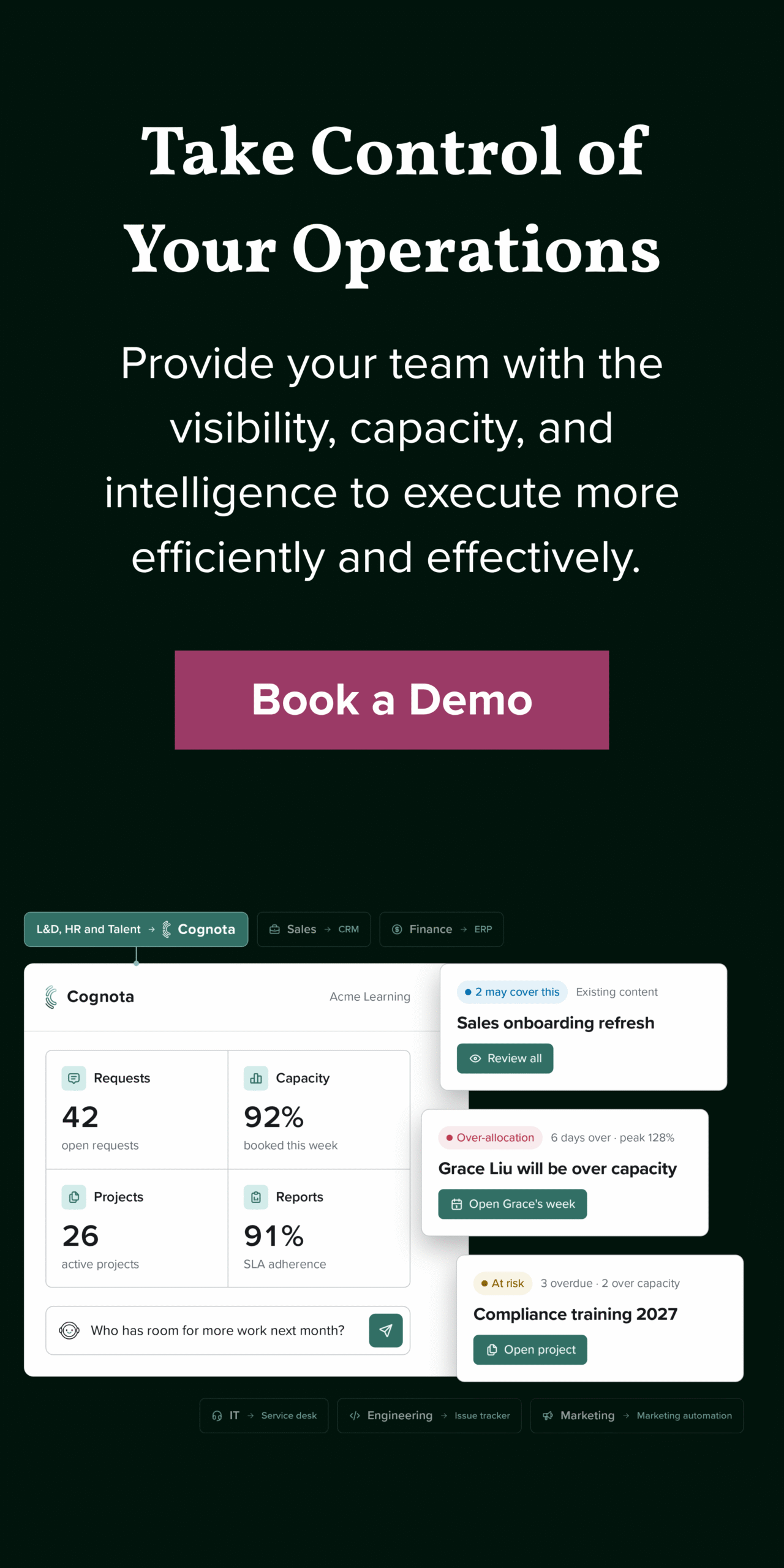
The answer is not another planning exercise that sits in a slide deck. It is a practical operating roadmap that creates visibility, turns data into signals, and gives leaders a disciplined way to make trade-offs. If you want to see how an operations layer can bring that work into one view, see Cognota in action.
Why workforce transformation becomes an operations problem
Workforce transformation is often described as a skills, culture, or technology initiative. Those elements matter, but they do not answer the operational questions that determine whether an initiative gets delivered: What work is entering the system? Who owns it? What must move first? What capacity does it consume? What will be delayed if a new request is approved?
The 2026 Brandon Hall Group and Cognota Joint Research Report points to the scope of the issue: 83% of teams use three to eight tools to manage operations, while 69% want to consolidate. Fragmentation creates more than administrative friction. It makes it difficult to connect strategy to the work being funded and delivered.
This is why an enterprise roadmap should include your full workforce enablement function. L&D may be the natural starting point because learning demand is highly visible, but Talent and HR programs face the same underlying pressures: competing stakeholders, unclear ownership, disconnected budgets, and limited evidence of impact. A shared operating approach gives each team room to specialize without forcing leaders to manage through spreadsheets and status meetings.
The enterprise workforce transformation roadmap: five operating moves
The strongest roadmaps follow a sequence that makes strategic intent executable: align, plan, execute, measure, and optimize. These are not one-time phases. They are operating disciplines that help People teams respond to change without losing control of the work already committed.
1. Align transformation work to business priorities
Start with the business moments that require workforce change. A new market strategy, regulatory shift, operating model redesign, technology rollout, leadership transition, or productivity goal may each create demand for L&D, Talent, and HR. Capture the request in a consistent intake process, including the sponsoring leader, expected outcome, affected population, deadline, risks, and measures of success.
Then test the request against agreed priorities. Not every request deserves the same response, and saying yes without understanding the trade-off is not partnership. Alignment means making the work visible enough for business leaders to see what their request displaces, accelerates, or puts at risk.
2. Plan capacity, cost, and ownership together
A roadmap becomes credible when it reflects actual capacity, not ideal capacity. Map internal effort across program managers, instructional designers, facilitators, HR business partners, talent leaders, subject matter experts, and external partners. Include the hidden work too: stakeholder reviews, governance approvals, vendor management, localization, communications, and reporting.
Planning should also establish a named owner for each initiative and a decision-maker for each major approval. Shared accountability often means unclear accountability. When ownership is explicit, leaders can identify bottlenecks before they turn into late launches or quality compromises.
When demand exceeds capacity, there are several valid choices. You can sequence work differently, narrow scope, defer lower-value activity, or use external expertise for a defined need. The right answer depends on strategic importance, time sensitivity, internal capability, and risk. What matters is that the decision is made with evidence rather than optimism.
3. Execute through one visible workflow
Execution breaks down when requests, approvals, project plans, and budget conversations live in separate places. The team spends too much time chasing updates and reconciling conflicting versions of the truth. A workforce transformation roadmap needs one operating rhythm: a front door for demand, standard stages for work, clear handoffs, and escalation paths for decisions that cannot wait.
This is where workflow governance matters. Define who can submit requests, who prioritizes them, when approval is required, and what information must be present before work begins. Apply the same discipline to AI-assisted work. People teams need one set of rules for quality, privacy, review, and accountability, whether a task is completed by a colleague, a consultant, or an AI agent.
Dedicated operations leadership can make an outsized difference. In the Brandon Hall Group and Cognota research, teams with a dedicated operations lead reported 34% faster delivery, 28% lower costs, and 39% higher stakeholder satisfaction. Those outcomes are not simply about working faster. They reflect fewer preventable handoff failures and better decisions about where the team should invest its time.
4. Measure outcomes, not activity alone
Completion rates, attendance, and project milestones can show whether work happened. They cannot, on their own, show whether transformation mattered. For each initiative, connect delivery measures to a business or workforce outcome that the sponsor recognizes.
For leadership development, that might mean leadership readiness, internal movement, retention in critical roles, or stronger bench strength. For a change initiative, it could mean adoption of new processes, reduced quality incidents, or time to proficiency. For workforce capability efforts, it may be the ability to redeploy talent toward priority work.
The measurement approach should be proportional. A high-stakes enterprise program deserves a deeper evaluation design than a small, repeatable request. But every initiative should answer three questions: Did we deliver what was agreed? Did the target population change behavior or build capability? Did that change contribute to the intended business result?
5. Optimize the portfolio, not just individual programs
Quarterly portfolio reviews are where the roadmap becomes a management system. Look across active and planned work for duplicated effort, overloaded teams, recurring demand patterns, missed dependencies, and underused vendor spend. Ask which initiatives are producing evidence of value and which are consuming capacity without a clear outcome.
This is also the point to improve the operating model itself. If business partners repeatedly submit incomplete requests, adjust intake. If approvals cause delays, clarify decision rights. If a critical skill need appears across several business units, consider a coordinated enterprise response rather than separate programs built in parallel.
Use maturity to set a realistic next step
A roadmap should meet your organization where it is. Teams in a Reactive stage are often managing urgent work through email, meetings, and disconnected spreadsheets. Managed teams have more repeatable processes but may still struggle to connect capacity and spend to strategic priorities. Strategic teams use governance and portfolio visibility to guide investment. Predictive teams use signals to anticipate demand and delivery risk. Adaptive teams continuously adjust based on changing business conditions.
Only an estimated 1% to 6% of teams reach the Adaptive stage. That is not a reason to chase maturity for its own sake. It is a reminder that progress comes from solving the next operational constraint, not attempting a wholesale reinvention. A team with inconsistent intake may need a single front door before it needs advanced forecasting. A team with clear demand but limited budget visibility may need portfolio cost management before it expands its measurement model.
The decision standard that keeps transformation moving
Every roadmap eventually faces a hard question: what should the People function stop, start, continue, or change? The quality of that answer depends on the visibility behind it. When leaders can see demand, priorities, capacity, cost, ownership, and risk in one operating view, transformation stops being a collection of initiatives and becomes a managed portfolio of business commitments.
That is the practical promise of workforce enablement operations: give your People teams the clarity to protect high-impact work, make trade-offs openly, and prove what their effort changes. The next useful step is not a bigger transformation statement. It is choosing one priority area where better visibility would lead to a better decision this quarter.