
A learning team can have a polished learner experience and still struggle to deliver on business priorities. That is the central distinction in the LearnOps vs LXP software conversation. One approach focuses on how employees find and engage with learning. The other focuses on how the learning function aligns work, manages demand, deploys capacity, and proves the value of its efforts.
For enterprise L&D and talent leaders, this is not a theoretical technology debate. It is a decision about where operational friction lives. When intake arrives through email, priorities shift without governance, budgets sit in disconnected files, and leaders cannot see the work required to deliver an initiative, a better content experience will not resolve the underlying problem.
If your team is being asked to deliver more strategic impact with limited capacity, see how Cognota brings LearnOps into action. The goal is not to add another disconnected system. It is to give learning operations the structure needed to execute with discipline.
LearnOps vs LXP software: the core difference
An LXP, or learning experience platform, is centered on the learner’s discovery and consumption experience. It is designed to help people explore relevant content, receive recommendations, and engage with learning in a more personalized way. Its primary perspective is the employee: What learning is relevant, available, and useful right now?
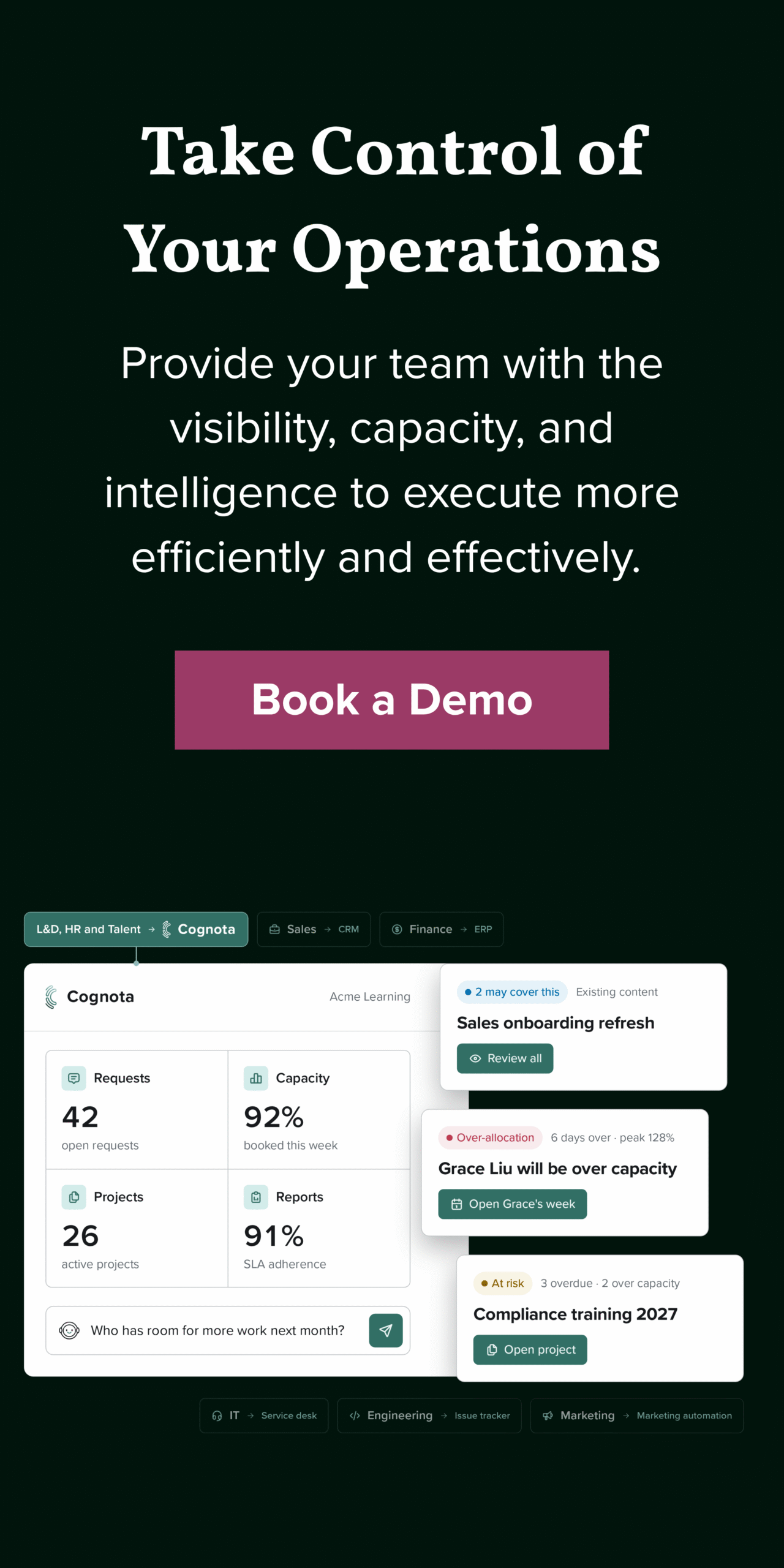
LearnOps® software is centered on the operating model of the learning and talent function. It helps leaders manage the work behind learning: stakeholder intake, prioritization, project governance, resource and capacity planning, budget visibility, performance measurement, and continuous optimization. Its primary perspective is the business: Which learning investments matter most, what will they require, and what impact are they producing?
Both perspectives can be valuable. But they answer different questions.
An LXP may help an employee discover a leadership resource. LearnOps helps the learning team determine whether a leadership initiative supports a priority business need, who owns the work, whether the team has the capacity to deliver it, what outside expertise is required, and how success will be measured.
That distinction matters because many enterprise teams have already improved the learner-facing side of learning. Their persistent challenge is the operational side: too many requests, too few resources, unclear priorities, and limited evidence connecting effort to business outcomes.
What LXP software is built to solve
LXP software is a sensible fit when the immediate challenge is learner engagement, content discovery, or personalization. Organizations with large and fragmented content libraries often need a clearer way for employees to find relevant development opportunities. For teams focused on talent mobility, self-directed development, or skills visibility, an experience layer can play an important role.
The value proposition is largely about access and relevance. Employees should not have to search multiple places or depend on a manager to surface every development option. An LXP can make learning feel more connected to individual goals and career interests.
Still, an LXP does not inherently establish enterprise learning priorities. It does not resolve competing stakeholder demands, determine whether a request merits investment, or give leaders a complete operating view of work in progress. Those are management disciplines, not experience-design problems.
This is why an LXP can improve the front end of learning while the learning team remains reactive behind the scenes. Content may be easier to discover, yet the team can still be overwhelmed by unstructured requests and unable to show where time and budget are going.
What LearnOps software is built to solve
LearnOps addresses the work that begins before a learning initiative is created and continues long after it is delivered. It treats learning as a business function that needs operational infrastructure, not simply a collection of programs and content.
Cognota’s LearnOps Framework organizes that work across five disciplines: Align, Plan, Execute, Measure, and Optimize. Together, they create a practical management system for enterprise learning teams.
Align learning work to business priorities
Alignment starts with a structured intake process. Instead of treating every request as equally urgent, teams can capture the business need, intended audience, expected outcomes, sponsoring stakeholder, and level of effort. This creates a more productive conversation with the business: not “Can you build this?” but “What problem are we solving, and is learning the right response?”
For a team supporting sales, operations, compliance, or leadership priorities, that shift is significant. It makes demand visible and helps leaders assess trade-offs before work begins.
Plan capacity, budgets, and delivery
Most L&D leaders know their team is busy. Fewer can see, in one operational view, the precise work consuming capacity across initiatives, roles, and time periods. LearnOps software brings that information into planning.
This matters when a high-priority request appears mid-quarter or when internal expertise is constrained. Leaders need to understand whether they can reprioritize, redistribute work, or bring in external support. Capacity planning is not an administrative exercise. It is how a learning function protects its ability to deliver strategic work.
Execute with governance instead of workarounds
Execution breaks down when project details, approvals, feedback, and ownership are scattered across inboxes and informal processes. LearnOps creates visibility into the lifecycle of learning work, helping teams manage dependencies and maintain accountability.
The objective is not more process for its own sake. It is fewer handoffs lost in the gaps, fewer surprise delays, and clearer decisions when priorities collide. Mature learning operations make work visible enough to manage, without forcing teams into rigid bureaucracy.
Measure and optimize the portfolio
Completion activity and satisfaction scores can be useful signals, but they rarely tell an executive whether learning is creating business value. LearnOps puts measurement in the operating rhythm, beginning with intended outcomes and continuing through portfolio-level performance reviews.
That does not mean every initiative can or should be tied to a single financial metric. Some programs serve risk reduction, capability readiness, or organizational change. The key is defining meaningful evidence before delivery, then using it to improve future investment decisions.
The trade-off: experience optimization versus operational maturity
The right question is not whether learner experience matters. It does. The question is whether learner experience is the constraint currently limiting your team’s performance.
If employees cannot find relevant content or have little ownership over development, LXP software may address a real gap. If the learning team lacks a reliable way to prioritize demand, forecast workload, govern projects, and measure its strategic contribution, LearnOps is the more foundational need.
For many large organizations, the answer is not either-or. An experience platform and an operational platform can serve complementary roles. But complementarity should not be confused with interchangeability. One cannot compensate for the absence of the other.
A useful diagnostic is to look at where leadership conversations get stuck. If executives ask why employees are not engaging with available learning, the experience question deserves attention. If they ask why the team cannot absorb critical requests, why delivery timelines are unpredictable, or why learning investments are difficult to evaluate, the operational question is more urgent.
How to assess your team’s current need
The LearnOps Maturity Model offers a practical lens. Teams often begin in a Reactive stage, where work is driven by incoming requests and institutional knowledge. As they become Managed and Strategic, they introduce consistent governance, planning, and business alignment. Predictive and Adaptive teams use operational data to anticipate demand, improve decisions, and continuously optimize performance.
This progression is not about judging a team for its current state. Enterprise L&D complexity grows quickly, particularly in organizations with multiple business units, changing workforce needs, and high expectations for measurable impact. A process that worked when the team was smaller may no longer provide the control or intelligence leaders need.
Consider four questions:
- Can you show which learning requests are aligned to top business priorities and which are not?
- Can you forecast the capacity required for committed work before accepting new demand?
- Can stakeholders see ownership, status, approvals, and risks without relying on manual follow-up?
- Can leadership evaluate learning investments using evidence beyond volume and completion?
If the answer is consistently no, the gap is likely operational. More learner-facing content options will not create the governance, capacity, or intelligence required to close it.
Build the operating layer your learning strategy needs
Enterprise learning leaders are under pressure to become more strategic while maintaining service to a growing number of stakeholders. That pressure cannot be solved through individual heroics or another disconnected point solution. It requires an operating model that makes priorities visible, turns capacity into a managed resource, and connects execution to outcomes.
The most effective teams do not treat operational discipline as a back-office concern. They use it to create more room for the work that matters: preparing people for change, building critical capabilities, and helping the organization perform. To explore what that could look like for your team, watch Cognota in action.