A sales leader needs onboarding for a newly launched product. Operations needs process training after a system change. Compliance has a deadline. Meanwhile, leaders are asking why several existing learning initiatives have not produced clearer performance results. This is the daily reality that makes learning prioritization methods more than an administrative exercise. They determine whether L&D capacity is invested in consequential business work or consumed by the loudest request.
For enterprise learning teams, the problem is rarely a shortage of ideas. It is a shortage of a shared, defensible way to decide what should happen now, what needs more discovery, what can wait, and what should not be built at all. Without that discipline, intake becomes a queue of promises, teams overcommit, and measurement arrives too late to change the outcome.
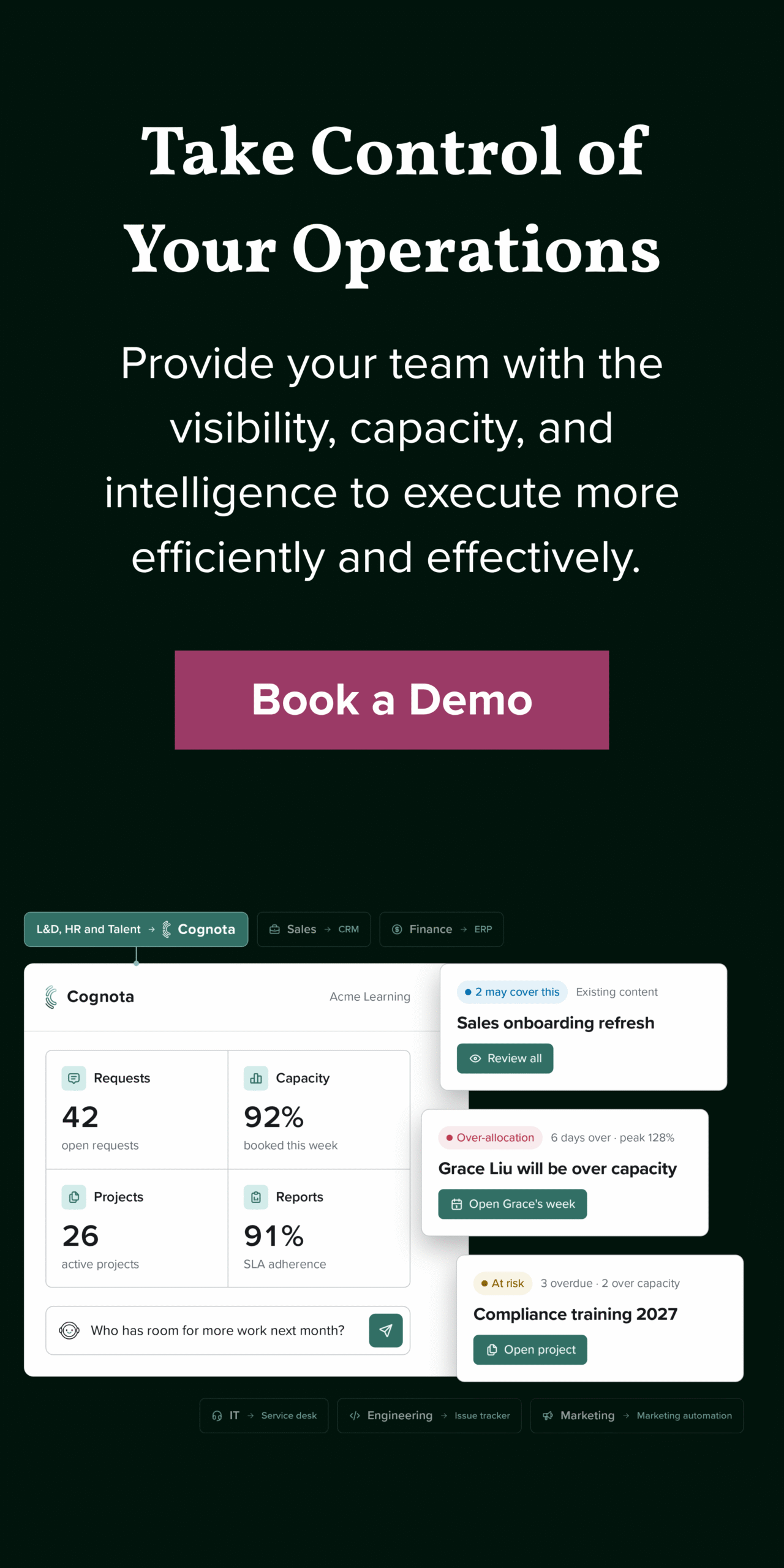
If your team needs a more connected way to govern demand, plan capacity, and track decisions through delivery, see Cognota in action to understand how a LearnOps® operating model can bring those workflows together.
Why learning prioritization breaks down
Most prioritization failures begin before a project is approved. A stakeholder arrives with a proposed solution: an eLearning course, a workshop, a certification path, or a communications campaign. The request may be reasonable, but the underlying performance problem, audience need, urgency, and expected business value are often unclear.
When every request enters the same pipeline with the same apparent urgency, learning leaders are forced into reactive trade-offs. The team may choose work based on executive sponsorship, proximity to a deadline, or the amount of noise surrounding the request. Those factors can matter, but they are not a complete decision model.
This is also why a simple priority label such as high, medium, or low rarely holds up. It tells the team what to do first without documenting why. When capacity gets tighter, or a new strategic initiative appears, the original logic disappears. Leaders cannot explain what was displaced, what impact is at risk, or whether the portfolio still reflects business priorities.
Effective prioritization creates visibility before commitment. It makes the criteria explicit, applies them consistently, and preserves the reasoning behind each decision.
Learning prioritization methods that work in enterprise L&D
No single method fits every portfolio. A compliance-driven initiative with a fixed regulatory deadline should not compete with an exploratory capability program in precisely the same way. The goal is not to create a perfect score for every request. It is to use a small number of decision methods that match the type of work and the maturity of the team.
1. Strategic alignment scoring
Strategic alignment scoring assesses whether a request directly supports an enterprise objective, business-unit priority, transformation effort, or measurable performance need. It is the foundational method because it shifts the conversation from “Do leaders want this?” to “What business outcome does this enable?”
A practical scoring model can evaluate alignment across several dimensions: connection to a stated strategic priority, size of the affected audience, significance of the performance gap, consequences of inaction, and confidence that learning is part of the right intervention. Teams can score each dimension on a consistent scale, then require requesters to provide evidence rather than assumptions.
The trade-off is that scoring can create false precision when the inputs are weak. A score of 18 versus 17 is not a verdict. It is a prompt for discussion. Use the score to make priorities comparable, then apply leadership judgment to the exceptions.
2. Value-versus-effort mapping
Value-versus-effort mapping is especially useful when the team has more approved work than available capacity. Place each initiative against two questions: What business or learner value could this create, and what will it take to design, develop, deploy, and support it?
High-value, lower-effort work often deserves early attention, particularly when it supports visible business priorities. High-value, high-effort work should not be rejected automatically. Instead, it may need phased delivery, dedicated sponsorship, or a decision to pause lower-value work. Low-value, high-effort requests are where learning leaders need permission to challenge the proposed approach.
Effort must include more than production hours. Account for subject matter expert availability, approvals, localization, change management, technology dependencies, measurement design, and post-launch support. Underestimating these operational demands is a common source of missed commitments.
3. Risk and urgency triage
Some work is non-negotiable. Legal, safety, policy, and major operational change initiatives may carry real risk if delayed or executed poorly. A risk-and-urgency method separates these commitments from discretionary learning demand.
The distinction matters because urgency is frequently overstated. A stakeholder’s preferred launch date is not necessarily a business-critical deadline. Teams should ask what happens if delivery moves by 30, 60, or 90 days. Is there financial exposure, operational disruption, or a material people risk? Or is the deadline primarily a planning preference?
Treating all urgent work as equally urgent trains the organization to escalate every request. A clear triage process protects capacity for genuine risk while making trade-offs visible to sponsors.
4. Portfolio balancing
Prioritization happens at the portfolio level, not just one request at a time. A collection of individually sensible projects can still create an unhealthy mix: too much reactive work, too many large transformations, or no investment in foundational capability building.
Portfolio balancing looks across work types, business units, strategic themes, delivery horizons, and capacity requirements. It helps leaders ask whether the team is allocating enough effort to future-facing capability while meeting immediate commitments. It also exposes concentration risk when a small number of initiatives consume a disproportionate share of design or project-management capacity.
This is where learning operations becomes essential. A portfolio view requires reliable data on demand, resource availability, project status, spend, and outcomes. Spreadsheets can support an early-stage process, but they become fragile as enterprise demand increases and multiple teams contribute to delivery.
Build a decision process people can trust
The strongest prioritization methods fail when they are treated as a once-a-year planning event. Priorities change as strategies shift, performance data emerges, and business conditions evolve. The process needs a regular operating rhythm.
Start with structured intake. Every request should identify the sponsoring business leader, desired outcome, target audience, problem to solve, deadline rationale, expected measures, and known dependencies. If a requester cannot articulate the outcome, the work may need discovery before it enters the delivery queue.
Next, establish a cross-functional governance forum with the authority to make trade-offs. L&D should lead the process, but business sponsors, finance partners, and operational leaders may need to participate when decisions affect shared capacity or strategic commitments. The purpose is not to add approval layers. It is to make prioritization decisions at the right level, with the right evidence.
Then, publish decisions and their rationale. Stakeholders do not need to agree with every outcome, but they are more likely to accept a deferred request when they understand the criteria, the capacity constraints, and the higher-priority work currently underway. Transparency is operational discipline, not an extra communication task.
Connect prioritization to the LearnOps® framework
Prioritization is strongest when it is connected to the full learning operating model. In the LearnOps® framework, teams Align learning investments to business outcomes, Plan the capacity and resources required, Execute work through disciplined workflows, Measure results, and Optimize based on evidence.
That sequence matters. A team cannot meaningfully prioritize if it does not know its available capacity. It cannot improve future decisions if it never measures whether completed work influenced the intended outcome. Prioritization is therefore not a gate at the front of the process. It is a continuous management practice.
The LearnOps® Maturity Model offers a useful diagnostic lens. Reactive teams tend to prioritize through escalation and personal influence. Managed teams introduce intake and basic visibility. Strategic teams connect the portfolio to enterprise goals. Predictive and Adaptive teams use demand patterns, performance data, and capacity intelligence to anticipate where investment will matter most.
The objective is not to eliminate judgment. Learning leadership will always require it. The objective is to give judgment better inputs, make decisions repeatable, and ensure finite resources are directed toward work that advances the business.
When the next urgent request arrives, the most valuable response is not an immediate yes or no. It is a disciplined question: compared with the work already committed, what outcome makes this the right investment now?