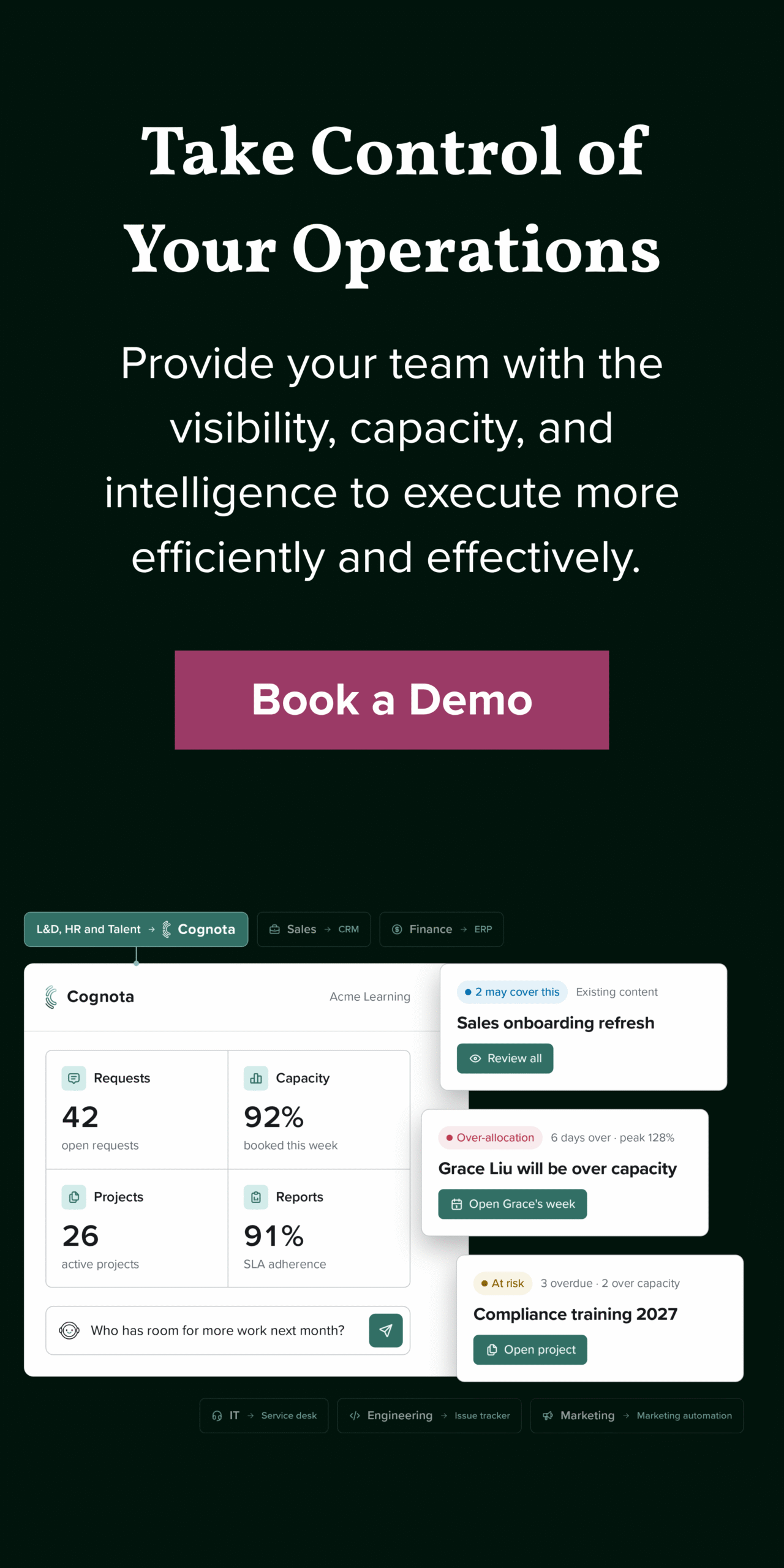
A learning leader rarely starts an HRIS versus LearnOps platform conversation because they want another system. It starts when the team cannot clearly answer basic operating questions: Which requests matter most? Who has capacity? What work is at risk? Where is the budget going? And what business result did the learning effort produce?
For enterprise L&D and talent teams, these are not administrative details. They determine whether learning is viewed as a strategic business function or a service desk responding to the loudest request. The distinction between an HRIS and a LearnOps platform is therefore less about technology categories and more about operational ownership.
If your team is managing strategic work through disconnected spreadsheets, inboxes, meetings, and workarounds, see Cognota in action to understand what an operational layer for learning can look like.
HRIS Versus LearnOps Platform: The Real Decision
An HRIS is a foundational part of the enterprise technology environment. It provides an established source of workforce data and supports the broader people ecosystem. A LearnOps platform serves a different purpose: it gives learning and talent teams the infrastructure to run their work as an integrated operation.
That difference matters because workforce information alone does not create operational discipline for L&D. Knowing that an audience exists, for example, does not decide whether a requested initiative is aligned to a business priority, whether the team has the right expertise available, or whether an external partner is needed to meet a critical deadline.
A LearnOps platform is designed for the decisions that happen before, during, and after learning work is delivered. It brings structure to demand, governance to prioritization, visibility to resource allocation, and intelligence to performance improvement. Rather than asking teams to stitch those activities together manually, it establishes a common operating model.
The question is not which category is better. Most enterprise teams need their established enterprise systems. The more useful question is: where does learning work get planned, governed, measured, and improved?
The Gap Shows Up in Day-to-Day Work
Many L&D leaders recognize the gap long before they name it. It appears when a business stakeholder submits a request and nobody can see the full queue of work. It appears when a director needs a capacity view for the next quarter and the answer requires several spreadsheets. It appears when finance asks for a budget forecast and project owners are working from different assumptions.
These problems are often treated as process issues. Process is part of the answer, but process without an operational system depends on heroic effort. Experienced team members become the bridge between disconnected tools, translating priorities, chasing approvals, and rebuilding status updates for every leadership meeting.
That model does not scale well, particularly in organizations where learning teams are being asked to support transformation, compliance, performance, leadership development, and changing skill needs with the same or fewer resources. It also creates risk. When operating knowledge lives in individuals instead of a shared system, leaders lose the ability to make timely, evidence-based decisions.
A LearnOps platform addresses this operational gap across five connected disciplines: Align, Plan, Execute, Measure, and Optimize. The value is not in adding process for its own sake. It is in creating a reliable path from business demand to managed execution and, ultimately, informed improvement.
Align work before committing resources
Alignment is where many teams lose capacity without realizing it. Requests enter from across the business, often with urgent language and incomplete context. Without a structured way to evaluate them, the team can end up treating every request as equally important.
A stronger operating model captures demand consistently and connects each initiative to the intended business outcome, audience, sponsor, urgency, and expected effort. Leaders can then make trade-offs visible. They can say yes with confidence, defer work with a rationale, or redirect a request before substantial resources are committed.
This is not about making L&D less responsive. It is about ensuring responsiveness serves the enterprise strategy rather than the latest escalation.
Plan capacity and spending with less guesswork
Planning is where strategy meets constraints. A learning plan may be ambitious, but it has to be executable with the people, budget, and specialized capabilities available.
When planning data is scattered, teams often discover resource conflicts too late. A designer is overallocated. A critical review is delayed. A priority project competes with unplanned intake. The result is predictable: rushed work, missed expectations, and leaders questioning why delivery appears inconsistent.
A LearnOps approach makes capacity a leadership conversation, not a last-minute rescue effort. Teams can see demand against available resources, evaluate scenarios, and decide where internal capacity is sufficient versus where on-demand expertise may be appropriate. For organizations facing variable demand, this visibility is a practical advantage, not an abstract one.
Execution Needs Governance, Not More Status Meetings
Execution is frequently mistaken for project tracking alone. But learning operations require more than a list of tasks. They require defined intake, clear ownership, consistent approvals, transparent handoffs, and a record of decisions that can withstand leadership scrutiny.
Governance is especially valuable in complex enterprises, where a single initiative may involve subject matter experts, business sponsors, compliance stakeholders, learning designers, facilitators, and external contributors. Without a shared operational system, each handoff creates an opportunity for context to be lost.
A LearnOps platform provides a coordinated environment for managing that work. The team gains a view of what is underway, who owns it, what requires action, and where work is blocked. Stakeholders gain clearer expectations without forcing learning leaders to spend their week assembling manual updates.
The trade-off is real: greater visibility requires teams to adopt shared ways of working. A platform will not fix unclear decision rights or a strategy that changes every week. It can, however, make those problems visible early enough for leadership to address them.
Measurement Must Connect Work to Business Intent
Enterprise L&D teams are under sustained pressure to demonstrate value. Yet many measurement efforts begin too late, after work is complete and the original business case is no longer clear.
Operational maturity changes the sequence. Teams define the intended outcome at intake, carry that intent through planning and execution, and use it to assess results. This does not mean every initiative produces a simple financial calculation. Some outcomes are leading indicators, risk controls, proficiency improvements, or readiness measures. The right measure depends on the work.
What matters is traceability. Leaders should be able to understand why an initiative was prioritized, what resources it required, how it progressed, and what evidence suggests it contributed to the desired result. That is a more credible conversation than reporting activity alone.
It also helps teams learn from their own operations. If similar projects repeatedly exceed planned effort, if certain request types create bottlenecks, or if a particular workflow slows time to value, those patterns can inform the next planning cycle.
Choose the Operating Model Your Maturity Requires
The right question is not whether a team has enough technology. It is whether its current operating model can support the level of strategic demand placed on it.
Cognota’s LearnOps Maturity Model offers a useful diagnostic lens. Teams at the Reactive stage are often focused on keeping up with demand. Managed teams have begun to standardize processes, while Strategic teams connect learning priorities more directly to business goals. Predictive and Adaptive teams use operational data to anticipate needs, optimize decisions, and continuously improve performance.
No stage is a failure. It is a clear view of the current state. A team dealing with fragmented intake and limited capacity should not try to imitate an Adaptive operating model overnight. It should first establish visibility, consistency, and decision discipline. Progress becomes more sustainable when each improvement addresses a real operational constraint.
For many enterprise leaders, the HRIS versus LearnOps platform discussion becomes clearer through that lens. The enterprise system landscape may already hold essential people data. What is missing is often the operational backbone that lets L&D turn demand into prioritized, measurable work.
The strongest next step is to map one real initiative from request to outcome. Notice where context disappears, where approvals stall, where capacity is assumed rather than planned, and where measurement loses connection to the original business need. That map will tell you far more about the operating system your team needs than a feature list ever could.