
A new compliance requirement lands, a business unit needs capability support for a transformation, and leaders want evidence that development investment is changing performance. The question is not whether HR should be involved. It is who owns the work required to turn a workforce priority into a well-run learning initiative. That is where learning operations vs HR operations becomes more than an org-chart debate.
Both functions help the organization perform, but they operate at different points in the employee experience and solve different operational problems. HR Operations creates consistency and reliability across people processes. Learning Operations, or LearnOps®, gives learning and talent teams the discipline to align demand, plan work, execute initiatives, measure results, and improve how they operate.
When the distinction is unclear, learning teams often inherit work without a defined intake path, capacity view, governance model, or measurement plan. HR Operations may receive requests that belong with learning, while learning leaders spend too much time manually coordinating work instead of advising the business. The result is friction that looks like a people problem but is usually an operating-model problem.
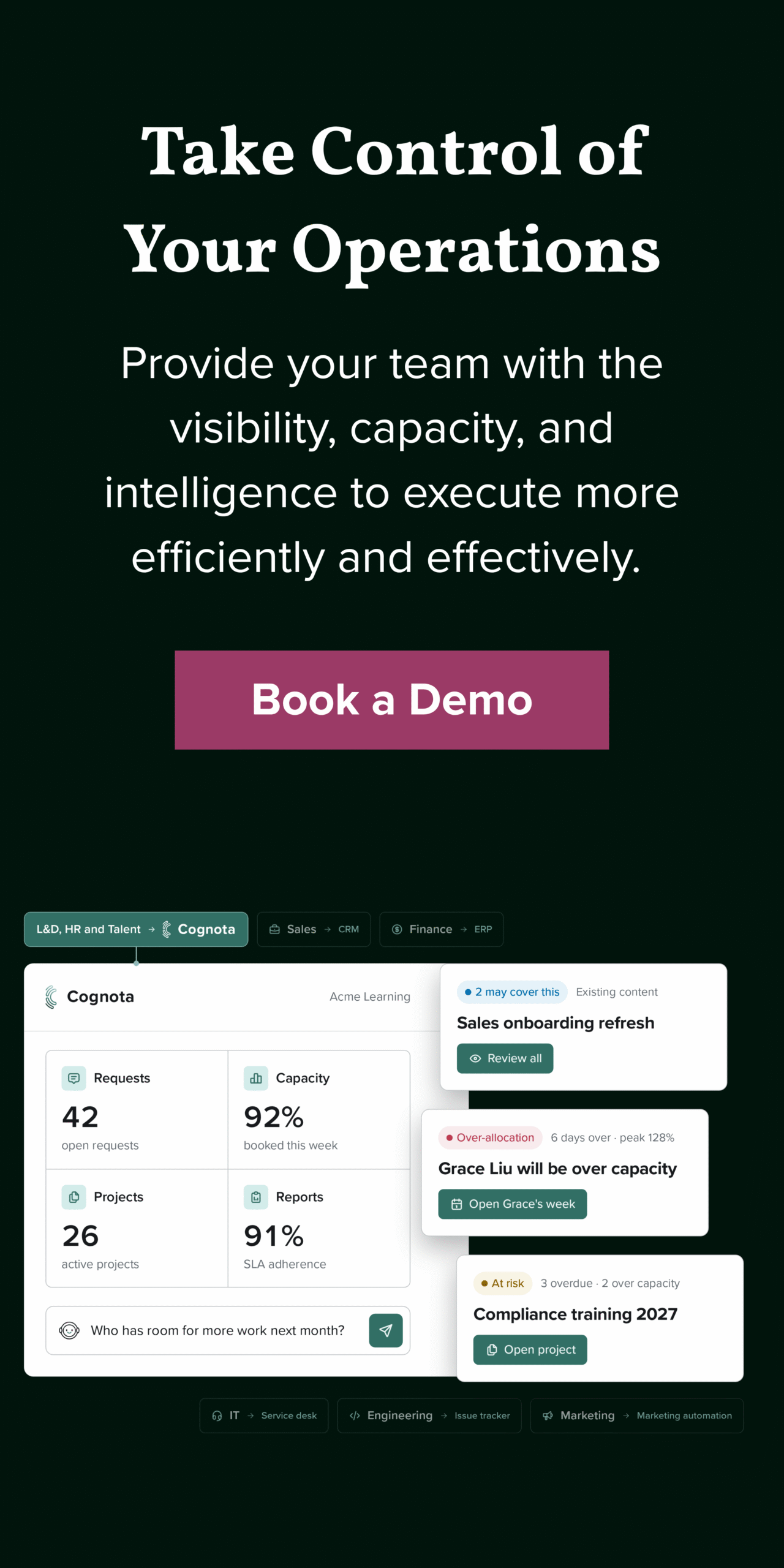
If your team is working to move from reactive delivery to disciplined execution, see Cognota in action and assess what an operational layer can make possible for your learning function.
What HR Operations Owns
HR Operations is responsible for making core people processes dependable, compliant, and consistent. Its mandate commonly includes the administration and governance surrounding employee data, lifecycle events, policies, benefits, payroll coordination, and service delivery. The exact scope varies by enterprise, especially in regulated industries, but the central objective is stable, accurate execution at scale.
This is essential work. A poorly run HR operation creates employee frustration, unnecessary risk, and leadership distrust. HR Operations establishes the process foundation that lets the broader people function function reliably.
Its measures tend to reflect service quality and process health: accuracy, cycle times, adherence to policy, case resolution, employee experience, and cost efficiency. Those measures are appropriate because HR Operations is designed to make recurring people processes work predictably.
Learning work has different characteristics. It is often project-based, demand-driven, and connected to changing business priorities. A sales leader may need readiness for a new product launch. A risk leader may need to address a capability gap. A business transformation may require targeted behavior change across specific roles. Those requests require a different operational discipline than administering a repeatable HR process.
Learning Operations vs HR Operations: The Core Difference
The simplest distinction is this: HR Operations runs the infrastructure of the employee lifecycle, while Learning Operations runs the operating system for learning and talent work.
Learning Operations does not replace HR Operations. It gives L&D and talent teams the capacity, execution, and intelligence required to manage their own increasingly complex portfolio. It creates a consistent way to receive demand, qualify priorities, scope work, assign resources, manage budgets, coordinate stakeholders, and connect outcomes back to business goals.
That difference matters because learning is not a single, linear process. An enterprise learning portfolio can include compliance needs, leadership development, onboarding support, performance enablement, internal mobility initiatives, and transformation programs. Each may involve different sponsors, audiences, timelines, specialists, and measures of success.
Without LearnOps, teams frequently rely on email, spreadsheets, meetings, and individual heroics to keep that portfolio moving. Work still gets delivered, but leaders cannot easily see what is coming, what resources are constrained, which initiatives are strategically aligned, or whether completed work created measurable value.
Gartner has consistently emphasized the need for HR leaders to connect talent priorities to enterprise outcomes. Learning Operations provides the practical management discipline for making that connection visible within the learning function. It turns strategy from a presentation topic into a repeatable operating practice.
HR Operations is process-centered
HR Operations is built to ensure that defined processes are performed correctly and consistently. Standardization is a major strength. When the work is repetitive and governed by clear policies, variation can create risk.
Learning Operations is portfolio-centered
Learning Operations is built to help teams make smart decisions across a changing body of work. Standardization still matters, but the work requires more flexibility. A high-priority transformation initiative may need accelerated planning and cross-functional coordination, while a lower-value request may need to be deferred, redesigned, or declined.
The trade-off is important. Treating every learning request like a standard HR service can make the function less responsive to strategic needs. Treating every request as a custom project, however, can overwhelm the team. LearnOps creates the governance needed to differentiate between the two.
Where the Functions Need Strong Handoffs
The most effective model is not separation for its own sake. It is clear accountability with intentional handoffs. HR Operations and Learning Operations should share relevant context while retaining ownership of their respective work.
For example, HR Operations may surface recurring employee questions, policy changes, or lifecycle moments that create a learning need. Learning Operations can then evaluate the request against business priorities, expected outcomes, available capacity, and the best delivery approach. In return, HR Operations benefits from knowing when learning initiatives affect employee communications, manager readiness, or process adoption.
The partnership is especially valuable when organizations are managing major change. HR Operations can help preserve process integrity and employee experience. Learning Operations can organize the capability-building work needed to help people adopt new behaviors and perform in new ways.
Clear decision rights prevent common breakdowns. HR Operations should not be expected to prioritize the full learning portfolio or manage learning production workflows. Likewise, learning leaders should not have to create ad hoc processes for every people-related request that reaches their team. Each function needs visibility into the other’s work, but visibility is not the same as ownership.
Build Learning Operations Around Five Disciplines
A mature LearnOps model gives learning leaders a practical way to manage this distinction. Cognota’s LearnOps Framework organizes the discipline around five connected areas: Align, Plan, Execute, Measure, and Optimize.
Align means connecting incoming work to enterprise priorities before resources are committed. It gives business stakeholders a transparent way to understand what the learning team can support and why.
Plan means turning approved work into a realistic portfolio. Teams need to understand demand, skills, budget, timelines, and capacity before commitments become missed deadlines.
Execute means managing workflow, approvals, dependencies, and collaboration with operational consistency. This is where teams reduce the invisible coordination work that drains capacity.
Measure means defining evidence of success that fits the initiative. Completion data alone rarely tells leaders whether a learning investment changed readiness, behavior, performance, risk, or business results.
Optimize means using that evidence to improve future decisions. Over time, the team learns which requests create value, where bottlenecks recur, and how to allocate resources more intelligently.
These disciplines do not make learning rigid. They make good judgment easier to apply at scale.
Signs Your Team Needs a Clearer LearnOps Model
The need is often visible before leaders name it. Learning demand arrives through scattered channels. Projects begin before priorities, scope, or success measures are agreed. Managers ask for status updates that require manual investigation. Subject matter experts become bottlenecks. Budget discussions happen after commitments are made. Teams cannot confidently explain which work is advancing business strategy.
These are not signs that the learning team lacks commitment or talent. They are signals of operational maturity. In Cognota’s LearnOps Maturity Model, reactive teams are often consumed by incoming requests, while managed and strategic teams establish clearer governance and visibility. Predictive and adaptive teams use operational data to anticipate demand, adjust capacity, and continuously improve effectiveness.
No enterprise needs to solve every maturity gap at once. A team facing uncontrolled demand may start by establishing a consistent intake and prioritization process. A team with strong intake but limited resource visibility may focus next on planning capacity. The right move depends on where work is breaking down and what the business needs most.
The Leadership Question Behind the Comparison
For senior learning and HR leaders, the goal is not to create another silo. It is to make sure learning has the operational infrastructure expected of every strategic business function.
HR Operations remains critical to a well-run people organization. But learning teams need their own way to govern work, manage constraints, and demonstrate contribution. When the responsibilities are clear, HR can operate with greater consistency and L&D can operate with greater strategic intent.
The next useful conversation is not, “Should learning sit closer to HR Operations?” It is, “Can our learning function reliably translate business demand into measurable capability outcomes?” The answer reveals far more about the organization’s readiness to scale.