A learning backlog is rarely just a list of unfinished courses. It is a visible symptom of a harder operational problem: too much demand, too little clarity, and no shared way to decide what deserves the team’s time. If you are figuring out how to reduce learning backlog, start by treating it as a portfolio decision, not a productivity problem.
For enterprise L&D teams, the stakes are higher than a missed due date. A backlog can delay compliance initiatives, leadership development, sales readiness, and business-critical transformation work. It also creates a frustrating cycle where stakeholders escalate louder requests while the team works harder to keep up – often without improving alignment, quality, or impact.
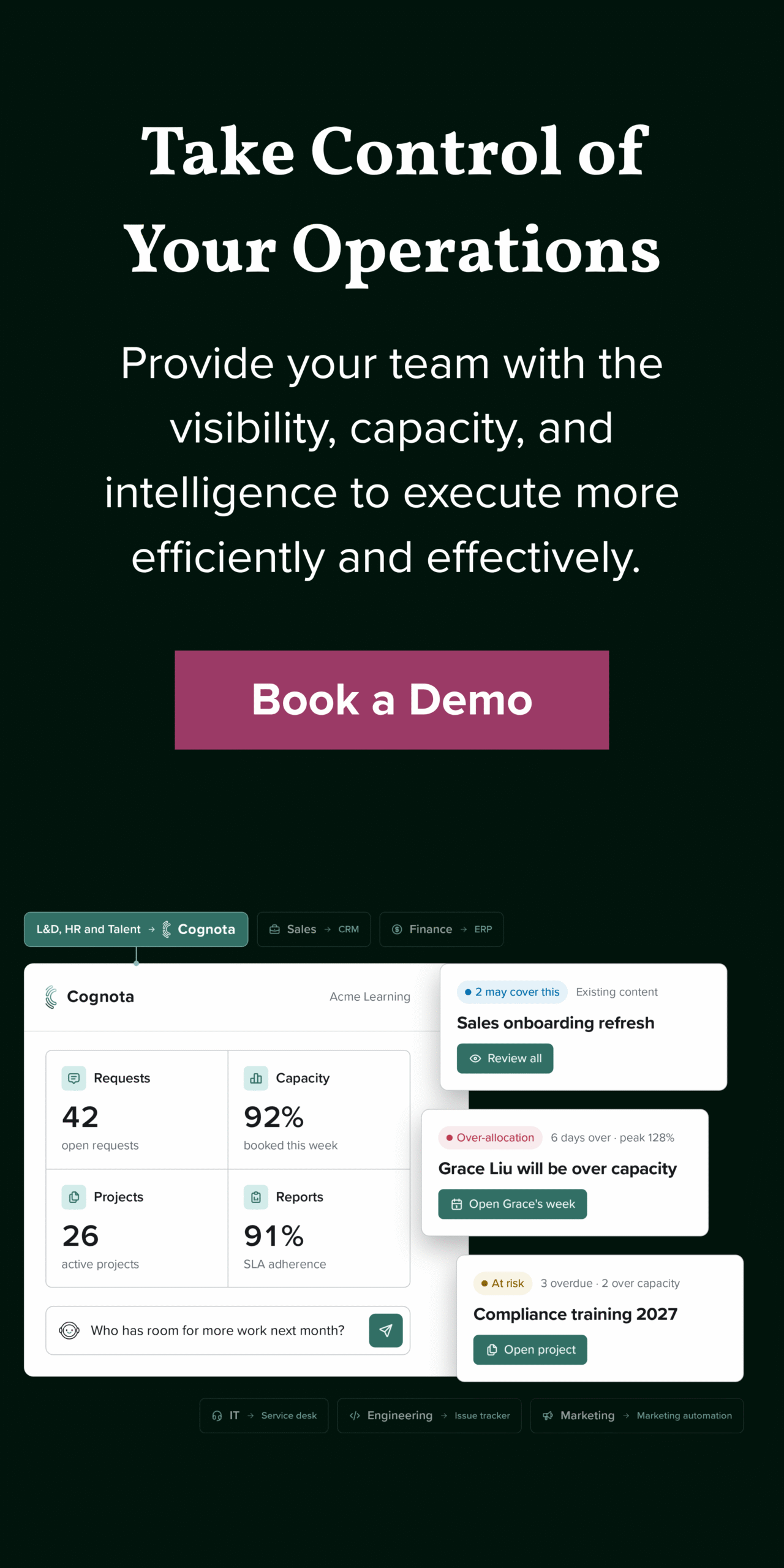
The answer is not asking instructional designers and program managers to move faster. It is creating visibility into demand, capacity, cost, and delivery risk so leaders can make better decisions before work enters production. See Cognota in action to explore what an operations layer for workforce enablement can make visible across your team’s work.
Why learning backlogs keep growing
Most learning backlogs are built upstream. Requests arrive through email, meetings, chat, spreadsheets, and informal conversations with business partners. Each request may sound reasonable on its own. Together, they create a queue that no team can realistically fulfill.
The underlying issue is that demand is often accepted before it is properly defined. A business leader asks for training when the real need may be a process issue, manager accountability gap, system change, or communication problem. Without a consistent intake process, L&D can become the default solution for every performance challenge.
Capacity is equally easy to misread. Teams may know how many people they employ, but not how much time is already committed to design, reviews, stakeholder meetings, vendor management, localization, reporting, and unexpected revisions. A project that appears to require 40 hours can consume far more once governance and rework are included.
The 2026 Brandon Hall Group and Cognota Joint Research Report found that 83% of teams use three to eight tools to manage operations, while 69% want to consolidate. When requests, plans, budgets, and work status live in separate places, leaders cannot see the full queue or spot conflicts early. The backlog grows in the gaps between tools.
How to reduce learning backlog with operational discipline
Reducing a backlog requires a repeatable operating rhythm. The most effective teams move through five connected practices: align, plan, execute, measure, and optimize. This is not about adding bureaucracy. It is about giving the team a fair, visible way to say yes, no, not yet, or not this way.
Align requests to a business outcome
Create one front door for learning requests. Every request should capture the business problem, target audience, desired outcome, urgency, sponsor, deadline, and consequences of inaction. If a requester cannot define the outcome, the work is not ready to prioritize.
This step changes the conversation. Instead of asking, “Can you build a course?” L&D can ask, “What performance change is required, and how will we know it happened?” Some requests will still belong in the learning portfolio. Others may need a different intervention, a smaller effort, or a conversation with the business owner before they consume design capacity.
For CHROs and CLOs overseeing several People teams, common intake also reveals duplication. Leadership development, manager enablement, onboarding, and skills initiatives can overlap across L&D, Talent, and HR. One view of demand helps teams coordinate the work rather than independently solving similar problems.
Plan with real capacity, not headcount
Headcount is not capacity. A team of 10 does not have 10 people available for net-new work. Start by accounting for committed programs, operational support, governance activities, planned time off, and the level of effort required for each type of work.
Then make trade-offs explicit. If an executive-sponsored initiative must move forward, leaders should be able to see what will move out, slow down, or require additional support. This is a healthier conversation than quietly absorbing another “urgent” request and hoping the team can catch up.
External expertise can be appropriate when a specialized project has a fixed need or when an internal team needs temporary support to protect a strategic commitment. But outside help does not solve poor prioritization. It works best when the scope, owner, budget, and expected outcome are already clear.
Establish a decision cadence
A backlog should not be reviewed only when someone escalates. Set a regular portfolio review with the right business and workforce enablement leaders. The purpose is to make choices, not simply report status.
Review new demand alongside active commitments. Ask which initiatives have the strongest business alignment, which have a real deadline, which face the greatest delivery risk, and which can be simplified or stopped. A request that was high priority three months ago may no longer deserve capacity if business conditions have changed.
Use clear decision categories: approve, defer, decline, redesign, or combine. The language matters. “Defer” should include a future review point, not become a polite way to let work disappear. “Decline” should explain the reason in terms of priorities and expected impact, not team unwillingness.
Protect execution from avoidable rework
Backlogs are often inflated by work that is technically in progress but repeatedly sent backward. Unclear roles, late approvals, shifting scope, and feedback from too many stakeholders can turn a straightforward initiative into months of churn.
Define who owns the business outcome, who approves scope, who provides subject matter expertise, and who has final signoff. Set expectations for review windows and feedback quality before production begins. If an approver changes the objective halfway through, treat that as a scope decision with visible capacity implications.
This is where governance protects both speed and quality. It gives teams a shared set of rules for people and AI-assisted work, rather than asking individual project leads to negotiate the process from scratch every time.
Measure the flow of work, not just completions
Completion rates tell you whether learners finished an experience. They do not tell you whether the L&D operation is becoming more reliable. To reduce learning backlog over time, track the health of the work system itself.
Useful measures include incoming demand, approved demand, deferred demand, work in progress, cycle time, on-time delivery, rework rate, budget variance, and stakeholder satisfaction. Look at trends by business unit and request type. If one group submits a high volume of urgent work with weak outcomes, that is a signal to address demand quality upstream.
The same 2026 research found that teams with a dedicated operations lead reported 34% faster delivery, 28% lower costs, and 39% higher stakeholder satisfaction. Those figures do not mean every organization needs the same structure. They do show that operational ownership matters when work is complex, demand is high, and multiple stakeholders shape the queue.
Move from reactive work to a managed portfolio
Not every backlog can be cleared quickly, and trying to clear every item may be the wrong goal. Some work should remain deferred because its value is uncertain. Some should be retired because the business need has passed. A smaller, more credible portfolio is better than a long list of commitments no one can confidently deliver.
In the LearnOps® Maturity Model, reactive teams respond to requests as they arrive. Managed teams create consistent processes for intake, prioritization, and delivery. Strategic teams connect the portfolio to business priorities and measure whether it is producing value. The shift begins when leaders stop viewing the backlog as a personal failure of the team and start viewing it as operational data.
Your workforce enablement team does not need more pressure to produce. It needs the visibility to lead, the signals to make trade-offs, and the authority to protect work that matters. When demand, capacity, and decisions are visible in one operating rhythm, the backlog becomes something you can manage – not a permanent measure of work left behind.