
[Checklist] What Should Be Landing on Your Desk
The standing report a CLO should expect, and why it arrives late. For Chief Learning Officers.
You are usually the last person in the chain to see a number and the first one asked to defend it. Most reporting packs that reach a CLO were built by people optimizing for completeness, which is why they run long, look backwards, and arrive after the meeting that needed them.
Four things belong in the pack. Three explain why it takes so long to produce. We’ve listed them below.
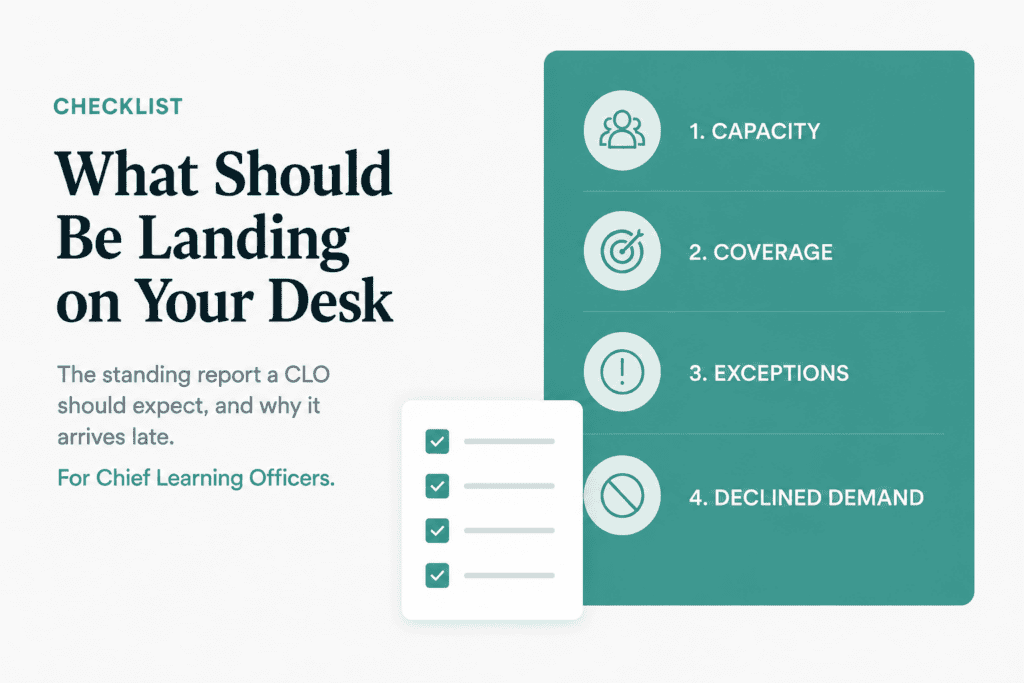
The Report You Should Be Getting
1. Committed capacity against available capacity, two quarters out
One number each, at the top, before any project detail. This is the only forward-looking item in the entire pack and it is the one that lets you answer the question an executive asks without warning.
Everything else your team sends you is history.
If this figure is not on page one, the pack is telling you what happened rather than what you can still change.
2. Coverage against priorities, and the share that matches none of them
Capacity by strategic priority, with the priorities named the way your CEO names them rather than by program type.
The more useful half is the inverse: what got built last quarter that maps to nothing on the list.
That number is never zero, and it is the cleanest argument you have for either more resource or firmer governance, depending on how large it is.
3. Exceptions, not status
A status report tells you 47 projects are green.
An exception report tells you the four that slipped, why, and what decision is required from you.
Ask for the format to change: anything on track gets one line, anything at risk gets a paragraph and a named decision with your name against it.
The pack gets shorter and you get more from it.
4. The demand you turned away
Requests declined, deferred, or redirected, with the requesting function named.
This is the best early warning system available to you.
A business unit that comes three times in a quarter and is deferred three times will quietly stand up its own training capability, and you will hear about it a year later when someone asks why there are two onboarding programs.
Why It Takes Three Weeks
5. Because the data is being assembled, not retrieved
When you ask a question and get an answer eleven days later, most of that time was someone reconstructing history from email threads, spreadsheets, and memory.
Here is the test: ask the same question again a quarter later and see whether the second answer comes faster.
If it does not, nothing was captured the first time and you are paying for the same archaeology every cycle.
6. Because the definitions get renegotiated every time
A meaningful share of the delay is a quiet argument inside your team about what “delivered” means, or which costs belong in the total, or whether a paused project counts as active.
Settle eight or ten of those terms once, in writing, and the lag drops sharply. Defining vocabulary removes more reporting delay than buying a tool does.
7. Because someone is protecting you from an uncomfortable number
Part of the latency is deliberate.
Reports slow down when the underlying figure is bad and somebody is assembling context to soften it before it reaches you.
Say plainly that you would rather have a rough number on Tuesday than a defensible one in three weeks. Then handle the first bad number the way you want the next ten to keep arriving.
A Closing Test
Ask which business units submitted requests you did not fund in the past year.
If nobody can produce that list within a day, you have no visibility into where shadow training functions are forming.
They form fastest in the units with the most discretionary budget, which are rarely the ones you are watching.
