A business leader asks whether a leadership program changed manager behavior, shortened time to readiness, or improved retention in a critical role. “We had 2,000 completions” is not an answer. It is activity data. It may be useful, but it does not tell the leader whether the work deserved another investment, more capacity, or a different approach.
That is why measure learning business impact is the question workforce enablement leaders need to answer. Measurement is not a final reporting exercise for L&D. It is how your People teams turn learning from a stream of requests into a disciplined business function that can set priorities, make trade-offs, and show where its work changes outcomes.
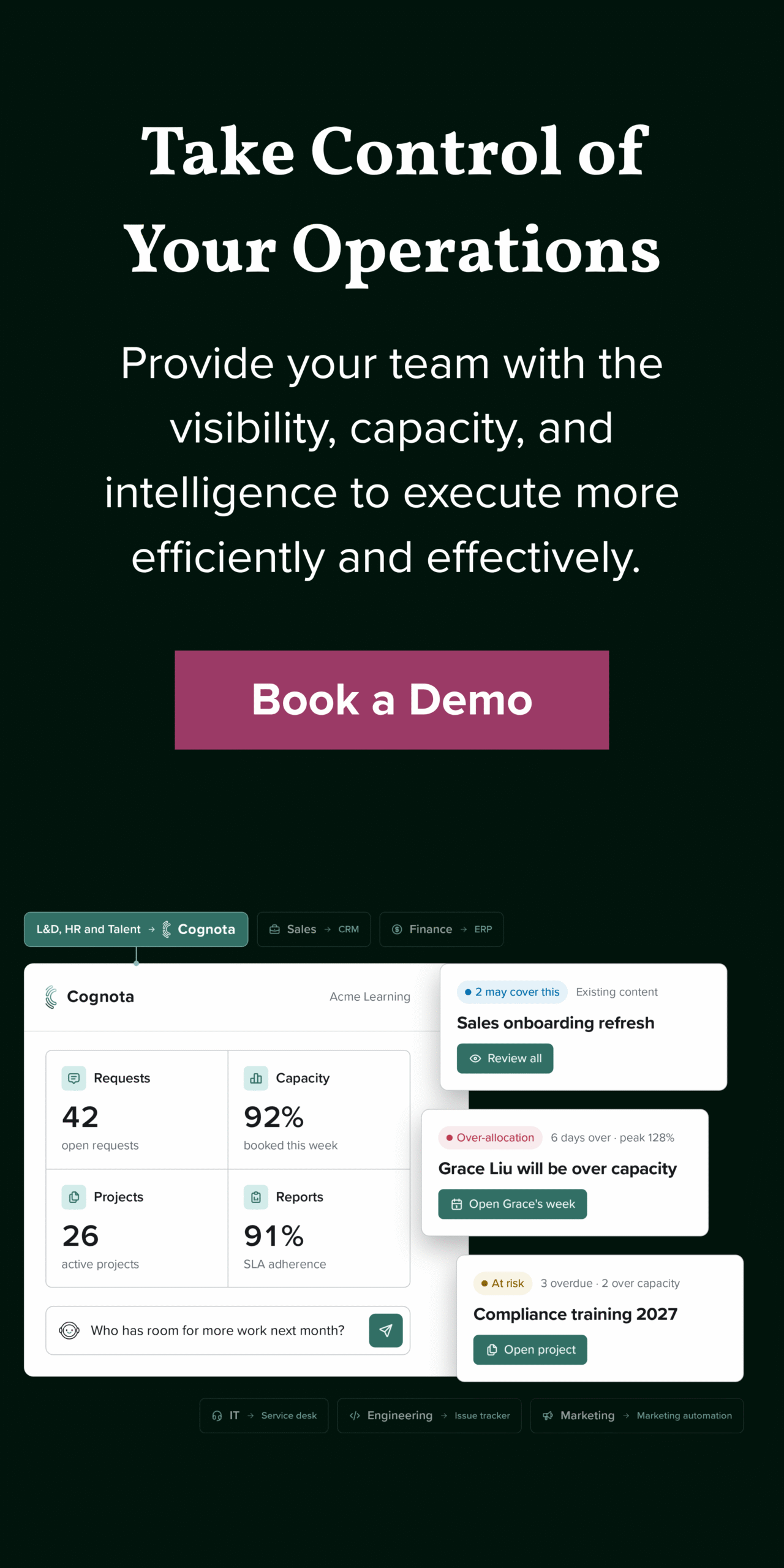
See how Cognota helps teams connect demand, capacity, delivery, and results in one operational view: https://cognota.com/learnops-platform-intro/
Why measure learning business impact instead of learning activity?
Completion rates, attendance, learner satisfaction, and knowledge checks all have a place. They tell you whether a program reached people, whether the experience worked, and whether learners retained key concepts. The problem begins when these measures become the whole story.
Business impact asks a different set of questions: Did frontline managers hold better performance conversations? Did new hires reach expected productivity sooner? Did a compliance intervention reduce repeat errors? Did a sales enablement effort improve the behaviors that precede revenue?
Those questions change the work before a program is ever built. They require L&D, Talent, and HR leaders to establish the business problem, define the audience and expected behavior change, and agree on evidence that would show progress. That alignment protects teams from producing polished solutions for unclear needs.
It also creates a more credible conversation with executives. Leaders rarely expect learning alone to move a major enterprise metric. They do expect a clear explanation of the contribution learning made, what else influenced the result, and what the team will do next. That is a much stronger standard than claiming credit for every positive change.
Measurement improves decisions while work is still underway
The value of measurement is not limited to proving the past. Its greater value is helping teams make better choices in the present.
Consider a learning team supporting a new manager initiative. If intake data shows that business units are requesting similar programs for different problems, the team can clarify the need before committing design capacity. If delivery data shows that a high-priority program is waiting on stakeholder reviews, leaders can address the decision bottleneck. If early behavior data is flat, they can adjust reinforcement or manager support rather than waiting until the program closes.
This is the operating discipline behind the workforce enablement cycle: align, plan, execute, measure, and optimize. Measurement belongs throughout the cycle because each stage produces a signal. The signal should lead to a decision, not simply another dashboard.
For example, a low completion rate could signal poor communications, a competing business priority, an inaccessible learning experience, or a manager who has not created time for participation. Treating it as a learner-engagement problem without context can send a team in the wrong direction. Measurement works when it connects the number to the operating reality behind it.
It makes capacity a strategic conversation
Most enterprise learning teams do not lack work. They lack a consistent way to show what work should take precedence and what a new request will displace.
Business-impact measurement makes those trade-offs visible. When leaders can see which initiatives are tied to strategic priorities, which have agreed success measures, and which are consuming the most effort, they can direct capacity toward alignment, quality, and impact. The conversation shifts from “Can you build this?” to “Is this the best use of our team’s capacity right now?”
That distinction matters in large organizations, where requests arrive from multiple business units with different levels of urgency and executive support. Without a shared view of demand, cost, ownership, and expected outcomes, the loudest request can easily become the next project.
The 2026 Brandon Hall Group and Cognota Joint Research Report found that 83% of teams use three to eight tools to manage operations, while 69% want to consolidate. Fragmented operations make impact measurement harder because the evidence is scattered across intake forms, project plans, vendor spreadsheets, survey tools, and stakeholder updates. Teams spend time assembling the story instead of acting on it.
It strengthens stakeholder trust without overclaiming
Learning does not operate in a vacuum. Manager support, process design, incentives, staffing levels, technology, and market conditions can all affect a business result. Smart measurement recognizes that complexity.
That does not mean avoiding impact measures because attribution is difficult. It means choosing an honest level of evidence. For a high-stakes initiative, a team may compare baseline and post-program performance, use a pilot group, or partner with business analytics leaders to examine related operational data. For a smaller initiative, structured manager observations, behavior checks, and stakeholder interviews may be the right approach.
The method depends on the decision at stake. A global leadership initiative deserves more rigor than a short update to a process. What matters is that the level of measurement is intentional and proportionate.
When teams explain both results and limitations, they earn trust. A stakeholder is more likely to believe, “Manager coaching behaviors improved in the participating group, but regional results varied and need further review,” than a vague declaration that a program transformed performance. Credibility comes from clarity, not inflated claims.
What to measure across the path to business impact
Business outcomes are often lagging indicators. If you wait only for them, you lose the chance to improve the work along the way. A practical measurement approach connects several layers of evidence.
Start with operational measures: demand volume, priority alignment, cycle time, workload, cost, and delivery risk. These show whether the team can execute the right work reliably. Then measure learning and adoption: participation, confidence, knowledge, manager support, and usage where applicable. Next, look for behavior change in the role. Finally, connect that behavior to the business measure the initiative was designed to influence.
The chain is not always linear. A strong learning experience may still fail to produce behavior change if managers do not reinforce it. A behavior change may not improve a business outcome if another process is broken. That is not a failure of measurement. It is precisely what measurement helps reveal.
Teams that are earlier in their operational maturity may begin by improving visibility into requests, priorities, and delivery. Managed teams create consistent measures and ownership. Strategic teams connect their portfolios to business priorities and use results to shape planning. Only a small share of teams reach the Adaptive stage, where signals can continuously inform decisions across the enterprise. The goal is not to jump stages. It is to build the next useful capability.
How to start measuring business impact without creating reporting overload
Start with one or two initiatives that matter to the business and have engaged sponsors. Agree on the problem being solved, the behavior expected to change, the business signal to monitor, and who owns each data point. Capture a baseline before delivery whenever possible.
Keep the measurement plan focused. If a metric will not lead to a decision, it probably does not belong in the first version of the plan. A smaller set of trusted measures is more valuable than a lengthy scorecard no one reviews.
Then create a regular operating rhythm. Review signals with sponsors while there is still time to act. Record what changed, why it changed, and what should be repeated or adjusted. Over time, those decisions become institutional knowledge rather than one-off lessons held in individual spreadsheets.
The point is not to turn every learning initiative into a research study. It is to make sure your team can answer the question behind every request: what business outcome are we trying to influence, and what evidence will tell us whether the work mattered?
When workforce enablement teams can answer that question consistently, they gain more than a better end-of-quarter update. They gain the visibility to lead, the signals to execute, and the confidence to invest their next hour of capacity where it can make the greatest difference.