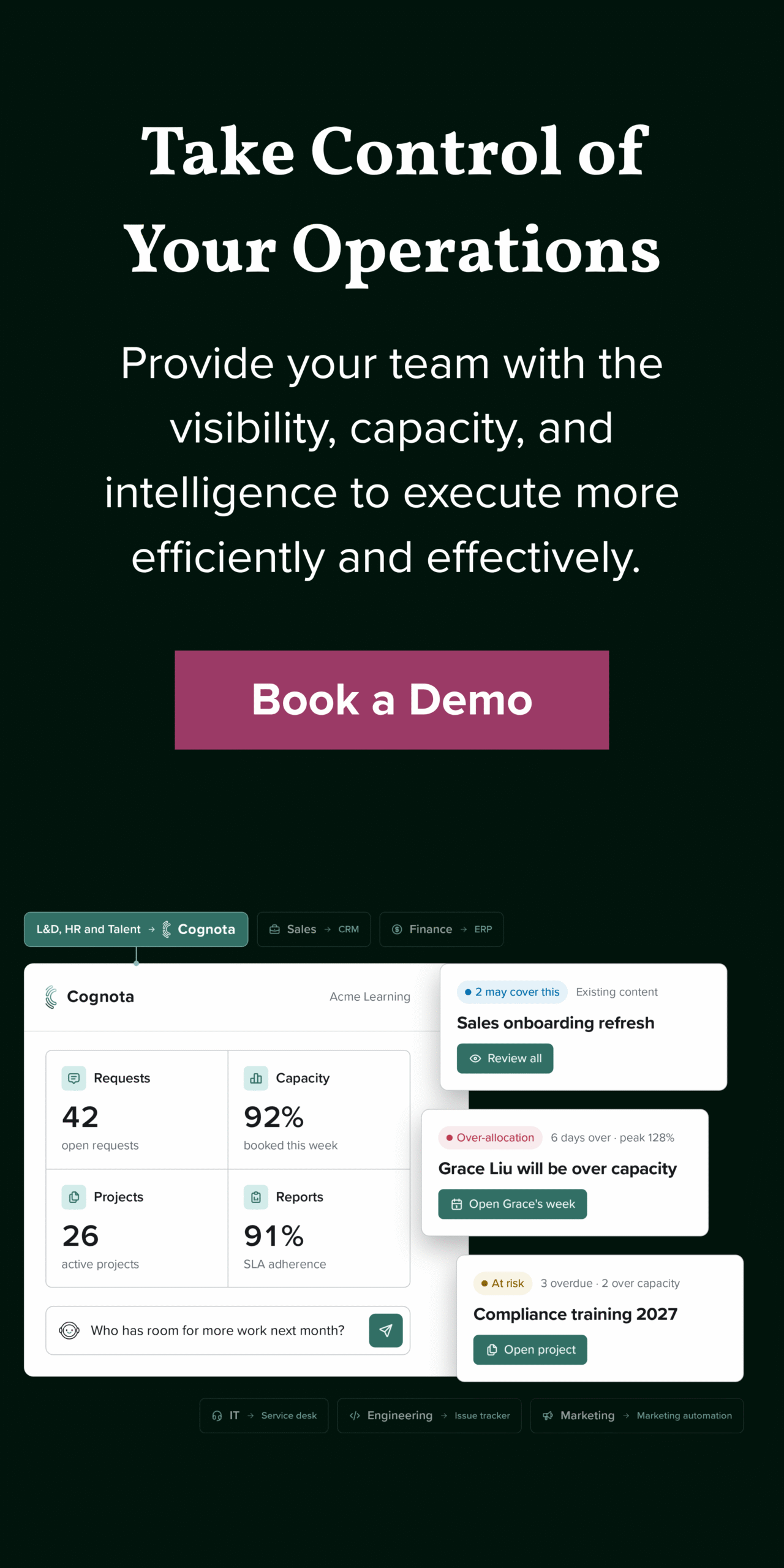
A learning team can have capable people, a full portfolio of initiatives, and a steady stream of business demand – then still struggle to explain where its capacity went or what outcomes its work produced. That is the operational gap LearnOps software is built to address. It gives enterprise L&D and talent teams a system for managing the work behind learning, not simply the learning experience itself.
For organizations with thousands of employees, the issue is rarely a lack of ideas. It is the volume of requests, stakeholders, approvals, suppliers, projects, data, and changing priorities surrounding those ideas. When that work lives across inboxes, spreadsheets, project boards, and disconnected systems, leaders lose visibility before they lose control.
If your team is being asked to deliver more strategic value with constrained resources, see Cognota in action through a LearnOps platform introduction. The right operational foundation can make the difference between reacting to demand and deliberately shaping the learning portfolio.
LearnOps Software Is the Operations Layer
LearnOps software is purpose-built infrastructure for planning, governing, and improving enterprise learning operations. It sits at the point where business demand becomes learning work: a leader submits a request, the team evaluates its strategic value, plans the required effort, assigns resources, monitors delivery, and measures the result.
That distinction matters because a learning delivery system and an operations system solve different problems. Delivery technology supports the learner-facing side of a program. LearnOps software supports the team responsible for deciding what gets built, why it matters, who will do the work, what it will cost, and whether it delivered value.
This is why adding another point solution often creates more friction than progress. A team may gain a better way to manage one activity while still relying on manual handoffs to connect intake, prioritization, budgeting, project governance, and measurement. The problem is not a missing feature. It is a missing operating model.
Cognota defines that model through five connected disciplines: Align, Plan, Execute, Measure, and Optimize. They are not a rigid sequence that ends when a program launches. They are the disciplines that allow a learning function to make better decisions as business needs change.
Why Enterprise Learning Teams Need It Now
Learning leaders are under a different level of scrutiny than they were a few years ago. Business partners expect speed, relevance, and evidence of impact. Finance leaders want clarity on investment and capacity. Executives want learning priorities tied to transformation, performance, and workforce readiness.
At the same time, many teams are operating with leaner headcount and a broader mandate. They support leadership development, capability building, compliance, change initiatives, sales readiness, and role-based performance needs, often across multiple business units. Without a shared operational view, the loudest request can become the next priority, regardless of its strategic value.
Research organizations such as Gartner, Fosway Group, and RedThread Research have consistently pushed the learning market toward skills, business impact, and better use of workforce data. For L&D leaders, the practical implication is straightforward: strategic conversations require operational evidence. It is difficult to demonstrate disciplined decision-making when demand, resources, and outcomes cannot be viewed together.
LearnOps software creates that evidence trail. It provides a consistent way to capture requests, assess them against agreed criteria, and document why a team accepted, deferred, redesigned, or declined work. That is not bureaucracy for its own sake. It is how L&D protects capacity for the initiatives that matter most.
The Five Operating Disciplines That Change the Work
Align demand to business priorities
Alignment starts before a project exists. Intake should capture the business problem, intended audience, desired performance change, sponsor, urgency, and measures of success. A request framed as “we need training” is not yet a defined need. LearnOps software gives teams a structured way to clarify demand before resources are committed.
This improves stakeholder conversations. Rather than debating individual requests in isolation, leaders can compare demand against enterprise priorities, risk, expected impact, and available capacity. The result is a more credible portfolio conversation: what will the team do, what will it defer, and what trade-offs are being made?
Plan capacity and investment before commitments become promises
Most learning teams know they are busy. Fewer can accurately see which roles are overloaded, how much work is in flight, where external support is needed, or what planned work means for the quarter ahead. Capacity planning turns that uncertainty into a manageable decision.
A useful operational system connects projects to people, effort, milestones, and budgets. It enables leaders to test scenarios before making commitments. Can this high-priority request be absorbed? What work must move if it cannot? Is the constraint budget, specialist capacity, stakeholder availability, or project governance?
There is no universal target for utilization. Teams supporting fast-changing business units may intentionally preserve more flexibility than teams with predictable annual cycles. The goal is not to maximize every hour. It is to make capacity visible enough to protect quality, responsiveness, and strategic focus.
Execute with governance, not extra administration
Execution is where fragmented work becomes expensive. A missed approval, unclear ownership, or late scope change can create rework that is invisible in a simple project status update. LearnOps software establishes common workflows, stage gates, responsibilities, and decision records so that work progresses with fewer avoidable surprises.
Standardization does not mean every initiative follows the same path. A short update to support a policy change should not carry the governance burden of an enterprise capability program. Strong operations allow for different levels of rigor while maintaining a consistent record of scope, progress, risk, and accountability.
For leaders, this produces a clearer portfolio view. Instead of chasing updates across teams, they can see work that is at risk, blocked, over capacity, or drifting from agreed outcomes. That visibility makes intervention earlier and more useful.
Measure the value of the work, not just its volume
Completion data can tell a team whether activity occurred. It cannot, by itself, show whether the activity solved a business problem. Measurement in LearnOps begins with the outcome agreed during intake, then connects evidence to the work as it moves through delivery and review.
Not every initiative needs an elaborate impact study. The right level of measurement depends on the stakes, scale, and available data. A high-investment program tied to a business transformation deserves more rigor than a small operational update. What matters is that the learning team can explain the logic behind its measures and use the findings to improve future decisions.
This is where ROI becomes more credible. It is not a number attached at the end of a project to satisfy a reporting request. It is a disciplined practice of defining intended value, tracking the appropriate indicators, and being candid about attribution and limitations.
Optimize the operating system over time
The final discipline is where mature teams separate themselves from perpetually busy ones. They examine patterns: recurring request types, approval delays, work that routinely exceeds estimates, scarce skills, supplier spend, and initiatives with stronger or weaker evidence of impact.
Those insights can lead to meaningful changes in process design, staffing decisions, investment priorities, and stakeholder expectations. They also help teams identify work that should be simplified, automated, redesigned, or stopped. Optimization is not about squeezing more activity from the same team. It is about reducing low-value friction so expertise can be applied where it has the greatest effect.
How to Recognize the Right Time to Adopt LearnOps Software
A team does not need to be in crisis to benefit from operational infrastructure. The strongest signal is often a growing mismatch between the complexity of the portfolio and the tools used to manage it. If leaders cannot confidently answer what work is underway, why it was prioritized, who has capacity, or what outcomes are emerging, the current operating model has reached its limit.
The LearnOps Maturity Model offers a practical lens. Reactive teams manage demand as it arrives. Managed teams establish repeatable processes. Strategic teams connect work to business priorities. Predictive teams use operational data to anticipate needs and constraints. Adaptive teams continuously adjust decisions using timely insight across strategy, impact, efficiency, and effectiveness.
Progress is not linear, and no team advances by purchasing technology alone. A platform amplifies the operating discipline around it. Teams need clear decision rights, shared definitions of value, leadership sponsorship, and a willingness to make trade-offs visible. But without a system that connects those practices, the discipline is difficult to sustain at enterprise scale.
LearnOps software gives L&D leaders a way to run learning as a measurable business function: one that can absorb demand intelligently, deploy capacity deliberately, execute with control, and improve based on evidence. The next useful question is not whether your team needs more work management. It is whether your current operations give you the confidence to say no, reallocate resources, and prove why the work you chose matters.