A US banking vendor consolidation example often begins with a deceptively simple mandate: reduce the number of external partners, lower administrative overhead, and create clearer accountability. For a large bank, that directive can quickly reach learning and talent teams that rely on a mix of content providers, subject matter experts, facilitators, compliance partners, and specialized capability support.
The risk is not consolidation itself. The risk is treating learning vendors as a procurement line item rather than as part of the operating capacity required to support regulatory change, product launches, leadership priorities, and workforce transformation. When decisions are made without a clear operating model, teams can reduce spend on paper while creating hidden bottlenecks, delayed work, and less visibility into business impact.
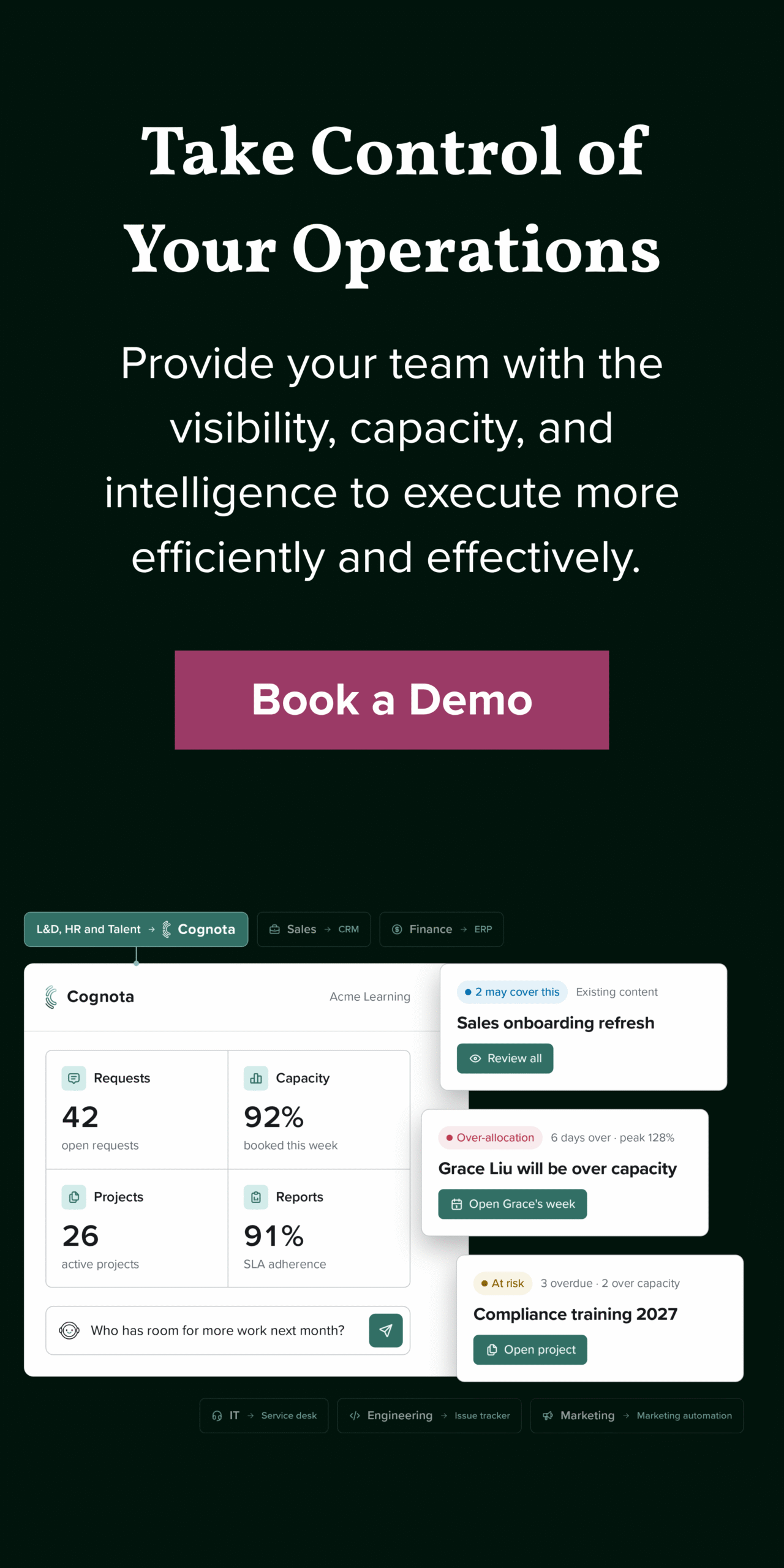
For learning leaders facing similar pressure, the question is not simply which vendors to keep. It is how to consolidate with enough intelligence to protect execution. See Cognota in action to understand how a dedicated LearnOps® operating layer can bring demand, capacity, workflow, and measurement into one accountable view.
The US Banking Vendor Consolidation Example
Consider a hypothetical US bank with 18,000 employees and a centralized learning team supporting retail banking, commercial lines, risk, operations, and corporate functions. Over several years, business units had built their own relationships with external learning vendors. Some engagements were centrally managed, others were funded locally, and several were renewed out of habit because no one had a complete picture of the work underway.
A finance-led review found more than 40 active learning and talent vendors. That number sounded excessive. But it did not explain which partners were strategic, which were duplicative, which filled essential specialist gaps, or what internal capacity would be needed if contracts ended.
The learning team faced a familiar challenge: demand was increasing while headcount was fixed. Compliance requirements had firm deadlines. Business leaders expected faster support for new products and manager capability. Reducing vendors without understanding the work behind each engagement could shift cost and risk onto an already stretched internal team.
The team therefore reframed consolidation as an operating decision, not a vendor count exercise.
Start With Demand, Not Contracts
The first step was to inventory active work, not just active suppliers. Every vendor engagement was connected to a learning request, business sponsor, expected outcome, internal owner, projected effort, cost, and deadline. That distinction mattered because two vendors with similar labels could be supporting very different needs.
One provider, for example, supplied broad leadership content that overlapped with another relationship. A second vendor offered highly specialized expertise for a risk-related initiative with a fixed regulatory deadline. A third was used intermittently to absorb production work during peak periods. Combining all three into a single category called “learning services” would have led to poor decisions.
This is where many consolidation programs stall. Procurement can identify duplicate invoices. Finance can identify spend trends. But learning leaders need to see the full chain from business demand to work effort to delivery capacity to measured results.
Within the LearnOps® Framework, this is the discipline of Align before Plan. A learning team needs a credible view of which requests serve strategic priorities, which work is mandatory, and which activities can be deferred, redesigned, or stopped. Vendor rationalization becomes more defensible when it starts with business value rather than a blanket reduction target.
Separate Strategic Partners From Flexible Capacity
The bank classified vendor relationships into three operating roles: strategic capability partners, specialized experts, and flexible capacity. The categories were simple, but they changed the conversation.
Strategic capability partners supported recurring, enterprise-wide priorities where consistency and institutional knowledge mattered. Specialized experts were retained for high-consequence or niche requirements that the internal team could not reasonably maintain year-round. Flexible capacity partners addressed variable demand, such as rapid development cycles or periods when several high-priority initiatives collided.
Not every relationship survived the review. Several vendors provided substantially similar services, often because different business units had sourced them independently. Those engagements were consolidated. Yet the team deliberately preserved access to specialized expertise and surge capacity.
That choice was not a failure to consolidate. It was a recognition that a lean operating model does not mean an inflexible one. A bank with predictable work may be able to bring more activity inside. A bank managing frequent regulatory, operational, or organizational change may need a smaller but more deliberate external network to avoid overloading internal teams.
Make Capacity Visible Before Removing It
The most consequential finding was not the number of vendors. It was the gap between planned work and available capacity.
The learning team had previously tracked project status in separate systems and spreadsheets. Individual leaders knew their teams were busy, but there was no shared, enterprise-level view of demand by skill type, initiative, or quarter. As a result, some work had been outsourced because of genuine capacity constraints, while other work had gone external because requests arrived without a consistent intake or prioritization process.
Once demand and effort were visible, leaders could make better choices. They stopped low-value requests earlier. They reassigned work based on available skills. They consolidated overlapping projects before selecting a vendor. And when external support was needed, the team could define the scope based on a real capacity gap instead of a vague sense of urgency.
This is a critical distinction for L&D leaders. Cutting vendors may reduce external spend, but it does not eliminate the work. If the work remains necessary, it moves somewhere: to internal staff, to delayed queues, or to business teams that may create inconsistent solutions outside established governance.
A mature learning operation plans for that transfer. It estimates the effort, confirms who owns the work, and tests whether internal capacity can absorb it without compromising higher-priority commitments.
Build Governance That Does Not Slow the Business
Consolidation can create another problem when every request must pass through a cumbersome approval process. The bank avoided that outcome by establishing clear decision rights.
Business sponsors retained accountability for the outcomes they needed. The learning team owned intake, prioritization, work planning, and delivery governance. Procurement managed commercial controls. Together, they agreed on thresholds for when external engagement required additional review and when approved partners could be activated quickly for known needs.
The value was not more process. It was fewer ambiguous handoffs. Teams no longer had to search for an appropriate vendor after a deadline had already been set. They could assess the request, determine whether internal capacity was available, and engage the right type of support with a documented business rationale.
For banks, governance also strengthens auditability. Leaders can show why a vendor was selected, what work was performed, which business objective it supported, and how costs were managed. That level of visibility is especially valuable when learning investments are scrutinized alongside broader efficiency programs.
Measure What Changed, Not Just What Was Saved
A vendor consolidation initiative should track savings, but savings alone are an incomplete measure of success. The bank monitored vendor count and external spend alongside operational measures: request cycle time, on-time delivery, workload distribution, rework, stakeholder satisfaction, and progress against initiative-level outcomes.
That broader scorecard exposed trade-offs early. In one area, reducing vendors simplified administration with no decline in delivery performance. In another, removing a specialist relationship increased review cycles and put a critical program at risk. The team adjusted before the issue became a business disruption.
This is the difference between a Managed learning operation and a Strategic one in the LearnOps® Maturity Model. Managed teams control work and establish consistency. Strategic teams connect operational decisions to business priorities and use evidence to improve resource allocation. The next levels, Predictive and Adaptive, require even stronger data discipline: the ability to anticipate demand and respond before capacity becomes a constraint.
What L&D Leaders Can Take From This Example
The strongest lesson from this US banking vendor consolidation example is that external vendors are not the core problem. Fragmented decision-making is. When demand, projects, resources, budgets, and outcomes sit in separate places, consolidation becomes a blunt instrument.
Learning leaders can change that by asking a more useful set of questions before ending or combining vendor relationships. What business demand does this partner support? Is the work recurring, specialized, or variable? What internal capability and capacity would replace it? What is the consequence if delivery slows? How will we know whether the new model improved execution?
Those questions move the conversation beyond “do more with less.” They establish the conditions to do the right work with the capacity available, while protecting the business from avoidable delivery risk.
Vendor consolidation will remain a recurring enterprise priority, particularly in financial services. The learning teams that fare best will not defend every existing relationship. They will bring the operational intelligence to distinguish duplication from necessary capacity, and cost reduction from true performance improvement.