Ask almost any Learning & Development leader what their primary operational goal is today, and you’ll hear a variation of the same phrase: speed to impact. We want to capture institutional knowledge faster, transform it into engaging learning experiences, and get it out to frontline teams before the business context shifts again.
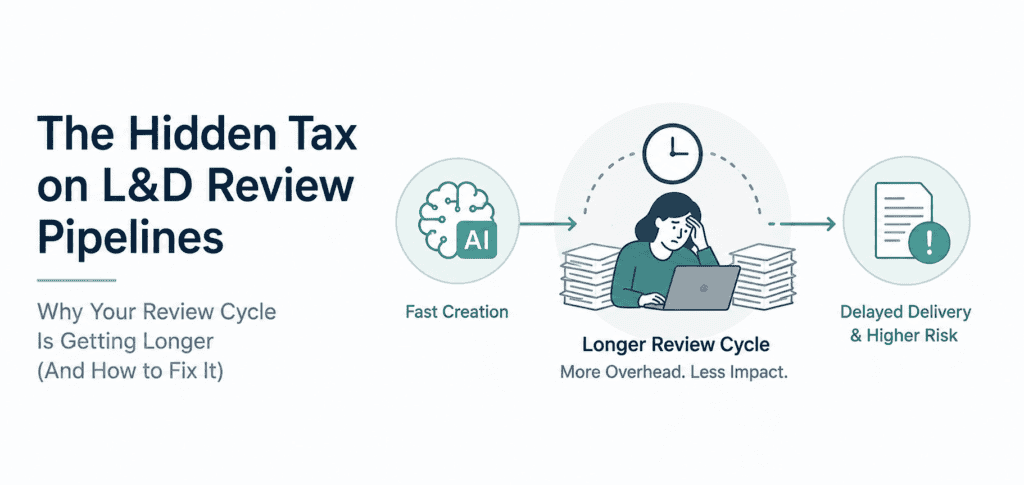
AI was supposed to be the ultimate accelerator for this pipeline. In theory, Subject Matter Experts (SMEs) can now draft content in minutes, instructional designers can generate course structures in seconds, and review cycles should shrink to record lows.
Except, behind the scenes, many L&D teams are experiencing the exact opposite.
While creation time has plummeted, review overhead is quietly exploding.
Instead of accelerating delivery, L&D teams are drowning in a new kind of operational drag, driven by degraded input quality, vanishing source signals, and format unfamiliarity. If your review cycles feel stickier and more exhausting than they did two years ago, you aren’t imagining it. Here is why it’s happening and what operational L&D teams can do about it.
The “AI Slop” Shift: When Fast Creation Becomes Slow Review
One of the cleanest observations of this shift comes from an instructional design leader who noticed a puzzling trend in their workflow: despite SMEs submitting material faster than ever, review time had doubled.
Why? Because SMEs are using generative AI heavily to draft content and submitting what amounts to AI slop.
When an SME uses a generic LLM prompt to generate a standard operating procedure, compliance summary, or technical module, the output looks polished briefly. It uses clean grammar, structured headings, and authoritative language. But under the hood, it is often bloated, repetitive, full of passive voice, and devoid of the nuanced, real-world context that makes SME knowledge valuable in the first place.
Instead of reviewing a concise draft written by a human who understands the operational realities of the job, reviewers are now forced to act as line editors for a machine. They must weed out hallucinated details, strip away corporate fluff, and push back to ask, “Is this actually how we do things here?”
The Operational Reality: The draft creation time was saved by the SME, but that time was simply transferred onto the reviewer, with interest.

The Loss of Provenance Signals
To make matters worse, verifying content has become significantly harder.
Senior content strategists highlight a critical shift in how material is reviewed: the death of provenance signals.
When SMEs manually drafted content, reviewers could easily pick up on source material. You could recognize a verbatim quote from a legacy policy PDF, spot an unformatted excerpt from a technical document, or identify an SME’s personal shorthand. These “provenance signals” gave reviewers an immediate anchor; they knew where the knowledge came from and could verify its accuracy quickly against existing single sources of truth.
Generative AI acts as a blender for source material. It smooths out stylistic markers, paraphrases external inputs, and synthesizes text into a uniform voice.
When reviewing AI-assisted SME submissions today, L&D teams often cannot tell what source the content was curated from. Did the AI pull this from an outdated internal wiki? A public blog post? A competitor’s documentation? Or did it make it up out of whole cloth?
Without clear origin markers, reviewers can no longer audit content by spot-checking known sources. Every claim, policy reference, and procedure requires manual, root-cause verification. The confidence gap widens, and the review process grinds to a halt.
The “Novelty Tax” on Review
Beyond content quality and source tracking, there is a third, often overlooked friction point in the modern L&D pipeline: format novelty.
An L&D manager leading experimental learning initiatives noticed that interactive projects (courses built using micro-simulations, non-linear scenarios, or unconventional media formats) consistently spent twice as long in stakeholder review as traditional slide-based courses.
Crucially, this delay had nothing to do with content risk or compliance errors.
It was a pure “novelty tax.” When SMEs and business stakeholders are asked to review content delivered in an unfamiliar format, they lack the mental models needed to evaluate it efficiently. They end up asking fundamental questions about navigation, UI, and structure rather than assessing accuracy and learning outcomes.
When you pair novel content formats with AI-generated text, you create a perfect storm of review friction:
- The SME is struggling to evaluate an unfamiliar format.
- The instructional designer is trying to verify unanchored AI content.
- The stakeholder delays sign-off because the entire artifact feels ungrounded.
How LearnOps Teams Can Reclaim Control of the Review Pipeline
If review overhead is going up because input quality is going down, solving the problem requires operational rigor at the intake stage, not just faster reading at the review stage.
Here is how modern L&D teams operating under a LearnOps methodology can eliminate these hidden bottlenecks:
A. Establish Clear SME Intake Guardrails (Kill the Slop at the Source)
Don’t let SMEs submit unrefined AI output. Define strict intake standards for raw content submissions:
- Require Grounding Sources: Require SMEs to submit the foundational documents (wikis, policy PDFs, recorded transcripts) alongside any AI-drafted text.
- Define AI Usage Standards: Set explicit guidelines for how SMEs should use AI, such as using LLMs to structure their thoughts or outline processes, rather than generating final prose.
B. Standardize Provenance Tracking
Make content origin visible within your project management and content development workflows:
- Embed metadata tags or mandatory source fields during the project initiation stage.
- Ensure every critical claim or compliance step in a draft links directly back to a verified internal source of truth.
C. Separate Format Education from Content Review
To avoid paying this “novelty tax,” don’t introduce new formats and critical content reviews at the same time:
- Pre-board reviewers on new formats: Give stakeholders a standard, 2-minute walkthrough of how interactive or non-traditional formats work using neutral, dummy content before sending them the actual deliverable.
- Scope the review explicitly: Give SMEs specific rubrics for what they are evaluating (e.g., “Verify steps 1 through 5 for technical accuracy; do not review visual styling or interaction logic”).

Final Thoughts: Creation is Cheap, Trust is Expensive
Generative tools have made content creation nearly free. But high-speed creation built on low-quality inputs and missing source signals doesn’t create business impact; it creates operational risk and reviewer fatigue.
Our job isn’t just to produce content faster; it’s to maintain high trust and tight alignment across the business. By recognizing the hidden taxes of AI slop, lost provenance, and format novelty, we can redesign our LearnOps workflows to protect our reviewers, preserve content integrity, and deliver real value at scale.