Learning teams don’t usually lack effort. They lack a system. That’s the thread running through a recent episode of the Capital H Podcast, where our Founder & CEO Ryan Austin joined Benoit Hardy-Vallée, Director of Deloitte Canada’s Human Capital Practice, for a conversation about how Learning Operations — LearnOps® — became a category, and why it matters more now than when it started.
Where LearnOps® came from
Ryan didn’t start out trying to build a LearnOps® company. He spent years in instructional design and knowledge transfer, eventually building a tool for capturing expertise before people left an organization. It worked, but as he put it on the podcast, it was a tool, not a business.
The real insight came later, in a conversation with an investor about what learning could borrow from DevOps and RevOps — disciplines built around treating a process as a system, not a series of disconnected tasks. Looking at how enterprise learning teams actually operated, the gap was obvious: spreadsheets, email threads, generic project management tools, and almost no shared data layer connecting any of it. That gap became LearnOps®.
Benoit’s read on the same period lines up. For years, he says, the operational side of learning was “a blind spot” — not because nobody cared, but because it was never systematized the way other business functions had been. Organizations redesigned their learning strategy without ever building the end-to-end process to run it, manage it, or govern it.

The messy middle, and why it breaks under pressure
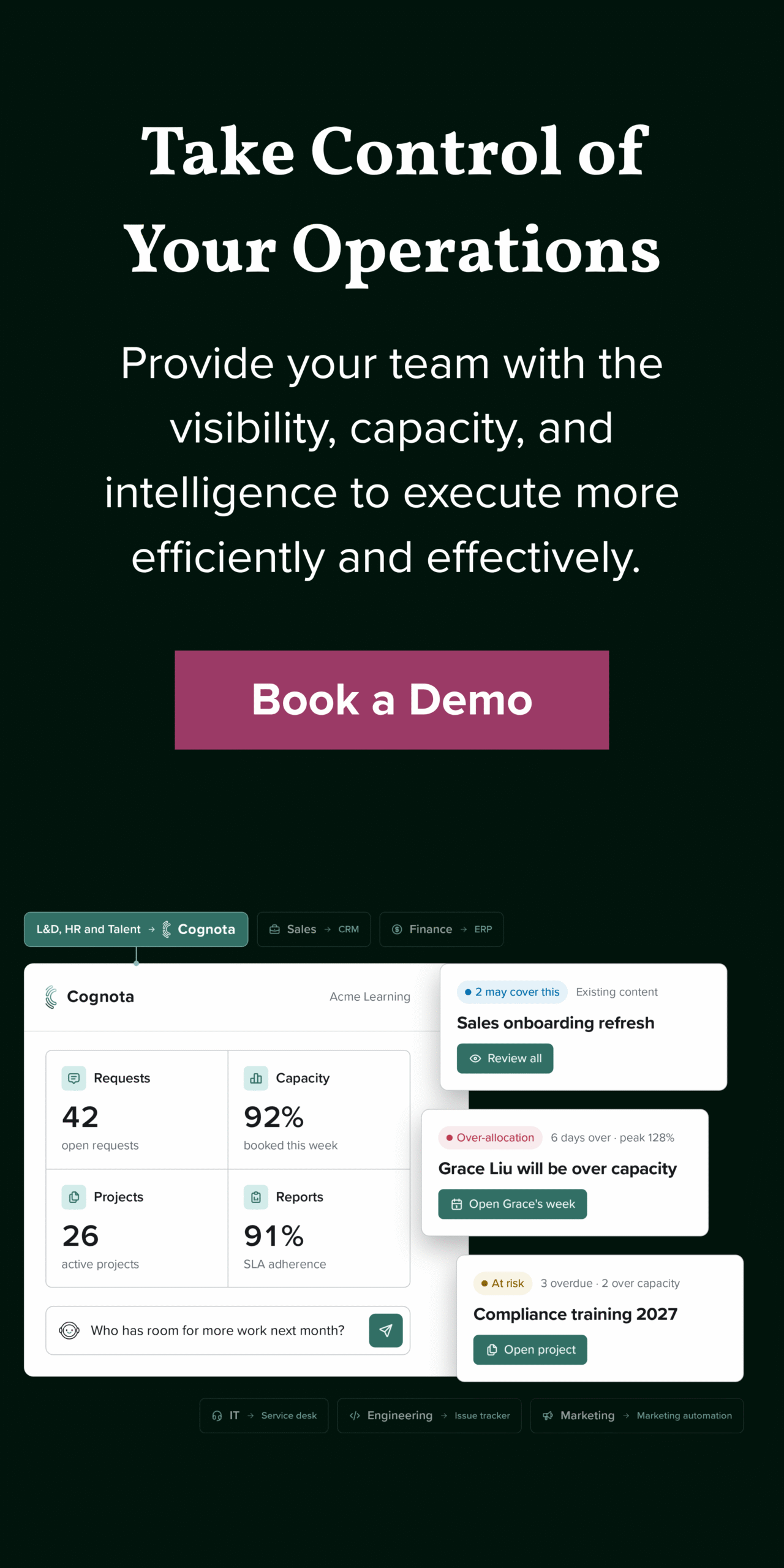
Ryan’s phrase for this gap is “the messy middle” — the space between the HR information system and the learning management system, where the actual work of planning, resourcing, and delivering learning happens. On average, he notes, even the largest enterprises are stitching that layer together with three to eight disparate tools.
His analogy for what that costs: running L&D without a structured data layer is like flying a plane that’s missing parts. You can still get it in the air. But every process downstream — measurement, prioritization, governance — is compensating for something that should have been there from the start.
That compensation shows up in familiar ways. A team fields a wave of requests from business partners and stands up a form to manage intake. It solves today’s problem, but it creates a new silo and quietly forfeits the chance to capture data that later stages — especially measurement — will need. Ryan’s point isn’t that any one of these tools is wrong; it’s that treating each problem in isolation is how the system falls apart.
AI raises the stakes on governance, not just capability
Both Ryan and Benoit push back on the assumption that AI’s biggest impact on learning is content creation. Benoit points out that generative AI made content creation cheap almost immediately — which means content was never where the durable value was going to sit. The harder, more valuable work is aligning what gets built to the capabilities an organization actually needs, and tracking whether it moved the needle once it’s delivered.
Ryan takes that a step further: because AI makes it so easy for anyone to “solution” a learning problem, the risk isn’t too little activity — it’s activity aimed at the wrong things, without the governance to catch it. A structured LearnOps® layer is what lets a team tell the difference between doing more and doing what matters.

What a concrete next step looks like
Asked what organizations should actually do in the next six months, both guests pointed to the same starting point: clarity before tooling.
Ryan’s version: get a real read on the current state versus the target state, decide on a governance model — centralized, federated, or decentralized — and build a data strategy backward from the outcomes and stakeholders that matter most.
Benoit’s version: settle the mandate. What does central L&D own, and what belongs with the business? Once that’s clear, the operational work of streamlining isn’t just cost-cutting — it’s in service of a specific capability the organization has decided matters. That’s what gives the work direction instead of just efficiency.
Listen to the full conversation
There’s a lot more in the episode — including how Ryan and Benoit think about organizational readiness for agentic AI, and where the LearnOps® category is headed next as more platforms open up their data.