A spreadsheet rarely becomes a problem all at once. It starts as a practical way to track requests, projects, budgets, and team assignments. Then the learning portfolio grows, priorities shift, stakeholders ask for status, and the same information appears in five different files. The real question in spreadsheets versus learning operations is not whether spreadsheets are useful. It is whether they can support the level of coordination, accountability, and insight enterprise L&D teams are now expected to deliver.
For a small team managing a predictable workload, a spreadsheet can be an efficient starting point. But as learning demand expands across business units, the operating model changes. Leaders need to see what work is entering the pipeline, which initiatives support strategic priorities, where capacity is constrained, what investments are being made, and what outcomes are emerging. A collection of manually maintained files cannot reliably answer those questions at the speed of the business.
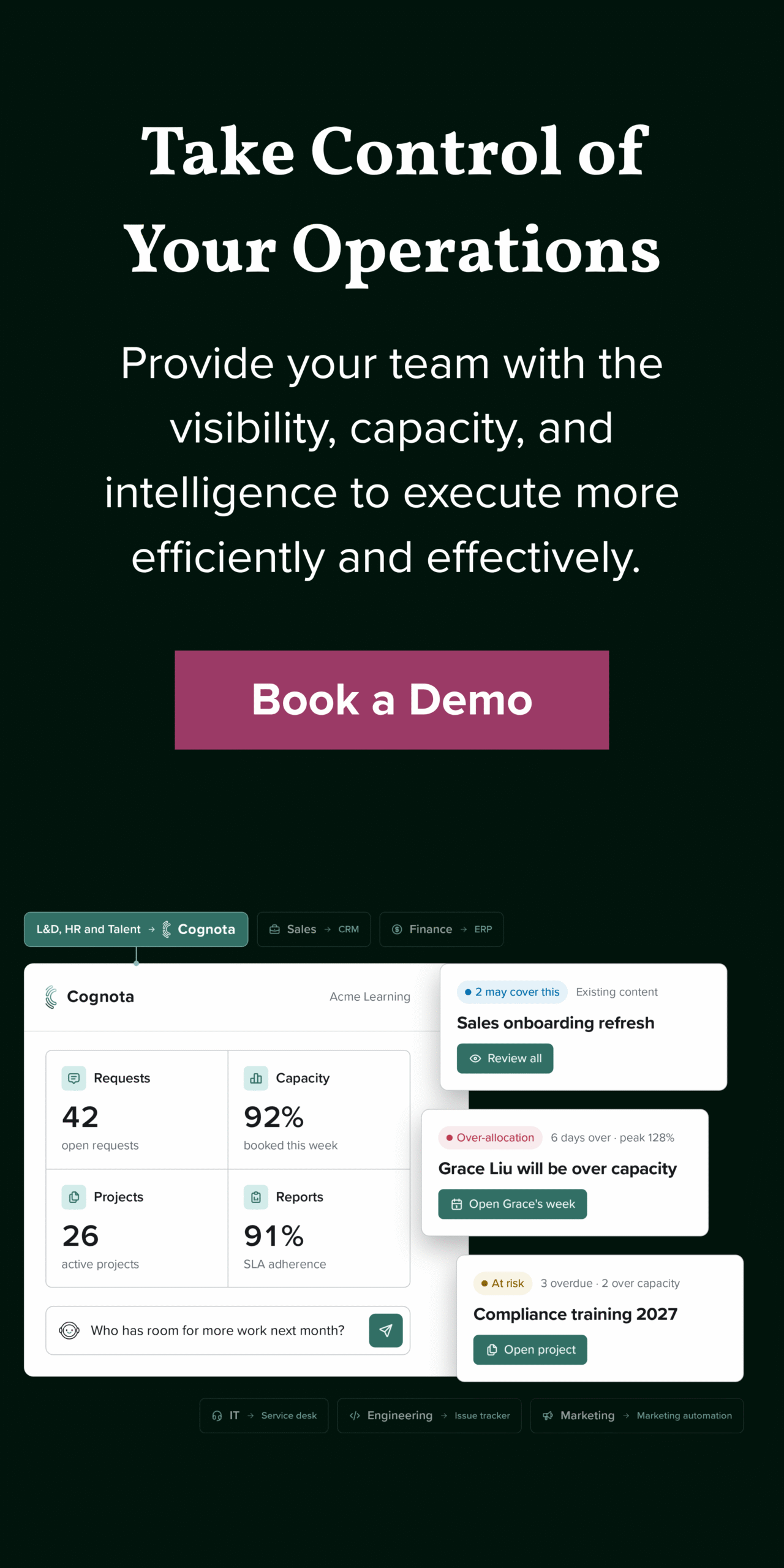
That gap has consequences. Teams spend time reconciling data instead of making decisions, project owners work from different assumptions, and leaders receive retrospective updates when they need forward-looking choices. If your team is reaching that point, see Cognota in action to understand what an operational layer for learning can look like.
Why spreadsheets break under operational pressure
The issue is not that spreadsheets lack features. The issue is that they were not designed to govern an interconnected operating system. Learning operations involves intake, prioritization, scoping, resource allocation, project execution, financial planning, stakeholder communication, measurement, and continuous improvement. Each discipline affects the others.
In a spreadsheet-driven environment, those connections depend on people remembering to update the right tab, send the latest version, and interpret fields consistently. That approach can work when work is limited and stable. It becomes fragile when dozens of initiatives, contributors, vendors, subject matter experts, and business sponsors are involved.
Version control is the visible problem. The deeper problem is decision control. When no shared operational record exists, teams struggle to establish a trusted answer to basic questions: What has been approved? Who owns the next step? Is the team overcommitted next quarter? Which work should be paused if priorities change? How much of the budget is committed versus planned?
These are not administrative details. They determine whether L&D can operate as a strategic business function or remains trapped in reactive execution.
Manual tracking hides the cost of context switching
A spreadsheet can show assigned names, but it rarely captures the full resource picture. People contribute to multiple projects, support urgent requests, attend governance meetings, review content, and manage work that never makes it into a project plan. Leaders may see apparent availability while the team experiences persistent overload.
That disconnect makes capacity planning difficult. A team may accept more work because individual rows look open, only to find that deadlines collide and quality suffers. Alternatively, leaders may outsource prematurely because they cannot see where internal capacity could be reallocated.
Operational maturity requires more than a list of assignments. It requires a clear view of demand, available skills, planned effort, competing priorities, and the trade-offs behind resourcing decisions.
Status updates become a second job
When work lives in separate spreadsheets, presentations, email threads, and meeting notes, status reporting becomes a manual production process. Project leads spend valuable time collecting updates, normalizing information, and explaining discrepancies. By the time an executive view is ready, it may already be outdated.
This is especially difficult for enterprise teams supporting transformation programs. Stakeholders do not simply want to know whether a learning asset is complete. They want confidence that critical initiatives are progressing, risks are visible, investments are governed, and learning work is connected to business outcomes.
Research and commentary from industry voices such as Josh Bersin, RedThread Research, and Fosway Group consistently point to a broader shift: HR and learning functions are under pressure to become more data-informed, agile, and business-aligned. That expectation cannot be met through a reporting process that depends on chasing updates at the end of each month.
Spreadsheets versus learning operations: the real distinction
The choice is not between a familiar file and a new piece of software. It is between tracking work and operating work.
Tracking answers, “What happened?” Operating answers, “What should we do next, who is accountable, and what is the likely impact?” Spreadsheets are often strong at documenting a point in time. Learning operations requires a connected system for managing decisions over time.
A LearnOps® approach organizes that system across five disciplines: Align, Plan, Execute, Measure, and Optimize. The framework matters because it recognizes that operational problems rarely live in one place. Poor intake affects prioritization. Weak planning creates resource conflicts. Inconsistent execution data limits measurement. Without measurement, optimization becomes guesswork.
A centralized operating model connects these disciplines rather than treating them as separate files and meetings. It creates a structured path from a business request to a governed decision, an executable plan, and a measurable outcome.
Align learning demand to business priorities
Not every request deserves the same response. Yet many teams receive work through informal channels: a message from an executive, a meeting request, or a last-minute email. The loudest request can become the most urgent simply because there is no consistent intake and prioritization process.
Learning operations creates a way to assess demand against agreed criteria. That may include strategic alignment, audience impact, urgency, risk, expected effort, and dependencies. The goal is not to slow work down with bureaucracy. It is to make choices visible and defensible.
When leaders can see the full demand portfolio, they can decide what to accelerate, defer, combine, or decline. That is a substantial shift from reacting to individual requests in isolation.
Plan capacity and investment before commitments become problems
Planning is where spreadsheets often appear most capable. Teams can build budget trackers, resource grids, and project timelines. But these artifacts typically represent separate snapshots, maintained by different owners and updated at different intervals.
A learning operations model brings those planning dimensions together. It gives leaders a clearer view of what has been requested, approved, staffed, and funded. More importantly, it makes trade-offs explicit before the team commits to work it cannot sustainably deliver.
There is still a place for spreadsheets in analysis, ad hoc modeling, and one-time data exploration. The distinction is that the spreadsheet should support a decision, not become the system of record for the entire learning function.
Execute with accountability, not follow-up fatigue
Execution depends on clear workflows, ownership, approvals, and visibility into blockers. In a spreadsheet environment, process often lives in the heads of experienced team members. When someone changes roles or takes time away, work can stall because the handoffs were never operationalized.
A defined operational workflow reduces that dependency. It clarifies who needs to act, what information is required, and where a request or project stands. That consistency is valuable for internal teams and for external contributors who need to engage at the right time without adding coordination overhead.
For organizations facing fluctuating demand, execution also requires flexible capacity. The right operating model helps leaders distinguish between a temporary peak, a persistent skills gap, and a planning issue. Those situations require different responses.
The maturity question leaders should ask
The LearnOps® Maturity Model provides a more useful diagnostic than asking whether a team uses spreadsheets. A team can use spreadsheets and still demonstrate disciplined practices in some areas. Another team can have multiple systems and remain highly reactive.
The better question is: how consistently can the function align work to strategy, plan resources, execute with governance, measure results, and optimize performance? Teams typically progress from Reactive to Managed, Strategic, Predictive, and Adaptive ways of operating. The movement is not about adding process for its own sake. It is about building the capacity, execution, and intelligence required to make better decisions.
A Reactive team may rely heavily on individual effort and manual coordination. A Managed team begins to establish repeatable processes. A Strategic team connects the learning portfolio to business priorities. Predictive and Adaptive teams use operational data to anticipate demand, improve allocation, and continuously refine how work gets done.
Spreadsheets can support parts of this progression, particularly early on. They become a constraint when the team needs consistent governance across a complex portfolio and cannot afford to depend on manual reconciliation.
When it is time to move beyond spreadsheets
The signal is rarely a single failure. It is a pattern: requests arrive without enough context, leaders cannot see the full portfolio, budget conversations take too long, resource conflicts surface late, and reporting requires a recurring fire drill. If those conditions are familiar, the problem is operational infrastructure, not team commitment.
The most effective next step is to map the work as it actually happens. Follow a request from intake through approval, planning, execution, and measurement. Identify where data is re-entered, where decisions become unclear, and where teams rely on personal follow-up to keep work moving. Those friction points reveal the operational gaps worth solving.
Learning teams do not need to abandon every spreadsheet. They need to stop asking spreadsheets to carry the weight of enterprise learning operations. When the operating model matches the complexity of the work, L&D leaders can spend less time reconciling activity and more time directing capacity toward the outcomes the business needs next.