The LMS versus LearnOps platform question usually appears after a learning team has already done the hard part: built a credible learning portfolio, earned stakeholder trust, and taken on more work than its operating model can support. The issue is not whether learning should be delivered. It is whether the team can consistently decide what work matters, staff it intelligently, move it through the right approvals, and prove the value it creates.
For enterprise L&D and talent leaders, that distinction is operationally significant. An LMS is the delivery layer in the learning ecosystem. A LearnOps platform is the operations layer that helps the team behind learning manage demand, resources, workflows, investments, and outcomes. One does not replace the other. They address different parts of the work.
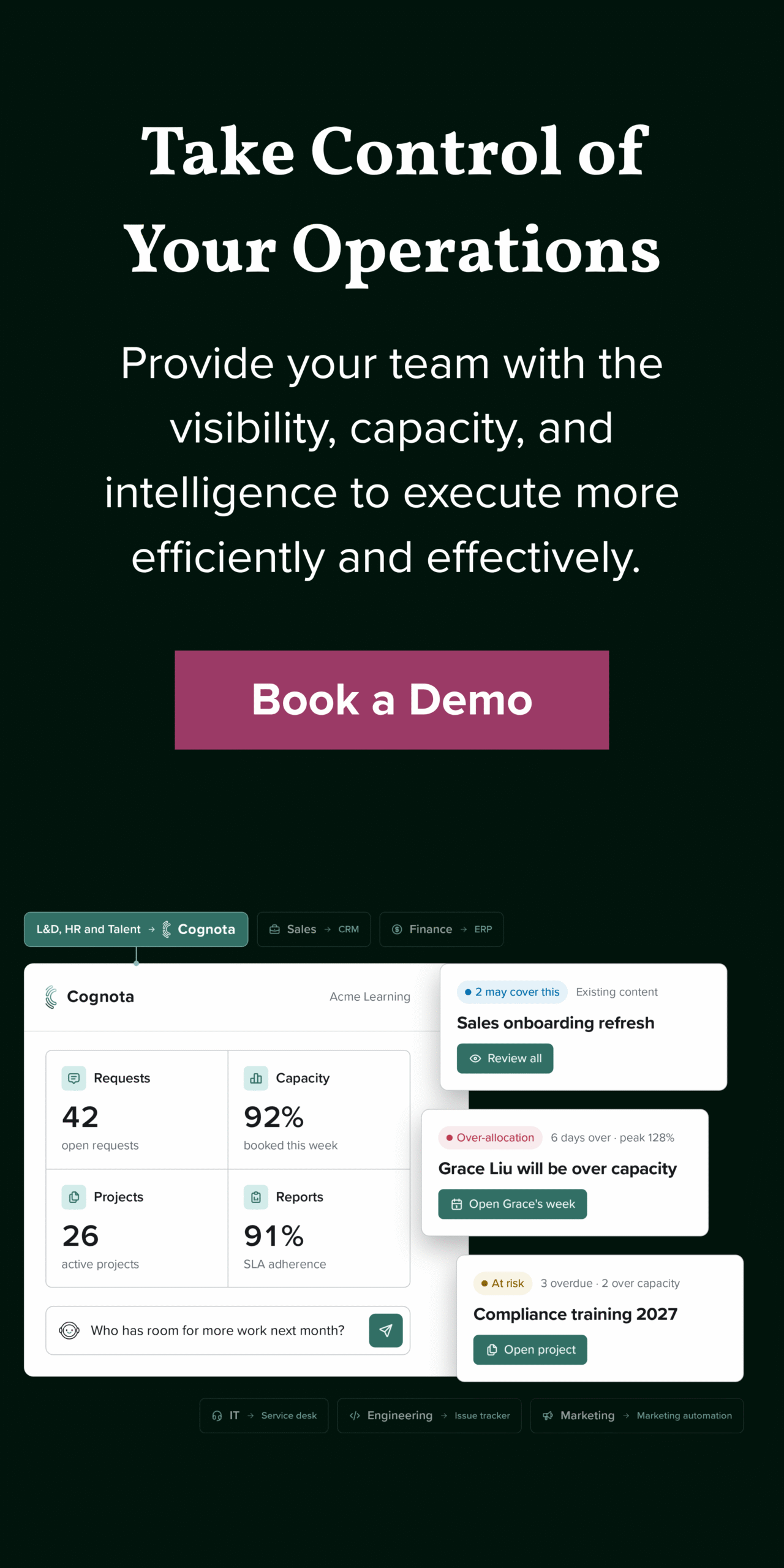
When requests arrive through inboxes, project plans live in disconnected files, and capacity is judged by instinct, even strong learning teams become reactive. To see what an operational layer can look like in practice, see Cognota in action and explore how LearnOps supports more disciplined execution.
LMS versus LearnOps platform: the core difference
An LMS supports the point at which learning reaches employees. That is a necessary part of an enterprise learning ecosystem, but it is not the whole operating model. The work begins well before a learning experience is ready for delivery and continues long after it has launched.
A LearnOps platform helps teams run that work as a connected business function. It creates a system for evaluating incoming demand, connecting initiatives to business priorities, organizing the work required to deliver them, and understanding where time and budget are going. It gives leaders a clearer view of the decisions that determine whether learning can create business impact.
This is why the common objection, “We already have an LMS,” misses the point. Most enterprise teams do. Yet many still struggle with intake queues, unclear ownership, uneven stakeholder expectations, hidden workloads, and reporting that shows activity without answering whether the right work received investment. The presence of a delivery layer does not eliminate the need for an operations layer.
The difference becomes clearest when a senior leader asks questions such as: Which requests should we decline or defer? What capacity will this initiative consume? Which strategic goal does it support? Where is work stalled? Are external resources needed? What changed after the initiative was delivered? Those are not delivery questions. They are operating questions.
Delivery is an event. Operations is a discipline.
Learning delivery has a visible finish line. A program is released, a campaign launches, or an audience is reached. Learning operations is the discipline that makes those outcomes repeatable. It brings governance to decisions that are otherwise made in scattered meetings, informal messages, and last-minute escalations.
That discipline matters most in organizations with competing priorities and limited specialist capacity. Financial services, healthcare, life sciences, and energy organizations often face fast-moving business needs alongside high expectations for consistency, risk management, and measurable performance. L&D cannot meet those expectations with heroic effort alone. It needs an operating system built for the volume and complexity of enterprise work.
Where the operational gap shows up
The gap is rarely announced as a technology problem. It appears as friction. A business partner asks for a program by a fixed date before the need has been defined. A team takes on another priority initiative without knowing what work will slip. Leaders cannot explain how investment decisions were made. Subject matter experts are overloaded, while outside support is engaged too late to protect critical timelines.
These are signs that learning work is being managed project by project rather than as a portfolio. The result is not simply inefficiency. It is reduced confidence in L&D’s ability to act as a strategic partner.
The LearnOps® Framework provides a practical way to diagnose this issue. High-performing learning organizations Align work to business priorities, Plan capacity and investment, Execute through governed workflows, Measure results, and Optimize based on evidence. These five disciplines are connected. Weakness in one creates drag across the rest.
Consider intake. Without a shared process to capture demand and evaluate it against priorities, teams often begin with a solution rather than a business problem. Planning then becomes guesswork because the actual scope, skills, budget, and dependencies are unclear. Execution slows as ownership and approvals shift. Measurement becomes an afterthought because success criteria were never agreed upon. The cycle repeats, and the backlog grows.
A LearnOps platform brings those decisions into view. It does not make difficult trade-offs disappear. It makes them explicit, traceable, and easier to manage at the portfolio level. That is a meaningful shift for leaders who need to protect their teams from unplanned work while remaining responsive to the business.
Capacity, execution, and intelligence are the real test
When evaluating an LMS versus a LearnOps platform, enterprise leaders should avoid treating the decision as a feature comparison. The better question is whether the current learning technology ecosystem gives the function enough capacity, execution discipline, and intelligence to meet its mandate.
Capacity is not just headcount. It is a clear understanding of available skills, workloads, planned work, and the cost of accepting another request. Teams that lack this visibility tend to overcommit, then rely on late nights or emergency external support to recover. Teams with a clear capacity model can have a more productive conversation: here is what we can deliver, what it will require, and what must change if priorities shift.
Execution is the ability to move work from request to outcome with consistent governance. It requires shared workflows, visible ownership, and a reliable source of truth for status and decisions. This reduces the time spent chasing updates and makes it easier for stakeholders to understand what is happening without creating another meeting.
Intelligence is the ability to turn operational and outcome data into better decisions. Learning leaders are under growing pressure to demonstrate business value, but value cannot be established solely at the end of a program. It must be designed into the work from the start, with alignment to business objectives and measures that reflect the intended change.
These dimensions reinforce each other. Better capacity visibility improves execution because teams can staff and sequence work realistically. Stronger execution produces cleaner data. Better intelligence helps leaders allocate future capacity to the initiatives most likely to matter.
Use maturity to decide what comes next
Not every organization needs the same operational change at the same moment. The LearnOps® Maturity Model is useful because it frames progress as a practical progression rather than a binary choice. Teams move from Reactive work, where demand drives the agenda, toward Managed and Strategic operations, then into Predictive and Adaptive ways of working where data and continuous optimization shape decisions.
A reactive team may need to standardize intake and establish a single view of demand. A managed team may need stronger resource planning and project governance. A strategic team may focus on connecting its portfolio to enterprise priorities and measuring impact more consistently. The right next step depends on the team’s current operating reality, not on an abstract definition of maturity.
This diagnostic approach also prevents a common mistake: buying more technology to compensate for unclear processes. Technology should reinforce a deliberate operating model. If leaders cannot articulate how requests are prioritized, how capacity is allocated, or how success is measured, the first task is to establish that discipline. A LearnOps platform can then make it scalable and visible across the function.
What enterprise leaders should ask
Start with the work your team manages before and after delivery. Can leaders see the full demand portfolio and its connection to business strategy? Can they forecast the impact of new requests on people, budgets, and deadlines? Can stakeholders follow progress without relying on manual status updates? Can the team identify bottlenecks early and decide where additional expertise is needed? Can it connect investment decisions to meaningful outcomes?
If the answer is no to several of these questions, the issue is unlikely to be solved by asking the team to work harder. It points to an operations gap.
The strongest learning organizations are not those that say yes to every request. They are the ones that can make purposeful choices, execute reliably, and show why those choices mattered. That is the opportunity behind LearnOps: giving L&D the operational foundation to become more strategic without losing the human judgment that great learning work requires.