A learning team can be busy every day and still be operating without control. Requests arrive through inboxes, priorities shift without clear trade-offs, and leaders ask for impact data after the work is complete. LearnOps maturity indicators make that gap visible. They show whether an L&D function is merely responding to demand or running a disciplined operation that can connect capacity, execution, and intelligence to business outcomes.
For enterprise learning leaders, maturity is not a badge. It is a practical way to identify the operating constraints that keep teams from doing their best work. A team may have talented instructional designers, respected facilitators, and a full slate of strategic programs, yet still struggle to explain where its time goes, what work should be deprioritized, or which initiatives changed performance.
The right indicators create a more useful conversation with business stakeholders. Instead of defending activity levels, learning leaders can show demand patterns, delivery trade-offs, resource needs, and the evidence behind investment decisions.
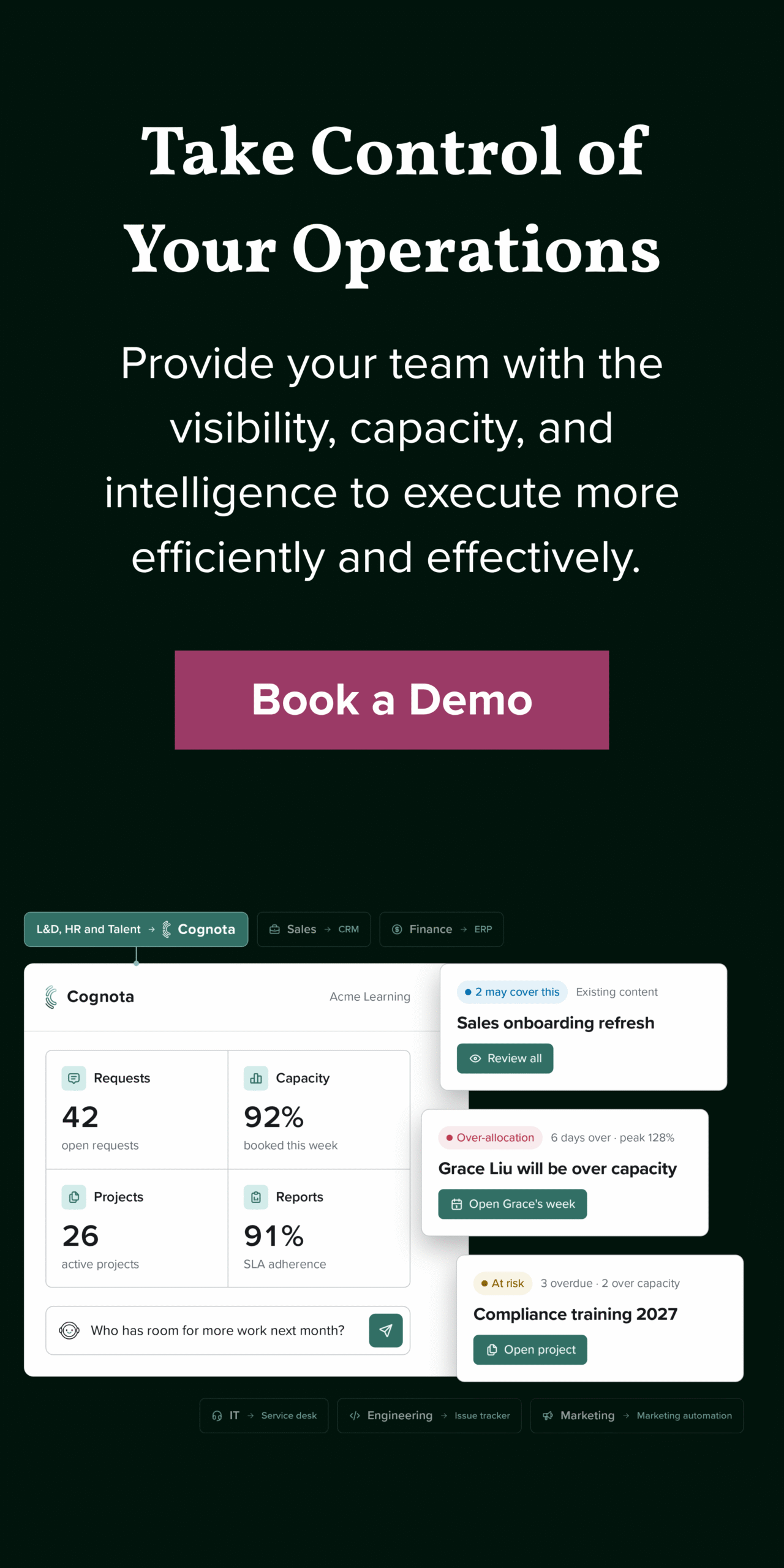
To see how Cognota brings those operational signals into one working environment, see the LearnOps platform in action.
What LearnOps maturity indicators actually measure
Cognota’s LearnOps® Maturity Model frames progress across five levels: Reactive, Managed, Strategic, Predictive, and Adaptive. It assesses learning operations through two connected dimensions: Strategy and Impact, plus Efficiency and Effectiveness. The distinction matters. A team can become highly efficient at processing requests and still lack a clear connection to enterprise priorities. Conversely, a team may have an ambitious strategy but no reliable way to plan, govern, or measure the work required to deliver it.
The most valuable indicators therefore do not focus on one metric in isolation. Completion rates, satisfaction scores, and course volume can offer useful context, but they rarely tell an executive whether learning is solving the right business problem. Mature teams combine operational data with strategic evidence: why work was approved, how resources were allocated, whether delivery met the intended need, and what changed afterward.
1. Demand enters through a defined intake process
Reactive teams often receive work through informal channels. A senior leader sends a message, a business unit raises an urgent request, or a recurring program continues because nobody has reassessed it. The result is a portfolio shaped by the loudest voice rather than the highest-value need.
A clear intake process is an early and powerful maturity indicator. It captures the business objective, target audience, urgency, expected outcome, sponsor, and effort required before work begins. It also makes demand visible across the function. Leaders can see what is coming, compare competing requests, and make deliberate decisions about what to accept, defer, redesign, or decline.
This does not mean every request needs excessive bureaucracy. High-volume, repeatable work may need a lighter path than an enterprise-wide capability initiative. Maturity means applying the right level of governance to the level of risk, investment, and strategic importance.
2. Prioritization is tied to business strategy
Managed learning teams can track requests. Strategic teams can explain why one request takes precedence over another. That difference is visible in the criteria used to prioritize work.
Look for a consistent connection between learning initiatives and defined business priorities, such as a transformation program, a revenue-critical capability, a compliance exposure, or a workforce transition. Each initiative should have a named business owner and a stated outcome that is meaningful outside the learning function.
If priorities change, the portfolio should change with them. That sounds obvious, but many teams continue delivering work that was approved months ago because there is no regular forum for revisiting decisions. A mature operating rhythm gives leaders a way to review the portfolio, surface dependencies, and reallocate effort before the team is overcommitted.
3. Capacity is planned, not inferred from burnout
Capacity is one of the clearest LearnOps maturity indicators because it exposes the hidden cost of fragmented operations. When leaders cannot see the effort attached to active and incoming work, they often discover capacity constraints only after deadlines slip or team members are overloaded.
More mature teams have a current view of available people, skills, planned effort, external support, and competing commitments. They can model what happens when a major initiative is added to the queue. They can also distinguish between a true capacity problem and a prioritization problem. Those are not the same issue, and they require different decisions.
Capacity planning should include more than project assignments. It needs to account for operational work, stakeholder meetings, maintenance, measurement, and the inevitable unplanned requests that arise in a large enterprise. Precision is valuable, but false precision is not. A practical estimate that leaders revisit regularly is more useful than a detailed plan nobody trusts.
4. Work moves through visible, repeatable workflows
Execution maturity appears in the handoffs. Are requirements, reviews, approvals, production tasks, and launch activities managed through a shared process? Or does the team rely on personal follow-ups and institutional memory to keep work moving?
Visible workflows reduce avoidable rework. They establish ownership, make blocked work easier to spot, and provide a record of decisions when stakeholders change or priorities shift. Over time, workflow data also reveals recurring friction. If review cycles repeatedly delay delivery, or if certain request types require extensive clarification, the team has evidence to improve the process rather than simply asking people to work faster.
Standardization should not erase judgment. Complex initiatives often need tailored workflows and broader stakeholder involvement. The goal is not uniformity for its own sake. It is consistent operational control where consistency improves speed, quality, and accountability.
5. Measurement begins before delivery
Teams at the Reactive level often measure what is easiest to collect after an initiative ends. Teams progressing toward Strategic maturity agree on success measures before execution starts. This is a critical shift because it changes the design conversation.
Before work is approved, learning leaders should be able to ask: What performance or business condition are we trying to influence? What baseline exists? What evidence would be credible to the sponsor? Who owns the data? Some outcomes can be observed quickly, while others require longer time horizons or must be interpreted alongside factors outside learning’s control.
That last point deserves candor. Learning is rarely the only variable affecting business performance. Mature measurement does not overclaim causation. It establishes a plausible contribution, uses appropriate evidence, and makes assumptions visible. This gives leaders a more credible foundation for investment decisions than a collection of activity metrics alone.
6. Insights change future decisions
Predictive and Adaptive teams do more than report on completed work. They use operational and outcome data to improve what happens next. They identify demand trends, recurring capability needs, bottlenecks, underused assets, and initiatives that consume disproportionate effort relative to their value.
An adaptive learning operation also builds feedback loops into the LearnOps® Framework: Align, Plan, Execute, Measure, and Optimize. These are not separate phases that end when a project closes. They are connected disciplines. Measurement informs optimization; optimization reshapes planning; planning clarifies what should align to strategy.
This is where intelligence becomes practical. Rather than asking only, “Did we deliver what was requested?” leaders can ask, “What should we stop, scale, redesign, or staff differently?” Those questions create room for a learning function to become more responsive without becoming more reactive.
How to use maturity indicators without turning them into a scorecard
A maturity model is most useful when it starts an honest diagnostic conversation. Few enterprise teams will sit cleanly at one level across every discipline. A function may have strong strategic alignment but inconsistent resource planning. Another may run disciplined workflows but struggle to measure impact because sponsors have not agreed on outcome data.
Start by identifying the constraints with the greatest operational consequence. If demand is invisible, improve intake and prioritization first. If the team is consistently overextended, make capacity and portfolio trade-offs visible. If executives question learning’s value, strengthen alignment and measurement at the point of approval. Trying to improve every indicator at once usually creates another initiative competing for scarce capacity.
The goal is not to look mature on paper. It is to build an operating model that gives learning leaders the clarity to make better decisions, the discipline to execute them, and the evidence to keep improving. When those conditions are in place, L&D can spend less time reacting to the next request and more time shaping the work that matters most.