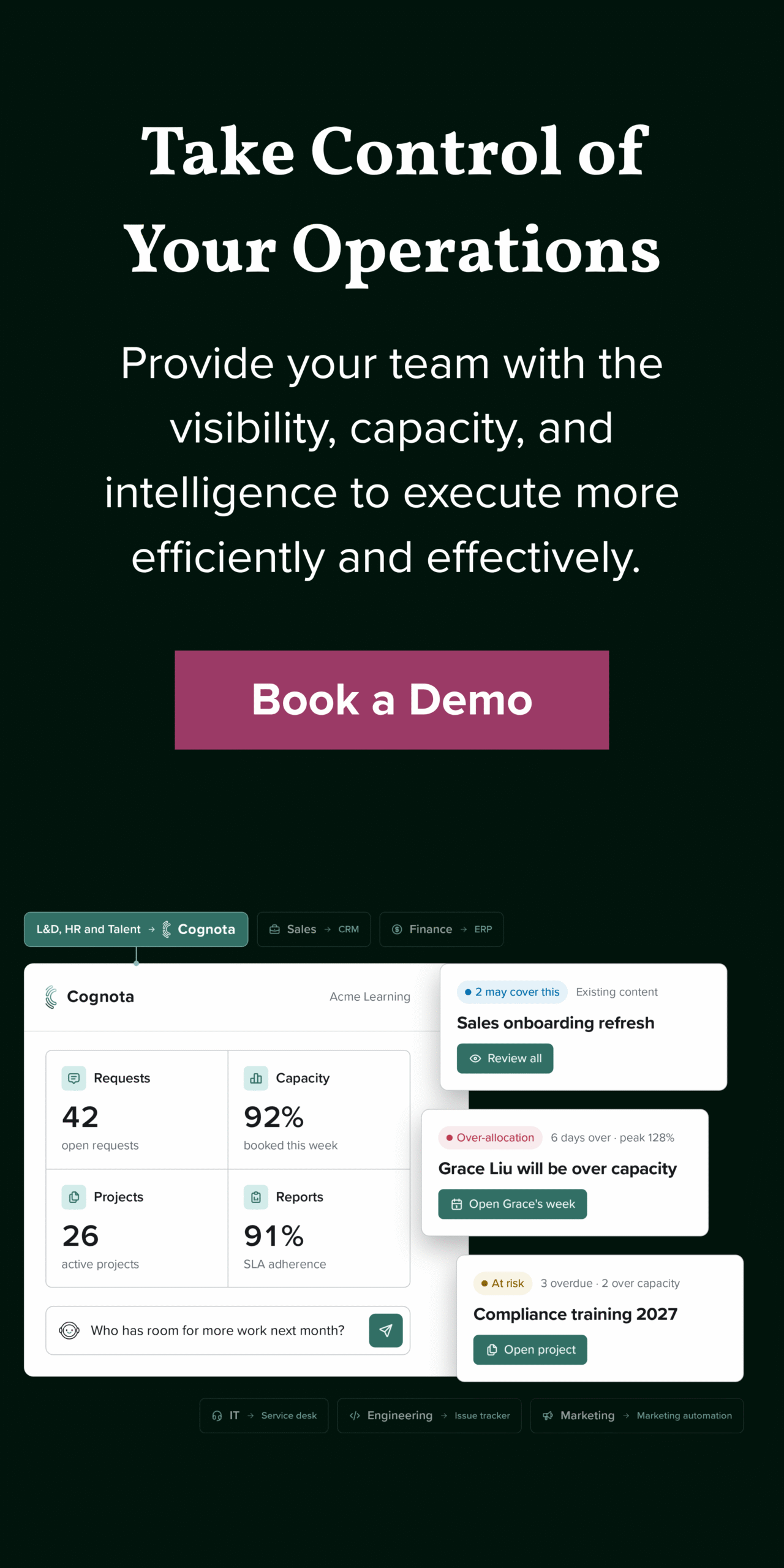
A learning workflow software comparison should not begin with a feature checklist. It should begin with the work your team is struggling to control: requests arriving through scattered channels, shifting priorities, unclear ownership, overloaded subject matter experts, and business leaders asking what learning delivered. For enterprise L&D teams, the question is not simply which platform has the most capabilities. It is which operational foundation helps the function execute with discipline.
That distinction matters when capacity is tight and expectations are rising. A learning team can have talented people, a strong content strategy, and a well-established delivery environment, yet still operate reactively if work enters without governance and resources are assigned without a shared plan. The right software should create visibility before the work begins, not merely document it after the fact.
If your team is evaluating how to move from reactive requests to measurable learning operations, see Cognota in action and assess what an operations layer can change across your learning function.
What a Learning Workflow Software Comparison Should Evaluate
Most evaluations focus too narrowly on task tracking. Task management is useful, but enterprise learning operations require more than a board of assigned activities. They require a system that connects demand, decisions, capacity, execution, and outcomes.
A meaningful learning workflow software comparison evaluates whether a platform supports the full operating rhythm of L&D. Can stakeholders submit requests in a structured way? Can leaders assess strategic fit before committing resources? Can the team see demand against available capacity? Can work move through clear stages with accountable owners? Can leadership connect completed initiatives to business measures?
Those questions align with the LearnOps® framework: Align, Plan, Execute, Measure, and Optimize. It is a practical way to distinguish software that helps teams organize work from software that helps them run learning as a business function.
Start with intake quality, not project volume
Unstructured intake creates downstream waste. When requests originate in email threads, meetings, spreadsheets, and informal messages, the team spends too much time clarifying scope, chasing approvals, and determining urgency. The resulting project backlog may look full, but it does not necessarily reflect business priorities.
Look for software that gives requesters a consistent path to articulate the audience, business need, timing, expected outcome, sponsorship, and constraints. The goal is not to make intake burdensome. It is to give learning leaders enough context to make an informed decision before work consumes valuable capacity.
Strong intake also supports governance. A request can be accepted, deferred, redirected, or declined based on transparent criteria rather than whoever makes the most noise. For teams supporting multiple business units, that change alone can improve stakeholder trust.
Compare planning depth, not just scheduling views
Many systems can show due dates. Fewer help leaders make realistic commitments across people, projects, budgets, and external support. That is where planning depth becomes a differentiator.
An enterprise learning team needs to see who is available, what skills are required, what work is already committed, and where delivery risk is building. A calendar cannot answer those questions on its own. Nor can a static spreadsheet that becomes outdated as soon as priorities change.
Evaluate whether the platform supports capacity planning at the portfolio level. Can leaders model scenarios before approving work? Can they identify bottlenecks by role or team? Can they understand the consequences of adding an urgent initiative without simply asking people to absorb more?
There is a trade-off here. Highly detailed planning can become administrative overhead if it requires constant manual maintenance. The best fit depends on the scale and complexity of your operation. For a team serving a large, regulated enterprise, better planning discipline is usually worth more than another lightweight view of tasks.
Evaluate Execution as a Governed Operating Model
Execution is where fragmented work becomes visible. Learning initiatives often involve instructional designers, program managers, facilitators, business sponsors, legal or compliance reviewers, subject matter experts, and technology partners. Without defined workflows, progress depends on individual persistence and institutional memory.
Workflow software should make the work visible at the level that matters. Leaders need portfolio-level insight into priorities, risks, decisions, and resource demand. Delivery teams need clarity on what happens next, who owns it, and what information is required to move forward.
Look for workflow flexibility with control
A rigid process can slow down a capable team. An entirely open process creates inconsistent delivery and weak governance. Effective workflow software balances both.
Assess whether workflows can reflect the way different types of work actually move. A rapid performance support request may require a different approval path than a global capability initiative. The platform should allow appropriate variation while preserving common standards for intake, approvals, status, and accountability.
This is especially important in financial services, healthcare, life sciences, and other environments where review requirements are real operational constraints. The right workflow does not remove necessary controls. It makes them easier to manage, track, and improve.
Also examine how the software handles exceptions. Priorities will change. Stakeholders will request accelerated delivery. Resources will become unavailable. A platform should make those changes visible and governable, rather than forcing teams to manage the real work outside the system.
Treat data quality as an execution issue
Operational data is often dismissed as an administrative concern. In reality, incomplete or inconsistent data makes it harder to decide what to fund, where to allocate people, and which work is truly at risk.
The strongest platforms make useful data part of the natural workflow. Status, decisions, demand, resourcing, costs, and outcomes should be captured as the team works, not reconstructed in a quarterly scramble. This reduces reporting effort while increasing leadership confidence in the information.
Gartner and other industry analysts have consistently highlighted the need for HR and talent functions to connect technology investments to business outcomes. For L&D, that connection depends on operational data that leaders can trust.
Measurement Should Change Decisions
Measurement is where many software evaluations become superficial. A platform may produce dashboards, but dashboards alone do not establish value. The question is whether the data helps the team make better decisions about priorities, investment, capacity, and performance.
Evaluate how the platform connects an initiative to its intended business outcome from the beginning. If success measures are only considered after delivery, the team has already lost an opportunity to align stakeholders on what impact should look like.
Useful measurement supports several levels of decision-making. Delivery teams need to understand progress and risks. Learning leaders need to assess portfolio health, resource utilization, and budget performance. Executives need a credible view of whether learning investment supports strategic priorities.
Do not expect software to manufacture impact evidence where no measurement approach exists. It cannot. But it can create the operating discipline to define intended outcomes, capture the right information, and review results consistently. That is a meaningful step toward more credible ROI conversations.
Assess the Platform Against Your Maturity, Not Someone Else’s
The LearnOps® Maturity Model offers a more useful lens than a generic scorecard. It describes five stages of operational progression: Reactive, Managed, Strategic, Predictive, and Adaptive. Teams advance across both Strategy/Impact and Efficiency/Effectiveness.
A Reactive team may need a reliable way to standardize intake and bring scattered work into view. A Managed team may be ready to strengthen resource planning and workflow governance. A Strategic team may need better portfolio intelligence and outcome measurement. More advanced teams may prioritize forecasting, optimization, and the ability to scale capacity as demand shifts.
This maturity-based approach prevents two common mistakes. The first is buying a platform designed for a level of complexity the team cannot yet sustain. The second is selecting a simple point solution that feels easy now but cannot support the operating model the function needs next year.
Ask vendors to demonstrate the scenarios that reflect your current constraints: a surge in demand, a priority conflict between business units, an approval delay, an overcommitted design team, or a leadership request for a portfolio view. A credible solution should show how the system supports decisions, not just how it displays information.
The Decision Is About Capacity, Execution, and Intelligence
A learning workflow platform is not a replacement for leadership judgment, sound learning strategy, or skilled practitioners. It is the infrastructure that makes those strengths easier to apply consistently across a complex enterprise.
When comparing options, prioritize the operational problems that keep your team from doing its best work. If demand is unclear, start with intake and alignment. If teams are overloaded, focus on capacity planning. If delivery is unpredictable, examine workflow governance. If executives question value, look closely at measurement and portfolio intelligence.
The most useful choice will not be the platform with the longest feature list. It will be the one that helps your team make better commitments, execute them with greater control, and learn from the results. That is how L&D moves from managing work to operating with measurable purpose.