A high-visibility learning initiative misses its launch date. The business asks for a new timeline, stakeholders want status updates, and the L&D team starts working harder to recover. Yet learning project delays rarely begin in the final week. They are usually set in motion much earlier, when demand enters without clear decisions, capacity is assumed rather than planned, or work begins before the right people agree on what success requires.
That distinction matters. Treating every delay as a project-management issue leads to more meetings, tighter reminders, and increasingly optimistic deadlines. Treating it as an operations issue reveals a different question: what conditions made the delay predictable?
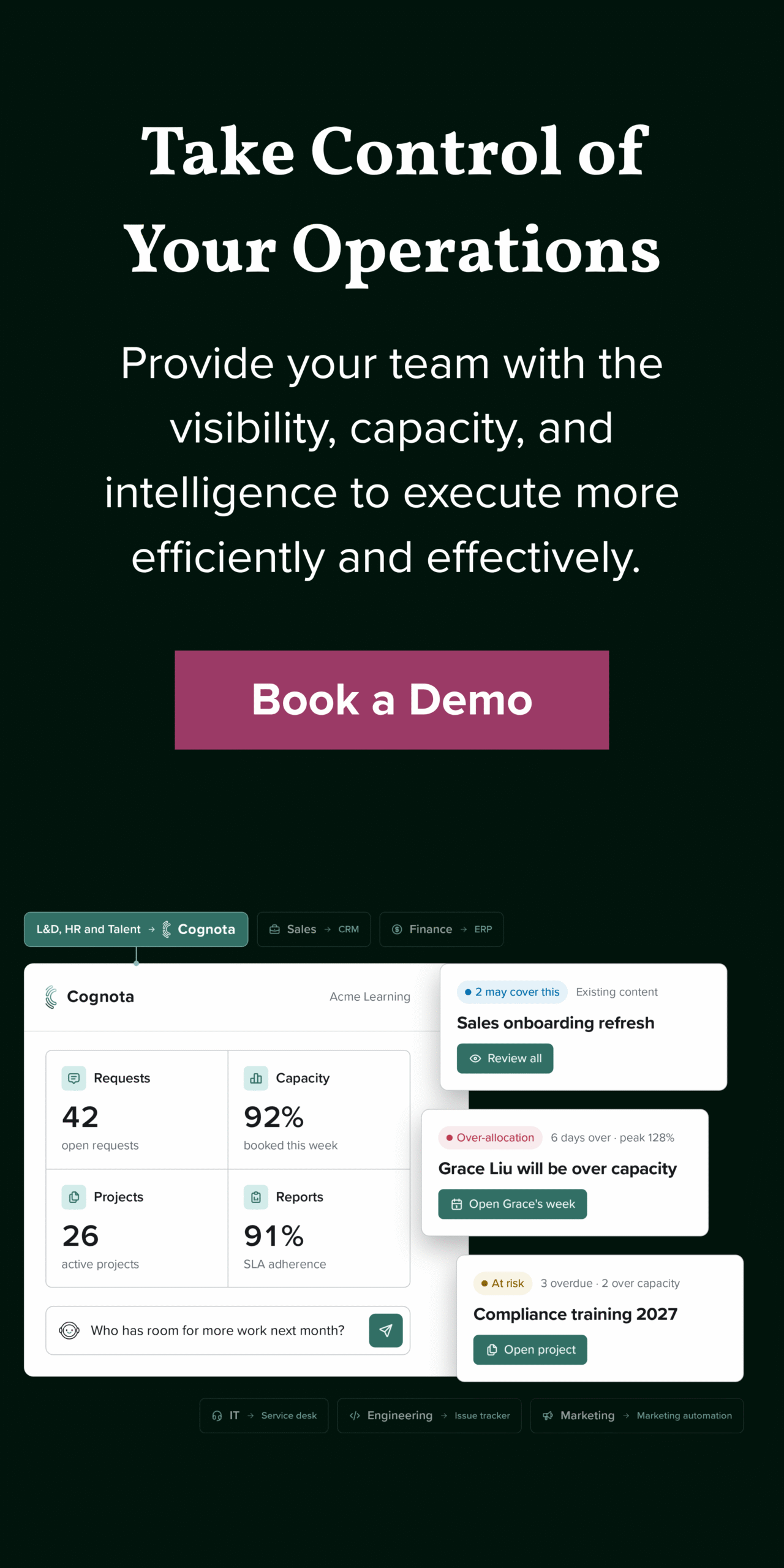
For enterprise learning teams, the goal is not simply to deliver faster. It is to create an operating model that makes priorities visible, protects finite capacity, and gives leaders a reliable view of trade-offs. If your team needs a clearer view of that operating model, see Cognota in action and explore how LearnOps® brings intake, planning, execution, and measurement into one connected discipline.
Learning Project Delays Start Before Development
A delayed project often looks like an execution failure because execution is where the missed date becomes visible. But the real cause may sit upstream. A request was accepted without a defined business outcome. A sponsor changed direction after design began. Subject matter experts were assumed to be available but were not. Several urgent requests were approved at once, each with an implied promise of immediate attention.
None of those problems is solved by asking instructional designers to work faster.
In mature learning operations, a request is not yet a project. It must first be evaluated against business priorities, expected impact, effort, dependencies, and available capacity. This is the Align discipline in the LearnOps® Framework: deciding what deserves investment before assigning people and publishing dates.
Without that discipline, teams inherit a hidden portfolio. Every stakeholder sees their initiative as active and urgent, while the learning team sees a backlog of competing commitments. Work-in-progress grows, handoffs multiply, and deadlines become less credible with every new exception.
The Four Operational Causes Behind Repeat Delays
Most recurring delays can be traced to a small number of operating failures. They overlap, which is why isolated fixes rarely last.
1. Demand arrives without a decision framework
When intake happens through email, chat, meetings, and informal executive requests, learning leaders lose the ability to compare work consistently. The team may know that demand is overwhelming, but it cannot show which requests are strategically essential, which can wait, and which need more definition before work begins.
A useful intake process does more than collect a title and due date. It establishes the business problem, intended audience, accountable sponsor, success measure, required launch window, and likely complexity. It also creates a decision point. A request can be approved, deferred, combined with related work, or sent back for clarification.
This can feel slower at the front end. In practice, it prevents the far more expensive delay of building the wrong thing or rebuilding a solution after late-stage feedback.
2. Capacity is managed by optimism
Many L&D teams know who is busy, but not how much capacity is genuinely available across the portfolio. The difference is significant. Being busy is a feeling; capacity is a planning decision based on roles, skills, allocation, planned absences, dependencies, and the reality of unplanned work.
When leaders commit work against theoretical availability, every interruption becomes a schedule risk. A critical business request, a compliance update, or a delayed review can displace work that already had a deadline. The team then appears unreliable, even though the problem was not effort. It was overcommitment.
Capacity planning should make trade-offs explicit. If a new initiative must start this month, leaders should be able to see what moves, what requires additional support, or what scope must change. That conversation is not a sign of resistance. It is responsible portfolio governance.
3. Dependencies are invisible until they block progress
Learning projects depend on more than learning teams. They often require input from business leaders, legal or compliance partners, subject matter experts, communications teams, and technology owners. A project plan that lists tasks but does not identify dependency owners creates a false sense of control.
The most damaging dependencies are usually not the obvious ones. They are approval cycles with no service expectation, experts whose contribution is treated as secondary to their day job, or content decisions that remain unresolved while production continues.
Teams should identify dependencies at planning, name an owner for each one, and set a decision date that occurs before the dependent work is due. If a decision is late, the impact should be visible immediately, not discovered in a status meeting after the schedule has already slipped.
4. Status reporting describes activity, not risk
A project can look green right up to the point it misses its date. This happens when reporting focuses on completed tasks rather than the health of the plan. “Design is 80% complete” says little if final approval has not been scheduled, the expert reviewer is unavailable, or three major changes are still open.
Effective governance separates progress from confidence. Leaders need to know whether a project is on track, what assumptions must hold for it to remain on track, and what decision is required if those assumptions fail. That is how teams escalate early enough for an executive sponsor to remove a barrier or reset a priority.
Move From Heroics to a Repeatable Operating Rhythm
Some learning teams deliver extraordinary work despite fragmented processes. Their people know how to chase approvals, negotiate priorities, and rescue projects near the finish line. But heroics do not scale, especially when budgets and headcount are constrained.
A repeatable operating rhythm gives the team a better alternative. Start by establishing a single, governed intake path. Not every request needs the same level of review, but every request should enter a system where demand can be assessed and prioritized.
Next, plan at the portfolio level, not project by project. Individual timelines can look reasonable while the total workload is impossible. Portfolio planning exposes collisions between workstreams, overloaded roles, and initiatives that rely on the same limited experts.
Then create a regular cadence for decisions. Weekly execution reviews can address near-term blockers. Monthly portfolio reviews can resolve priority conflicts and approve changes to scope or sequencing. The exact cadence depends on the volume and volatility of demand, but the principle remains constant: decisions should happen before delays become emergencies.
Finally, measure delay patterns rather than treating each missed date as a one-off. Look for the point at which projects slow down. Is it waiting for sponsor decisions? Sourcing content? Expert review? Resource allocation? The answer tells you where to improve the operating system, not merely where to apply pressure.
Use Maturity to Diagnose the Real Problem
The LearnOps® Maturity Model offers a practical lens for this work. Reactive teams respond to requests as they arrive and rely heavily on individual effort. Managed teams have more consistent processes, but may still struggle to connect demand, capacity, and business outcomes. Strategic teams use governance to align investment to priorities. Predictive and Adaptive teams use operational data to anticipate demand, model trade-offs, and continuously refine performance.
This is not a judgment of team capability. A highly skilled L&D team can remain reactive when its tools and processes do not support disciplined operations. The value of a maturity assessment is that it makes the next improvement clear. A team overwhelmed by intake should not begin with sophisticated forecasting. It should first establish visibility and prioritization. A team with sound intake but persistent bottlenecks may need better resource planning and dependency management.
The sequence matters. Trying to optimize a workflow before standardizing it creates complexity without control.
What Leaders Should Ask When a Date Slips
When a project is delayed, avoid the reflexive question: “Who owns this?” Accountability matters, but the more useful questions expose the system behind the outcome:
- Was the business outcome and scope agreed before work began?
- Did the team have confirmed capacity, or only an assumed allocation?
- Which dependency changed the timeline, and when did its risk become visible?
- What portfolio decision would have prevented this work from competing with higher-priority commitments?
The answers may be uncomfortable. They may show that an executive request bypassed intake, that deadlines were committed before discovery, or that the team has been carrying more work than its staffing model can sustain. That clarity is productive. It turns a missed milestone into evidence for a better operating decision.
Learning project delays will not disappear entirely. Enterprise work involves change, uncertainty, and legitimate shifts in business need. The objective is not perfect predictability. It is a learning operation that can see the trade-offs early, make them visible to the right leaders, and respond without burning out the people responsible for delivery. When that becomes routine, on-time delivery stops depending on heroics and starts reflecting operational maturity.