A critical learning initiative lands with a fixed deadline, a senior sponsor, and no room to shift internal priorities. The team needs instructional design, facilitation, change support, or specialized subject matter expertise – fast. Learning marketplaces can provide that capacity. But access to experts is only the beginning. Without a disciplined operating model, external work can become another source of fragmented spend, unclear ownership, and hard-to-measure outcomes.
For enterprise L&D leaders, the question is not whether outside expertise has value. It does. The question is whether each engagement advances a defined business priority, fits the team’s capacity plan, and produces evidence that leaders can use to make better decisions next time. That is where marketplace strategy becomes a LearnOps® conversation.
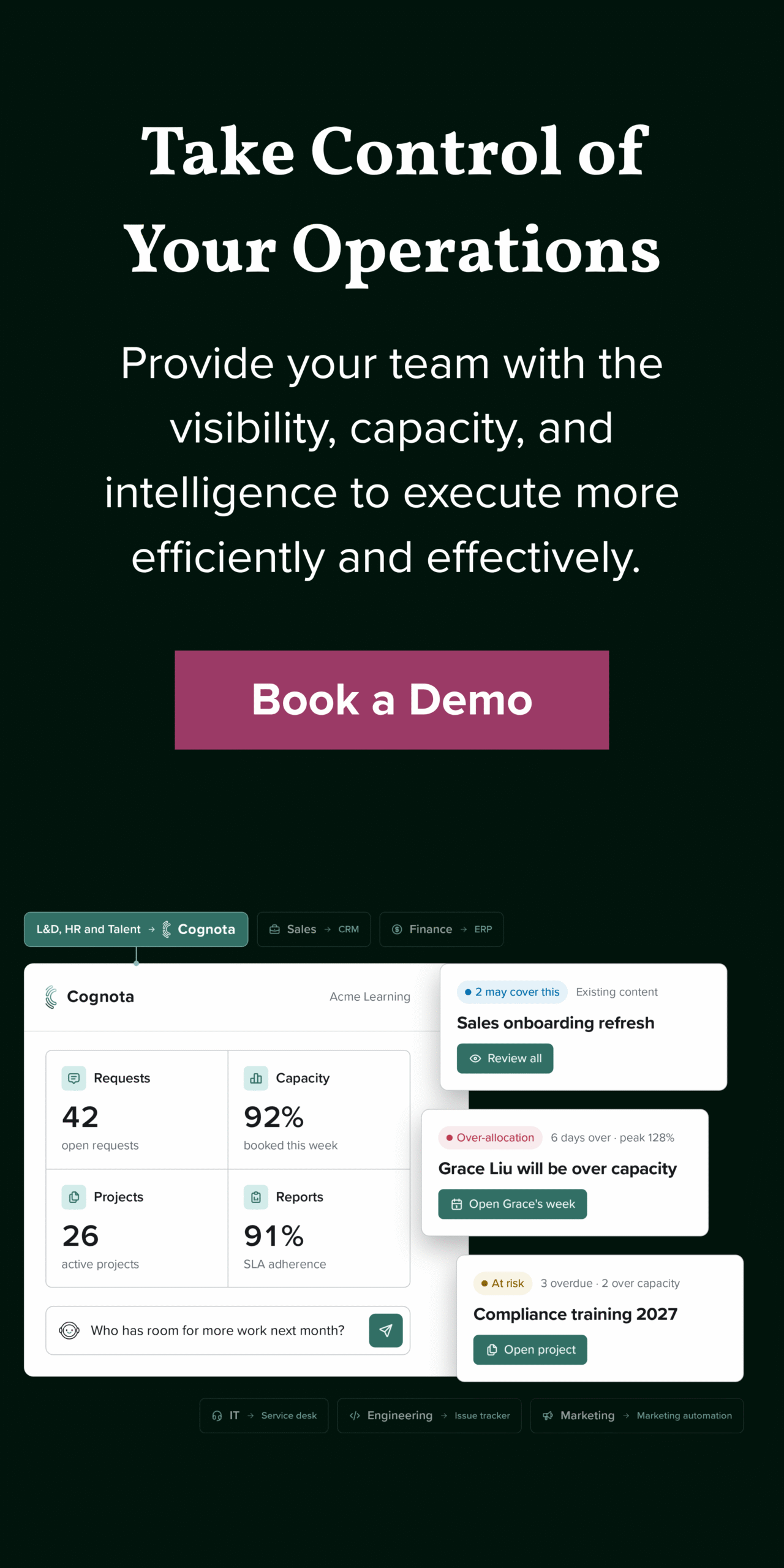
If your team is looking to connect capacity decisions to intake, planning, governance, and measurement, see Cognota in action through a LearnOps platform introduction.
What Learning Marketplaces Actually Solve
Learning marketplaces connect organizations with qualified external learning and talent professionals. Depending on the need, that may include learning strategists, instructional designers, facilitators, learning technologists, change practitioners, content developers, or measurement specialists. For teams managing a full portfolio of enterprise initiatives, that flexibility can be a meaningful advantage.
The strongest use case is not replacing the core L&D team. It is extending it when demand exceeds planned capacity or when a project requires expertise that is not needed year-round. A new product launch, compliance change, leadership initiative, system transformation, or enterprise-wide capability program may create a short-term spike that internal resources cannot absorb without delaying other strategic work.
That distinction matters. A marketplace should help L&D leaders make intentional capacity decisions, not simply react to whoever is available when pressure rises. Used well, it gives teams more options. Used poorly, it can obscure the real issue: the organization has not established clear demand management, prioritization, or resource planning practices.
Why Learning Marketplaces Fail Without Governance
The risk is rarely the external specialist. The risk is the operating environment around the engagement. When requests arrive through email, stakeholder relationships, or urgent escalations, the organization may approve external work before defining the business problem, success measures, available internal capability, or accountable owner.
The result is familiar to many learning leaders. Multiple vendors or independent specialists are working across disconnected initiatives. Budget data sits in separate files. Internal team members spend time chasing approvals and status updates. Sponsors see activity but not always impact. At the end of the quarter, L&D is asked why costs increased, what work was delivered, and which investments changed performance.
Gartner and other workplace learning analysts have consistently highlighted the pressure on L&D functions to demonstrate strategic business value while adapting to shifting skill needs. That pressure makes operational visibility nonnegotiable. Leaders need to know not only what was purchased, but why it was prioritized, how it was delivered, and what happened afterward.
A marketplace does not create that visibility on its own. It needs to sit inside a system of work.
Align external capacity to business demand
Every marketplace request should begin with a clear intake process. What business goal is driving the request? Who owns the outcome? Is learning the right intervention? What audience, timing, risk, and performance measures are involved? These questions protect both the budget and the learner experience.
Alignment also prevents a common failure mode: using external capacity to accelerate low-value work. Fast execution is valuable only when the work itself deserves to move quickly. Teams with mature operations can distinguish between urgent requests and strategically important ones, then make capacity decisions accordingly.
Plan before the pressure arrives
External capacity is most effective when it is part of resource planning rather than an emergency response. L&D leaders should be able to view committed work, planned initiatives, available internal skills, projected bottlenecks, and budget exposure in one operating picture.
That does not mean every need can be predicted. It means surprises are easier to absorb because the team understands its baseline capacity. A marketplace then becomes a controlled lever for managing peaks, specialized needs, and time-sensitive work.
Execute with clear accountability
Once an engagement begins, work should not disappear into a separate process. External contributors need defined scope, milestones, decision rights, review points, and access to the context required to deliver well. Internal stakeholders need a clear view of progress without creating unnecessary status-reporting overhead.
This is especially important in regulated industries, where learning initiatives may involve legal, compliance, operational, or clinical stakeholders. Speed still matters, but it cannot come at the expense of governance. The right operating model makes both possible by establishing the path before the work begins.
The LearnOps® Lens for Marketplace Decisions
Cognota’s LearnOps® Framework offers a practical way to evaluate whether a learning marketplace is supporting operational maturity or adding complexity. The five disciplines – Align, Plan, Execute, Measure, and Optimize – turn marketplace use into a repeatable management practice.
Align means connecting each external engagement to a business priority and accountable sponsor. Plan means forecasting demand, budget, and resource requirements before the work becomes urgent. Execute means managing the workflow, approvals, and collaboration needed to deliver consistently. Measure means tracking more than completion or satisfaction, including operational efficiency and outcome signals agreed at the start. Optimize means using that evidence to improve future sourcing, prioritization, and capacity choices.
This sequence is not bureaucracy. It is how enterprise learning teams retain control while moving faster.
Consider an L&D team that repeatedly brings in external designers for high-priority projects. If those engagements are measured only by delivery dates, the team cannot tell whether it is buying the right skills, briefing work effectively, or reducing internal bottlenecks. If it tracks request quality, cycle time, budget variance, stakeholder outcomes, and recurring capability gaps, it can make smarter decisions over time. It may find that certain expertise should remain flexible, while other repeat needs justify building internal capability.
That is the difference between marketplace activity and marketplace intelligence.
What to Look for in an Enterprise Learning Marketplace
A large directory of profiles is not enough. Enterprise teams need confidence that external specialists can be evaluated against the requirements of complex, business-critical work. Vetting matters, but so do the operational controls surrounding the engagement.
Look for a marketplace model that supports quality, relevant expertise, and visibility into the work. The marketplace should complement the way L&D prioritizes and manages initiatives, rather than forcing leaders to create a parallel process. It should also make it easier to capture institutional knowledge. When an external engagement ends, the organization should retain the rationale, decisions, deliverables, and performance insights that inform the next one.
The right choice depends on your maturity. A reactive team may first need a more consistent intake and approval process. A managed team may need better portfolio visibility and resource planning. A strategic team may focus on linking external capacity to enterprise workforce priorities and measurable business outcomes. The LearnOps® Maturity Model helps leaders identify that starting point without pretending there is one correct operating model for every organization.
Build Capacity Without Losing Control
The best learning marketplaces do not remove the need for internal L&D leadership. They make that leadership more effective. Internal teams remain responsible for understanding the business, setting priorities, protecting quality, and translating learning activity into performance outcomes. External specialists add focused capacity and expertise where it creates the most value.
This model is particularly useful when learning demand is volatile. Rather than permanently expanding headcount for every temporary peak, teams can create a more flexible capacity strategy. The trade-off is that flexibility requires stronger planning and governance. Without those disciplines, variable capacity can become variable quality and unpredictable spend.
For L&D leaders, the practical next step is to examine the last few external engagements. Were they tied to a documented business need? Was the decision based on capacity data or urgency alone? Could the team show leaders what was delivered, what it cost, and what changed as a result? The answers reveal more about operational maturity than any marketplace brochure ever could.
When learning teams can add expertise at the right moment while keeping work aligned, visible, and measurable, capacity stops being a constraint that dictates strategy. It becomes a lever the organization can use with intention.