The most expensive learning problem in an enterprise is rarely a lack of content. It is the work that disappears between systems: a business request arrives without clear sponsorship, priorities change without resource adjustments, and leaders ask for impact data after delivery is already underway. HR systems and LMS architecture gaps are where this operational friction accumulates.
For learning and talent leaders, the issue is not that existing enterprise systems have failed. They were built for distinct purposes. The issue is that neither one serves as the operational layer for the work required to turn business needs into governed, measurable learning initiatives. Without that layer, teams compensate with spreadsheets, inboxes, meetings, and individual heroics.
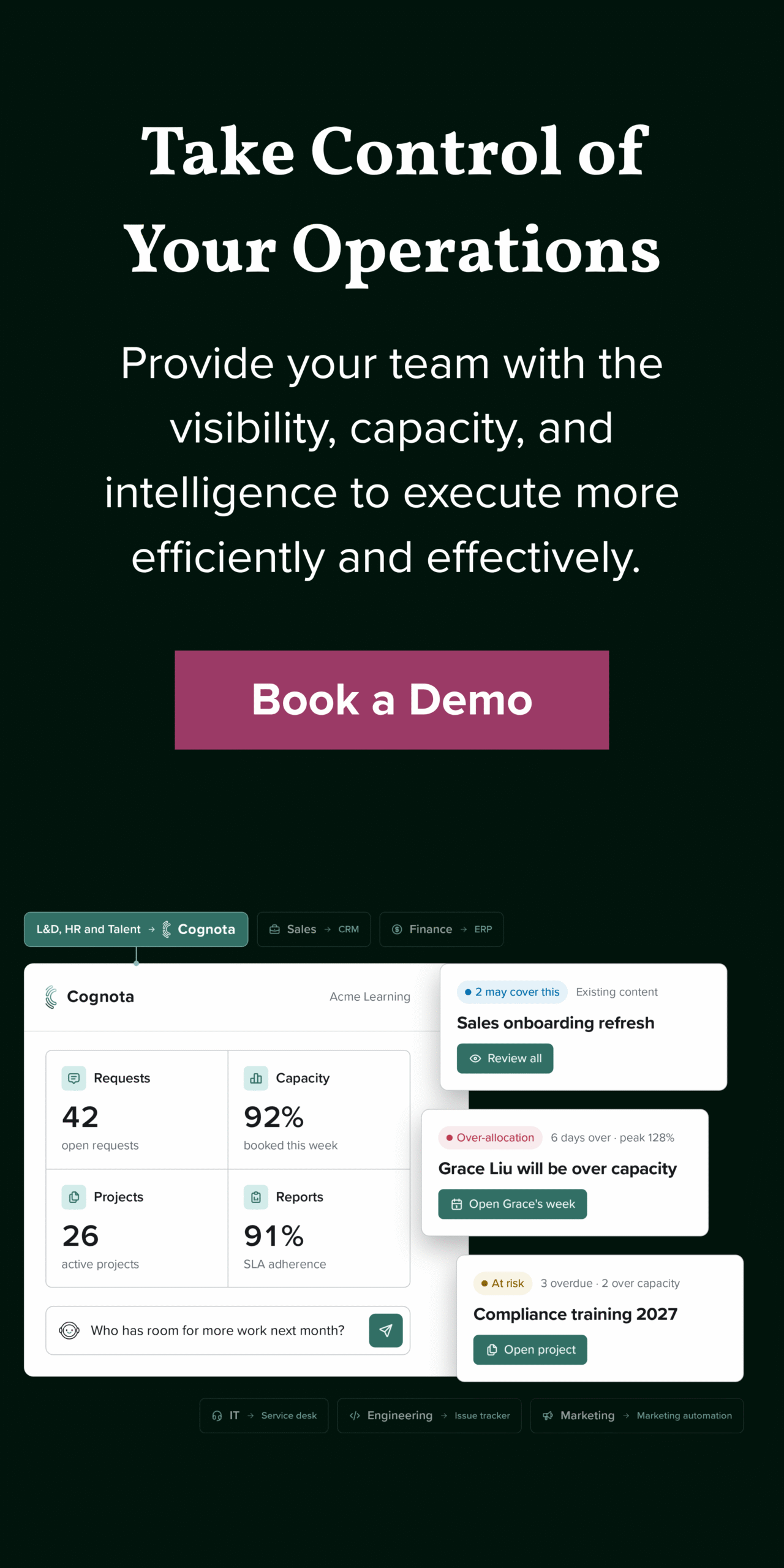
That may work when demand is stable and the portfolio is small. It breaks down when a regulated business needs to respond to changing risk requirements, a transformation program creates competing requests, or leaders need a credible view of capacity, spend, and outcomes. To see how an operational layer can close this gap, see Cognota in action.
The Architecture Gap Is an Operating Model Problem
When people describe an architecture gap, they often focus on integration. Data should move cleanly between systems, and that matters. But data movement alone does not solve the harder question: how does the learning function decide what work to accept, sequence, fund, staff, measure, and improve?
That is an operating model question. It sits above any individual course, program, or platform. It requires a common process for turning demand into decisions and decisions into execution.
Consider a typical enterprise request: a sales leader needs enablement for a new product launch; a risk leader needs a workforce initiative tied to a control change; a business unit wants manager development to support a reorganization. Each request has a different urgency, audience, dependency, cost profile, and expected business result. If requests enter through email and are tracked separately, the learning team cannot consistently compare them or show executives what trade-offs were made.
The result is a familiar pattern. High-visibility work gets attention first. Lower-profile but strategically important work waits. Budgets are reconciled after commitments are made. Subject matter experts are overbooked. Measurement becomes a retrospective exercise rather than a design requirement.
Where HR Systems and LMS Architecture Gaps Show Up
The gap is most visible at the handoffs, because handoffs are where ownership becomes unclear. Enterprise learning teams commonly feel the strain in five connected areas.
First is demand intake. A request may be valid, but validity is not the same as priority. Teams need a disciplined way to capture the business problem, audience, deadline, sponsor, risk, expected outcome, and effort required before work enters the portfolio.
Second is portfolio planning. Leaders need to see all committed work alongside proposed work, not just the projects that have become urgent. This is where strategy can be translated into priorities and where teams can make explicit choices about what will be deferred, redesigned, or declined.
Third is execution governance. Learning work involves many dependencies: stakeholders, reviewers, internal experts, outside contributors, localization, legal review, and change communications. When ownership and workflow live in disconnected places, status reporting becomes manual and late.
Fourth is capacity and financial visibility. Headcount alone does not explain capacity. A team may have the right number of people but lack the right skills, available reviewer time, or budget flexibility at the moment demand peaks. Without a current view of effort, availability, and spend, planning becomes an annual assumption instead of an operating discipline.
Finally, there is measurement. Teams are regularly asked to demonstrate value, yet the business objective, baseline, and success criteria were never consistently captured when the request was approved. No analytics layer can fully repair a measurement design that began too late.
These are not minor administrative gaps. They affect the learning function’s capacity to take on valuable work, its ability to execute reliably, and its intelligence about where investments are producing results.
Why Point Solutions Create More Work
A common response is to add another project management workspace, survey tool, shared spreadsheet, or custom intake form. Each may improve one local process. But a collection of point solutions can also create a new burden: people must re-enter information, reconcile versions, and decide which system represents the current truth.
This is why the question should not be, “What tool are we missing?” It should be, “What operational system connects the way we align, plan, execute, measure, and optimize learning work?”
That distinction matters for enterprise teams. A platform can contain useful information without creating a decision-making process. A dashboard can show activity without revealing whether the portfolio reflects strategic priorities. A form can collect requests without giving leaders a consistent way to assess demand against available capacity.
Research firms including RedThread Research have helped shift the conversation from isolated HR technology to the systems of work that enable better decisions and experiences. For L&D, that means treating operations as a strategic capability, not back-office administration.
Build the Missing Operations Layer
The right response is not to replace every system around learning. It is to establish an operations layer that orchestrates the work between them. That layer should create a single, governed view of demand, commitments, resources, budgets, workflows, and intended outcomes.
Start with alignment. Every significant initiative should have a defined business need and an accountable sponsor. The goal is not bureaucracy. It is preventing teams from investing scarce capacity in requests that are vague, duplicative, or disconnected from a business priority.
Then plan at the portfolio level. Planning should make trade-offs visible before teams are overloaded. Leaders need to know what work is underway, what is coming next, what is constrained, and what changing a priority will displace. In large organizations, this is especially valuable when central L&D, business-unit teams, and HR partners share responsibility for outcomes.
Execution needs enough structure to remove avoidable coordination work. Clear stages, owners, approvals, and status signals help teams spend less time chasing updates and more time solving learning and performance problems. The objective is consistency without forcing every initiative into the same delivery pattern.
Measurement should begin before execution. Define what will change if the initiative succeeds, how that change will be observed, and what contextual factors could influence the result. Not every program warrants an elaborate impact study. High-stakes, high-investment, or strategic initiatives deserve stronger evidence than routine work. This is where maturity shows: measurement becomes proportionate and decision-ready rather than performative.
Use LearnOps® Maturity to Diagnose the Real Constraint
The LearnOps® Maturity Model offers a practical way to assess whether the gap is primarily strategic or operational. Reactive teams are often overwhelmed by incoming work and dependent on manual coordination. Managed teams have repeatable processes, but visibility may still be fragmented. Strategic teams connect the portfolio to enterprise priorities and begin using data to shape investment choices.
Predictive and Adaptive teams go further. They use operational intelligence to anticipate demand, model constraints, learn from outcomes, and continuously refine how work is prioritized and delivered. The point is not to label a team. It is to identify the next capability that will create meaningful improvement.
For example, a team struggling with late requests may not need more status meetings. It may need a stronger intake and prioritization process. A team that consistently misses deadlines may not have an execution issue at all; it may have a capacity-planning issue. A team unable to show business value may need to redesign how initiatives are approved and measured, not simply add more post-program surveys.
This diagnostic approach prevents a costly mistake: solving symptoms with more technology while leaving the operating model unchanged.
What Executive Sponsors Should Expect
A mature learning operation should be able to answer a straightforward set of leadership questions without assembling a custom analysis each time. What business priorities are driving the portfolio? What work is consuming the most capacity? Which commitments are at risk and why? Where are budgets being allocated? What outcomes are expected, and what evidence is available?
Those answers do not require perfect data or universal standardization. They require shared definitions, disciplined workflows, and a system that treats learning operations as connected work. The trade-off is that teams must invest in governance and change management. Some stakeholders will prefer informal requests because they feel faster. But informal intake is only fast for the requester; the hidden cost is carried by the team that must sort, clarify, prioritize, and recover later.
The organizations that close HR systems and LMS architecture gaps do not pursue integration for its own sake. They create the operational infrastructure that lets learning leaders make better decisions under pressure. That is how L&D moves from reacting to requests to managing a portfolio with capacity, execution, and intelligence.
When the next high-priority request arrives, the real test is not whether the team can absorb it through extra effort. It is whether the organization can see the trade-off, govern the decision, and deliver work that is connected to the outcome the business actually needs.