A learning leader receives a request for a regulatory rollout, a sales launch, and manager development in the same week. HR operations may hold critical workforce data and policies, but it is rarely designed to decide which learning work should happen first, who has capacity to deliver it, or whether the finished program changed business performance. That is where HR operations versus LearnOps becomes more than a question of team labels. It is a question of operating model.
For enterprise L&D and talent teams, the distinction matters because the demand for learning has become continuous. Leaders are expected to support transformation, performance, compliance, mobility, and new technology adoption while managing constrained budgets and stretched internal teams. When the operational model is unclear, learning work is often handled through email, spreadsheets, and heroic effort. The result is not simply inefficiency. It is less visibility into priorities, trade-offs, and impact.
HR operations and LearnOps should work in concert. They do not own the same problems, and treating them as interchangeable creates gaps that neither function can solve alone.
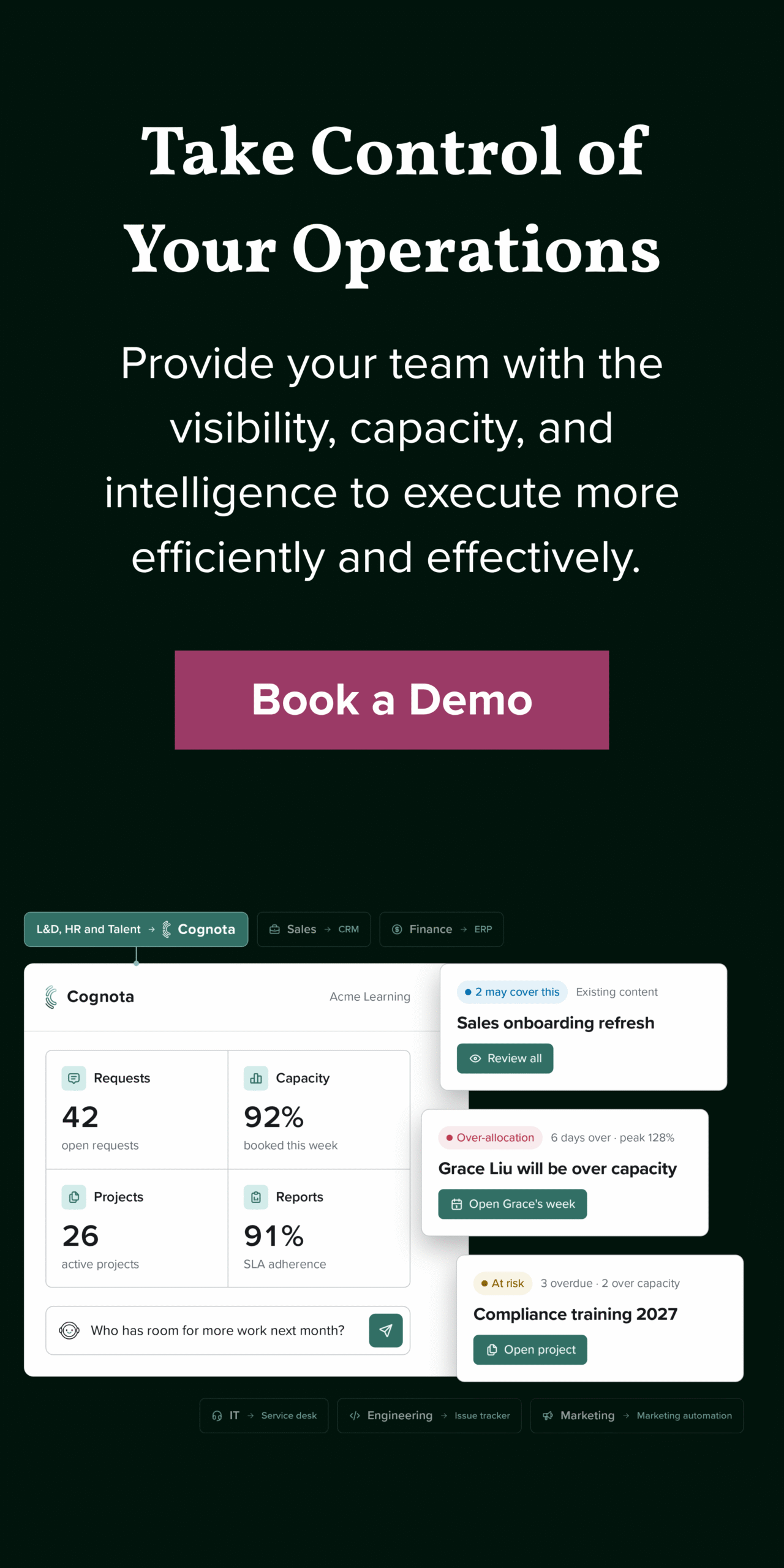
If your team is carrying that gap today, see Cognota in action to understand what an operations layer built specifically for learning and talent work can look like.
HR Operations Versus LearnOps: Different Operating Questions
HR operations creates consistency across core people processes. Its focus is typically on the reliable administration, governance, and support of the employee experience at scale. It helps the organization run its people infrastructure with accuracy, policy discipline, and service-level accountability.
LearnOps® is the operating discipline for planning, governing, and improving the work required to deliver learning and talent outcomes. It addresses a different set of questions: Which initiatives best support business priorities? What work is entering the learning function? Do we have the people, budget, and external capacity to deliver it? Where is work delayed? Did the initiative produce a measurable result? What should change next cycle?
The distinction is practical. HR operations often helps ensure a process is administered consistently. LearnOps helps a learning team decide whether a request deserves investment, organize the work behind approved priorities, and assess whether the investment delivered value.
Neither discipline replaces the other. A mature enterprise needs strong HR operations to provide enterprise continuity and governance. It also needs LearnOps when learning demand has outgrown informal coordination. The larger and more regulated the organization, the more visible that need becomes.
Why Learning Teams Need Their Own Operations Model
Many L&D teams have evolved from small service functions into strategic partners without receiving the operational infrastructure to match. They are asked to influence enterprise performance, yet still manage intake through inboxes, project status through disconnected files, and capacity through best guesses.
This is where the pressure becomes cumulative. A single urgent request can be manageable. Fifty requests from business units, each with different sponsors, timelines, audiences, and definitions of success, expose the limits of ad hoc work management. Teams lose time reconciling priorities, chasing approvals, and explaining where projects stand. Leaders lose a reliable view of demand, resource constraints, and investment decisions.
LearnOps brings discipline to that complexity through five connected practices: Align, Plan, Execute, Measure, and Optimize. These practices are not a linear administrative exercise. They create a repeatable operating rhythm for connecting learning work to business needs, making capacity decisions before commitments are made, governing delivery, evaluating results, and using evidence to improve future investments.
That model is particularly valuable when L&D supports high-consequence work such as risk reduction, product readiness, organizational change, or manager capability. In these situations, speed matters, but ungoverned speed can create rework, duplication, and poorly defined outcomes. LearnOps gives teams a way to move quickly with greater control.
HR Operations Keeps the Enterprise Running
HR operations is essential because employees and managers need dependable, consistent experiences. The function typically establishes process discipline across HR services, maintains governance standards, and helps leaders navigate policies and workforce changes. Its success is often reflected in reliability, accuracy, compliance, and service quality.
That mandate is broad by design. But broad enterprise support does not automatically create the detailed operational visibility that L&D needs. Learning teams require a living view of demand pipelines, active work, dependencies, skills, specialists, production capacity, and performance measures. Those decisions happen at a level of granularity unique to the learning function.
LearnOps Makes Learning Work Visible and Governed
LearnOps begins before development work starts. It gives teams a structured way to receive requests, clarify the business problem, identify sponsors, assess expected value, and decide whether the work belongs in the portfolio. That early governance matters because the costliest work is often work that should not have been prioritized in its original form.
Once work is approved, LearnOps supports disciplined execution. Teams can see what is in flight, where decisions are pending, which work has slipped, and whether internal capacity matches the portfolio. If demand exceeds available resources, leaders can make an informed choice: defer lower-value work, change scope, reallocate resources, or bring in specialized support. The point is not to eliminate constraints. It is to make constraints manageable before they become delivery failures.
Measurement is equally central. Completion activity alone cannot tell an executive whether a learning initiative helped improve performance, reduce risk, or enable a strategic change. LearnOps creates the operating conditions to define success measures earlier, monitor progress, and use outcomes to improve future planning.
The Organizational Cost of Blurring the Roles
When LearnOps is absorbed into general HR administration, learning teams may become order takers. Requests arrive without a shared prioritization process, and urgency becomes the loudest decision criterion. Work gets delivered, but portfolio value is difficult to demonstrate because the team did not have consistent intake, planning, or measurement practices from the beginning.
The opposite problem can also occur. A learning team may build separate processes without alignment to HR operations, creating duplicate governance, inconsistent employee experiences, or avoidable friction with enterprise policies. LearnOps is not a case for operating in isolation. It is a case for clear accountability and a connected operating model.
The right balance depends on organizational structure. A centralized L&D function may need strong portfolio governance across multiple business units. A federated model may need common standards while allowing local teams to manage distinct priorities. In both cases, the core question remains the same: who owns the operational decisions that turn learning demand into measurable business contribution?
A Maturity Lens for the Decision
The LearnOps® Maturity Model offers a useful way to diagnose the gap. Teams at the Reactive stage often respond to requests as they arrive, with limited capacity visibility and inconsistent measurement. Managed teams have more repeatable processes but may still struggle to connect work to enterprise strategy. Strategic, Predictive, and Adaptive teams increasingly use portfolio intelligence, performance data, and forward planning to shape demand rather than simply absorb it.
This progression is not about labeling a team as behind. It is about identifying the next operational capability that will have the greatest impact. For some teams, that is establishing a consistent intake process. For others, it is building a credible capacity plan or tying initiative measures to business outcomes. The maturity model turns a vague desire to “be more strategic” into specific operational decisions.
Industry analysts such as Josh Bersin and RedThread Research have consistently highlighted the shift from isolated HR programs toward connected, business-oriented people practices. For L&D leaders, that shift raises the standard. Learning must not only be well designed. It must be well operated.
What Executive Leaders Should Ask
The most productive conversation is not whether HR operations or LearnOps is more important. It is whether the enterprise has clear answers to the operational questions learning teams face every day.
Can leaders see the full demand entering L&D before promising delivery dates? Can they compare initiatives against strategic priorities and capacity? Can they identify bottlenecks early enough to act? Can they explain where budget and specialist time are going? Can they connect major learning investments to outcomes that business partners recognize?
If those answers are inconsistent, the issue is likely not the commitment or talent of the learning team. It is the absence of an operating system designed for learning work. Cognota provides that operational layer, helping enterprise learning and talent teams increase capacity, strengthen execution, and make better decisions with actionable intelligence.
The next step is not to redraw every organizational chart. Start by making the work visible. When demand, priorities, capacity, and outcomes can be discussed in the same operating conversation, learning earns the ability to shape the business agenda rather than merely respond to it.