A high-priority request arrives with an executive sponsor, a tight deadline, and an expectation that learning will solve a business problem quickly. Meanwhile, the team is already committed to compliance work, leadership development, platform administration, and a growing project queue. The question is not whether the new request matters. It is how to allocate learning resources without creating invisible trade-offs that erode quality, burn out the team, and disconnect learning from business priorities.
For enterprise L&D leaders, resource allocation is an operating discipline. It determines which initiatives move forward, what work gets delayed, where external capacity is warranted, and whether the learning function can demonstrate disciplined decision-making under pressure. When allocation happens through inbox volume, sponsor influence, or whoever escalates first, the team stays reactive by default.
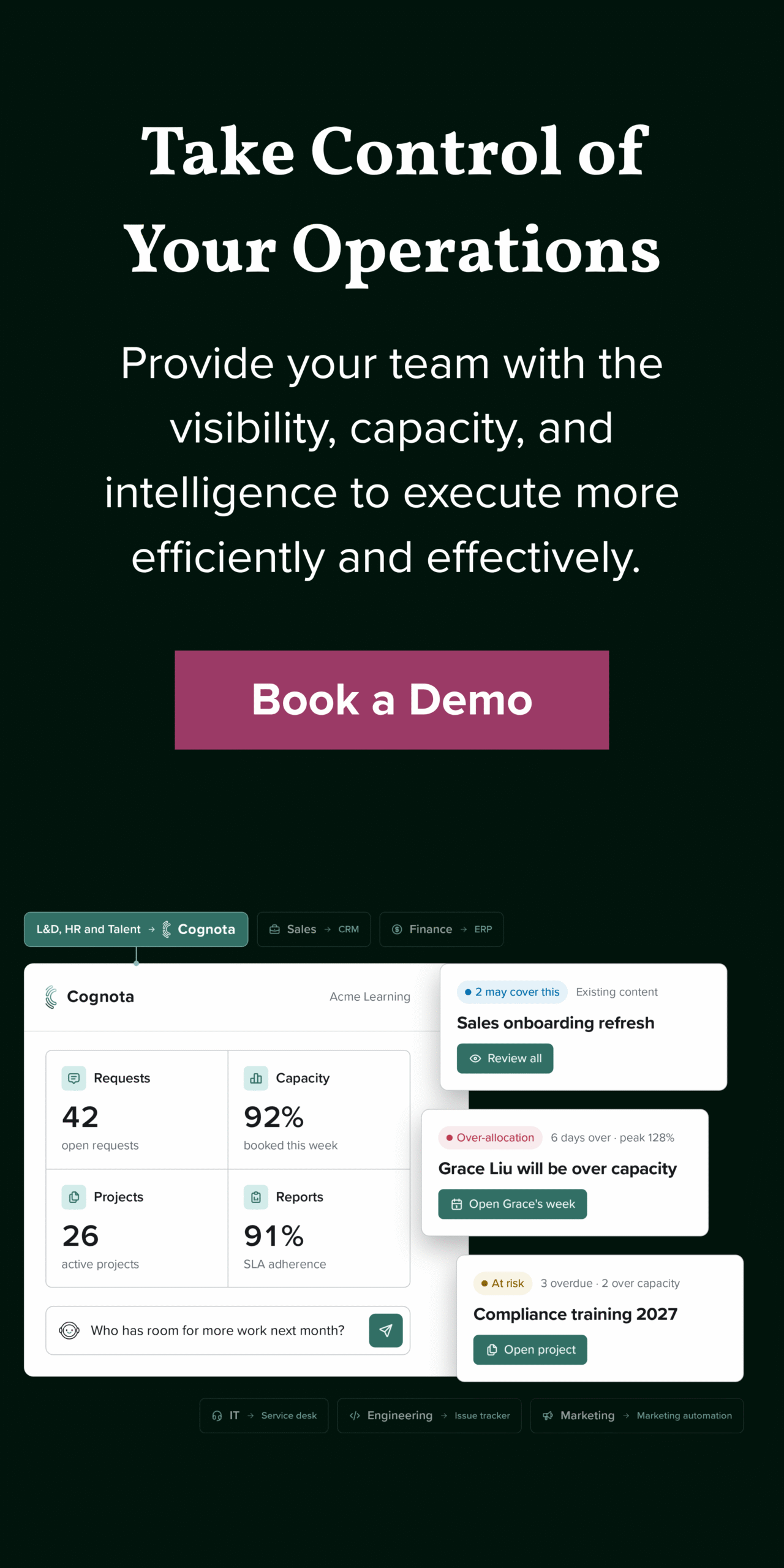
If your team needs a clearer operational view of demand, capacity, and investment decisions, see Cognota in action through a platform introduction built for modern LearnOps teams.
How to Allocate Learning Resources Around Business Value
Start by separating urgency from value. An urgent request may require attention, but it should not automatically receive the same investment as an initiative tied to revenue protection, regulatory exposure, a major transformation, productivity, or a material workforce capability gap. The most effective teams make those distinctions visible before assigning people or budget.
A practical prioritization conversation evaluates each request against a small set of consistent criteria: strategic alignment, expected business impact, risk of inaction, audience reach, effort required, and time sensitivity. The point is not to create a perfect scoring model. It is to give stakeholders a transparent basis for decisions that might otherwise feel political.
For example, a short intervention supporting a new operating process across a revenue-critical function may deserve immediate attention even if its audience is relatively small. A broad development initiative may be strategically valuable but better scheduled after a peak business period. Both can matter. They simply require different levels and timing of investment.
This is the Align discipline in the LearnOps® Framework. Before planning work, learning leaders need a shared view of the outcomes the business expects and the role learning can realistically play. Without that alignment, resource planning becomes a debate about activities instead of a decision about impact.
Make Capacity Visible Before You Commit It
Most teams do not have a capacity problem alone. They have a capacity visibility problem. Leaders may know their people are busy, but they cannot readily see how much time is committed, which skills are constrained, or what new work would displace.
Build a capacity view that accounts for more than project hours. Include intake and stakeholder consultation, design and development, reviews and approvals, program administration, measurement, maintenance of existing learning, and unplanned requests. The last category is often where carefully constructed plans fail.
Then identify the bottlenecks. A team may have sufficient instructional design capacity but too few people with video production expertise, compliance knowledge, data analysis capability, or authority to approve content. Allocating five additional projects to a team without addressing its actual constraint does not increase throughput. It increases work in progress.
This is where operational maturity becomes visible. Reactive teams assign work based on availability in the moment. Managed teams track workloads. Strategic teams forecast demand and use capacity data to negotiate priorities before commitments become promises. The LearnOps® Maturity Model provides a useful diagnostic: if your team cannot explain where capacity is going and why, it is difficult to make a credible case for more of it.
Plan Investments as a Portfolio, Not a Collection of Requests
Learning budgets are often allocated project by project, which makes it easy to overfund visible initiatives while underfunding essential operational work. A portfolio perspective creates more balance. It asks whether the overall investment mix reflects the organization’s near-term risks, strategic priorities, and workforce needs.
A healthy portfolio usually includes a deliberate combination of mandatory work, business-critical transformation work, capability building, and improvement work that strengthens the learning operation itself. The proportions will vary. A highly regulated organization may devote more resources to risk and compliance. An organization undergoing a large-scale change may temporarily concentrate investment on adoption and manager enablement.
The trade-off is real: committing every available resource to urgent delivery can prevent the team from improving intake, measurement, governance, and reuse. Yet investing too heavily in operational improvement while critical business demand is unmet will damage confidence. Leaders need to protect enough capacity for both execution today and better execution tomorrow.
Budget decisions should follow the same logic. Instead of treating dollars as a separate conversation from people’s time, evaluate the total cost of an initiative: internal effort, specialized expertise, technology or content costs, stakeholder time, and the opportunity cost of deprioritized work. That fuller view helps sponsors understand that a “free” request still consumes finite capacity.
Use Demand Governance to Protect the Team and the Business
Governance can sound bureaucratic until a high-value initiative is delayed because no one could see the queue. Effective demand governance is not about adding gates for their own sake. It gives stakeholders a reliable way to request work, understand decisions, and adjust scope before a project becomes unmanageable.
Establish a regular review cadence with the business partners who can make priority decisions. Review incoming demand, work in progress, capacity forecasts, and initiatives at risk. When a new request must move ahead, make the displacement explicit: what will pause, change in scope, or require additional support?
That final question is particularly important. Teams are often asked to absorb new work without a corresponding decision to reduce, defer, automate, or source other work differently. Over time, this creates a culture where heroic effort substitutes for planning. It may feel responsive in the moment, but it produces inconsistent quality and makes performance impossible to predict.
Clear governance also improves stakeholder relationships. A sponsor may not like a delay, but they are more likely to accept it when the rationale is tied to agreed business priorities and capacity facts rather than an opaque “no.”
Match the Work to the Right Source of Capacity
Not every learning need should be handled the same way. Core strategic work, institutional knowledge, and programs requiring deep internal partnership often belong with internal teams. Other needs may call for specialized expertise, flexible production capacity, or short-term support during periods of exceptional demand.
The decision should be based on the nature of the work, not a blanket preference for building or buying. Consider the sensitivity of the content, the expertise required, the frequency of the work, the speed needed, and whether the capability is strategic to retain internally. A repeatable, high-volume task may justify process improvement or dedicated internal capacity. A niche, time-bound need may be better served by on-demand expertise.
The Cognota Assist™ Marketplace can help enterprise teams extend capacity through a vetted network of learning and talent specialists when demand exceeds internal bandwidth. Used thoughtfully, flexible capacity is not a substitute for resource planning. It is one way to execute an intentional plan without forcing the team to choose between strategic work and urgent delivery.
Measure Allocation Decisions, Not Just Learning Activity
Resource allocation improves when leaders can see what happened after the decision. Measure more than completions or project launch dates. Track cycle time, delivery predictability, workload distribution, budget variance, stakeholder satisfaction, and the business measures connected to the initiative’s original purpose.
Not every program will have a direct financial outcome, and pretending otherwise weakens the conversation. But every significant initiative should have a defined hypothesis: reduce errors, accelerate adoption, improve manager capability, support a change, lower risk, or strengthen a critical skill. That hypothesis gives the team a basis for evaluating whether its investment was proportionate to the result.
Use the findings to refine future choices. If a category of work repeatedly creates high effort with limited impact, redesign the approach or challenge the demand. If a small intervention reliably supports a meaningful business outcome, consider increasing its priority. This is the Optimize discipline: turning operational data into better decisions rather than simply producing more reporting.
Learning leaders are not expected to satisfy every request with the resources they have. They are expected to make deliberate, defensible choices about where capacity will create the most value. When demand, priorities, skills, budgets, and outcomes are managed as one operating system, resource allocation becomes less about saying no and more about helping the business invest with intent.