A business leader needs a new capability launched before a product release, a compliance deadline, or a major operating change. The request lands in an inbox with little context, an ambitious date, and an assumption that L&D can absorb the work. That recurring moment is why an enterprise L&D operating model example needs to be more than an org chart. It needs to show how the learning function makes decisions, manages demand, protects capacity, and proves whether work changed a business outcome.
For enterprise learning leaders, the issue is rarely commitment or expertise. It is operating without a consistent system for turning business demand into prioritized, measurable work. Teams then become reactive by default, even when their mandate is strategic.
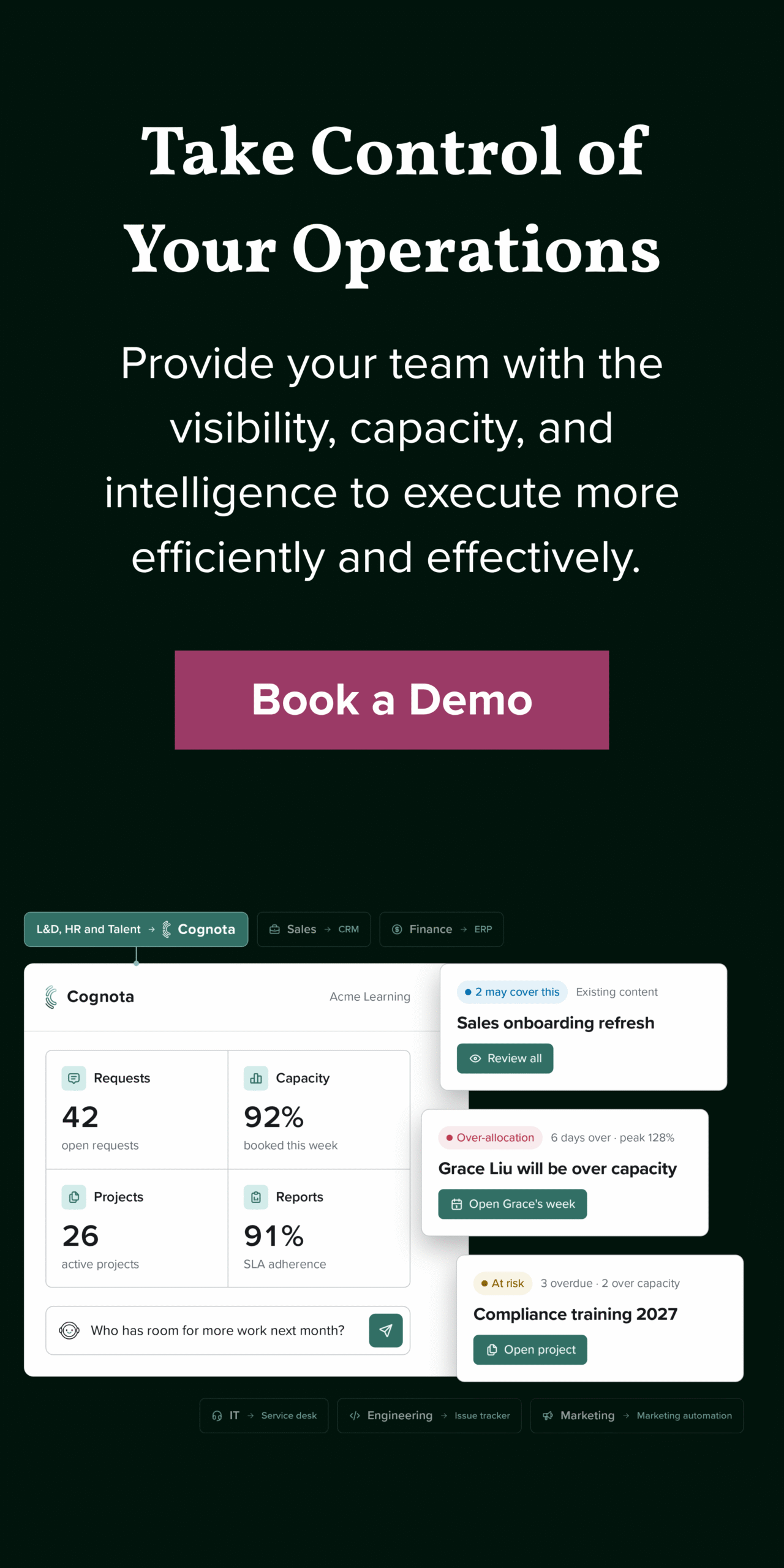
If your team is working to establish that system, see Cognota in action and explore what an operational layer for learning and talent can look like in practice.
What an enterprise L&D operating model should solve
An operating model defines how L&D creates value repeatedly. It establishes who owns which decisions, what information enters the work process, how resources are assigned, and how results inform the next investment decision. This is different from a departmental strategy. Strategy sets the direction; the operating model makes that direction executable.
Consider a fictional 12,000-employee insurance company. Its learning team supports claims transformation, leadership development, frontline performance, and required risk initiatives. Before adopting a formal model, every business unit has a different way to request support. Projects are accepted based on urgency, executive visibility, or whoever follows up most often. Leaders see activity, but cannot see the full demand pipeline, team capacity, or portfolio-level impact.
The new operating model does not centralize every learning decision. It centralizes the operational discipline around decisions. Business partners remain close to their functions, while shared standards make work visible and comparable across the enterprise.
An enterprise L&D operating model example in practice
This example follows the five LearnOps® disciplines: Align, Plan, Execute, Measure, and Optimize. The sequence matters. Measurement cannot repair work that was never connected to a business need, and better execution cannot overcome a capacity plan built on incomplete demand data.
Align: turn requests into business cases
Every initiative begins with a structured intake. The requester identifies the business sponsor, performance problem, target audience, desired outcome, deadline, dependencies, and the consequence of not acting. L&D does not treat every request as a predetermined solution. It clarifies whether learning is the right intervention and what evidence would indicate progress.
A small portfolio governance group reviews new requests weekly. It includes the L&D operations lead, senior learning leaders, and relevant business partners. Their job is not to add bureaucracy. Their job is to make trade-offs visible early.
For example, a request to create a broad manager program may be reframed around a specific performance issue: improving the quality and speed of coaching conversations during a claims-system rollout. That clarity changes the scope, measurement approach, and level of effort.
Plan: manage demand before assigning work
Once approved, each initiative receives a priority score based on strategic alignment, business impact, urgency, risk, audience scale, and effort. The scoring model should be transparent enough that stakeholders understand why one initiative moves ahead while another waits.
The operations team then reviews capacity across instructional design, program management, facilitation, subject matter expertise, change support, and measurement. They plan against real availability rather than optimistic assumptions. This is where many teams discover that their apparent backlog is actually an unmanaged portfolio problem.
In this example, the company maintains a rolling quarterly plan. Leaders can see committed work, proposed work, constrained work, and work that should be stopped or deferred. When demand exceeds internal capacity, the team can make an intentional sourcing decision rather than asking employees to absorb another urgent project. Cognota Assist™ Marketplace can be one option for accessing specialized learning and talent capacity when a clear gap exists.
There is a trade-off here. A heavily centralized planning process can improve control but slow response time. A fully decentralized model may move faster locally but creates duplication and inconsistent quality. Most enterprises need a hybrid structure: common intake, governance, data definitions, and portfolio visibility, with business-aligned teams retaining authority over the work closest to their needs.
Execute: make delivery work visible
Approved initiatives move through a consistent workflow with clear owners, milestones, dependencies, approvals, and status definitions. In the insurance company example, a transformation initiative may pass through discovery, solution design, development, readiness, launch, and post-launch review.
The value of this approach is not a more elaborate project plan. It is shared operational truth. A senior leader can see why a launch is at risk, whether the issue is a delayed content review, unavailable subject matter experts, a change in audience scope, or insufficient team capacity. The learning team no longer needs to recreate the story manually for every status meeting.
Execution discipline also creates better stakeholder conversations. If a business partner changes a launch date or adds a new audience, the team can show the impact on scope, resource requirements, and other priorities. That changes the conversation from “Can you do this?” to “What should we trade off to do this well?”
Measure: connect work to performance
Completion and attendance data can be useful operational signals, but they do not answer the executive question: did this initiative help the business perform differently? Measurement should be designed during intake, not added after launch.
For the claims-system rollout, the L&D team might track leading indicators such as manager confidence, practice completion, and demonstrated proficiency. It can then work with business partners to examine relevant performance indicators, such as adoption quality, reduction in rework, or time to independent performance. Attribution requires care. Performance outcomes have multiple causes, so L&D should avoid claiming sole credit for a business result.
The goal is a credible contribution story supported by evidence. This is consistent with the work of industry analysts and practitioners such as Josh Bersin and RedThread Research, who have repeatedly pushed learning leaders to connect capability-building efforts with work and business outcomes rather than activity alone.
Optimize: turn portfolio data into better decisions
Optimization is where the model becomes self-improving. At regular portfolio reviews, leaders compare planned versus actual effort, cycle time, stakeholder satisfaction, utilization, demand trends, and outcome evidence. They identify recurring friction points and adjust the system.
Perhaps the data shows that urgent requests routinely enter without a business sponsor, or that a particular approval step is delaying high-priority programs. Maybe demand for sales enablement exceeds available design capacity every quarter. These patterns are not individual performance failures. They are operating signals.
The team can then refine intake questions, rebalance work, adjust service expectations, invest in repeatable capabilities, or shift budget toward initiatives with stronger strategic value. This is what moves L&D from activity management to operational intelligence.
Roles and governance that make the model work
The strongest model separates accountability without creating silos. A senior L&D leader owns strategy, enterprise priorities, and executive alignment. An L&D operations leader owns the operating cadence, intake process, portfolio visibility, capacity planning, and data quality. Business-facing learning partners own stakeholder relationships and performance diagnosis. Program and project owners move approved work through the defined workflow. Measurement partners ensure that evaluation is feasible and aligned to the initiative’s original business case.
Not every enterprise needs a large centralized operations team. The right design depends on demand volume, regulatory pressure, geographic spread, and the maturity of business partners. But every enterprise needs a clear owner for the operating system itself. When that responsibility is distributed informally across already-busy leaders, governance becomes inconsistent and operational debt accumulates quickly.
Use maturity to decide where to start
A team at the Reactive stage of the LearnOps® Maturity Model may need to begin with a common intake process and basic demand visibility. A Managed team may already have project discipline but lack resource planning across the portfolio. A Strategic team can focus on outcome measurement and stronger business planning. Predictive and Adaptive teams use operational data to anticipate demand and continuously rebalance investments.
Trying to build every element at once usually creates resistance. Start with the constraint causing the greatest business cost. If leaders cannot explain where capacity is going, establish portfolio and resource visibility first. If the team is delivering plenty of work but cannot demonstrate value, redesign intake and measurement around business outcomes.
A mature enterprise L&D operating model is not defined by how many processes it has. It is defined by whether leaders can make better decisions with confidence, whether teams can protect capacity for work that matters, and whether learning is treated as a managed business investment. The next request that reaches your inbox is an opportunity to begin operating that way.