A learning leader approves an urgent request, assigns work to an internal team, and later discovers the initiative consumed far more capacity and external spend than expected. The learning experience may still be delivered successfully. But the operating decision was made without a complete financial picture. So, does an LMS manage budgets? For most enterprise teams, the practical answer is no – at least not in the way learning leaders need to plan, govern, and defend investment.
That distinction matters when L&D is under pressure to do more with fewer resources. A learning system is central to the delivery layer. Budget management belongs to the operational layer, where teams decide which work to fund, what resources it requires, where trade-offs are necessary, and whether investment is producing business value.
If your team can see learning activity but cannot confidently connect demand, project costs, capacity, vendor spend, and outcomes, it may be time to see the LearnOps platform in action with Cognota.
Does an LMS Manage Budgets? Define “Manage” First
The question is often too broad. Some learning systems can store a cost field, support basic reporting, or pass information to another business system. That may help with recordkeeping. It is not the same as active budget management.
For enterprise L&D, managing a budget means creating a reliable operating view before money is committed. Leaders need to understand approved and forecasted spend, internal labor requirements, planned versus actual costs, budget ownership, and the financial implications of a growing intake queue. They also need governance that makes those numbers useful in decision-making.
A static cost entry cannot answer questions such as: Can we take on this new compliance initiative without delaying a strategic capability program? Do we have enough instructional design capacity, or should we bring in specialized support? Which business priorities are drawing the most investment, and are they generating measurable impact?
Those are operational questions. They arise upstream of delivery and continue long after a program is launched.
Where Learning Budget Gaps Usually Appear
Budget problems rarely begin with a single large purchase. They build quietly across disconnected workflows. A stakeholder submits a request in one place. A manager estimates effort in a spreadsheet. External support is approved in email. Finance receives a different version of the numbers. By the time leadership asks for a budget view, the team is reconciling decisions that have already been made.
This creates three common blind spots.
Demand arrives without a costed plan
An intake process may capture what a business partner wants, but not the full scope, expected effort, strategic value, or funding source. Without a disciplined way to qualify demand, every request can appear equally urgent. The result is reactive execution: work begins before leaders have established whether it deserves capacity and budget.
Capacity is treated as free
Internal team time has a real cost, even when it does not show up as an invoice. When learning teams lack visibility into roles, workload, and planned effort, they can underestimate the price of “doing it ourselves.” That can lead to overcommitment, missed deadlines, burnout, or expensive last-minute outsourcing.
Spend is disconnected from impact
Knowing how much was spent is necessary, but insufficient. Mature teams connect investment to the business priority it supports, the expected performance outcome, and the measures that will indicate progress. Without that connection, budget discussions become defensive exercises rather than strategic conversations about where learning can create the most value.
The LMS Is the Delivery Layer. LearnOps Is the Operations Layer.
This is not an argument against the LMS. Enterprise learning teams need a dependable delivery layer. The problem is expecting one system to solve every operational challenge surrounding learning.
LearnOps® gives learning and talent teams an operating model for that work. Its five disciplines – Align, Plan, Execute, Measure, and Optimize – reflect the decisions that occur around learning delivery. Budget planning sits primarily in Align and Plan, but it should inform every stage. Teams align investment to business goals, plan resources and spend, execute with governance, measure outcomes, and optimize future decisions based on what they learn.
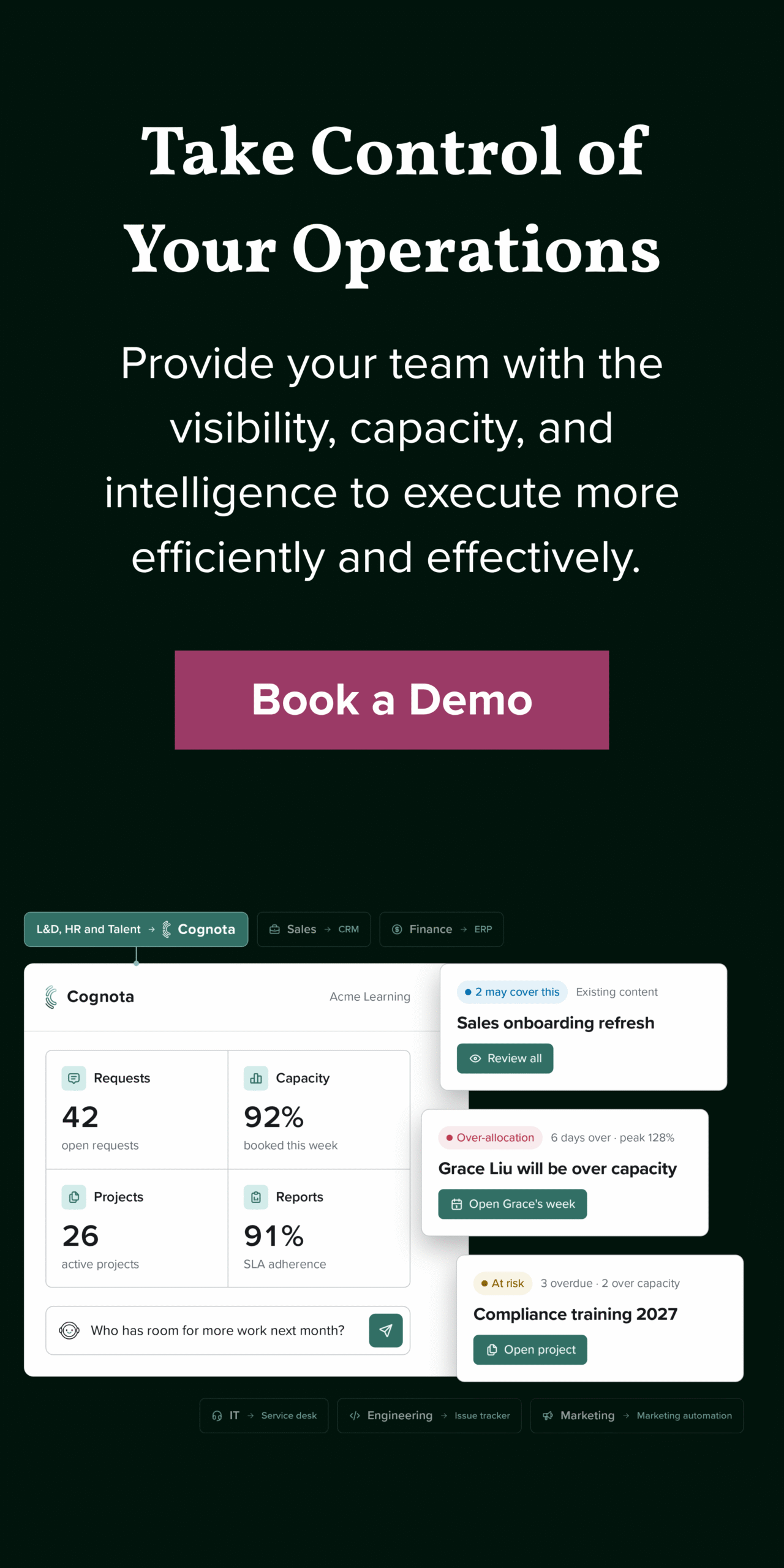
Cognota was built for this operational layer. It gives teams a connected environment to manage intake, workflows, project governance, resource planning, and budgets alongside the work itself. The goal is not to replace the systems enterprises use for learning delivery or workforce data. It is to give L&D the infrastructure to operate with greater capacity, execution, and intelligence.
For a learning leader, that changes the quality of the budget conversation. Instead of saying, “We spent our allocation,” the team can explain where investment went, why choices were made, what demand was deferred, and how resources supported strategic priorities.
What Budget Management Should Look Like in L&D
Effective learning budget management is less about producing a perfect forecast and more about making informed decisions early enough to influence outcomes. That starts with a shared source of truth for work in the pipeline and work already underway.
A strong operating model connects each initiative to an owner, strategic objective, expected scope, estimated effort, planned internal and external costs, and a clear approval path. As requirements change, teams can update forecasts rather than discovering overruns at quarter-end. Leaders can compare options before committing resources.
It also creates a healthier relationship between L&D and finance. Finance teams do not need another isolated learning report. They need confidence that learning investments are governed, traceable, and connected to enterprise priorities. L&D needs enough operational detail to explain variances without spending days assembling data from disconnected sources.
There is still nuance. Not every initiative needs the same level of financial rigor. A small update to existing content should not carry the governance burden of a multi-region transformation program. The point is to apply the right controls to the right level of investment, while maintaining visibility across the full portfolio.
Use Budget Visibility to Make Better Trade-Offs
Budget visibility is valuable because it forces prioritization. Most enterprise L&D teams do not have a shortage of requests. They have a shortage of capacity to deliver every request at the quality and speed stakeholders expect.
When leaders can see demand, resources, and spend together, they can make deliberate choices. They may pause low-value work, re-sequence a project, shift internal capacity, or engage outside expertise for a narrow, time-sensitive need. Cognota Assist™ can extend this model by connecting teams with vetted learning and talent specialists when additional capacity is needed.
The alternative is not neutral. When trade-offs are hidden, they still happen – through rushed work, overloaded teams, unclear ownership, and initiatives that continue because no one has a complete view of their cost or value.
This is also where the LearnOps® Maturity Model can be useful diagnostically. Reactive teams often manage budgets after the fact. Managed teams introduce repeatable processes and visibility. Strategic teams connect investment to business outcomes. Predictive and Adaptive teams use operational data to anticipate demand, adjust capacity, and continuously improve how resources are deployed.
The goal is not financial perfection. It is operational maturity: the ability to make resource decisions with evidence rather than urgency alone.
Questions to Ask Before Relying on Your LMS for Budgets
Rather than asking whether your current learning system has a budget field, ask whether your operating environment can answer a few critical questions at any point in the quarter:
- What work has been requested, approved, deferred, or declined – and why?
- What is the forecasted cost of current commitments, including internal capacity?
- Which business priorities consume the largest share of learning investment?
- Where are budget or resource risks emerging before they affect delivery?
- Can leaders connect investment decisions to measurable business outcomes?
If answering those questions requires manually merging spreadsheets, inbox conversations, and separate project plans, the issue is not a lack of effort. It is an operations gap.
L&D teams are increasingly expected to act as strategic business partners, not order takers. That expectation requires a clearer view of how demand becomes work, how work consumes resources, and how investment contributes to performance. See how Cognota supports that operating discipline and brings budget, capacity, and execution into one connected view.
The most useful budget conversation is not the one held after the money is spent. It is the one that helps your team choose the right work before the commitment is made.