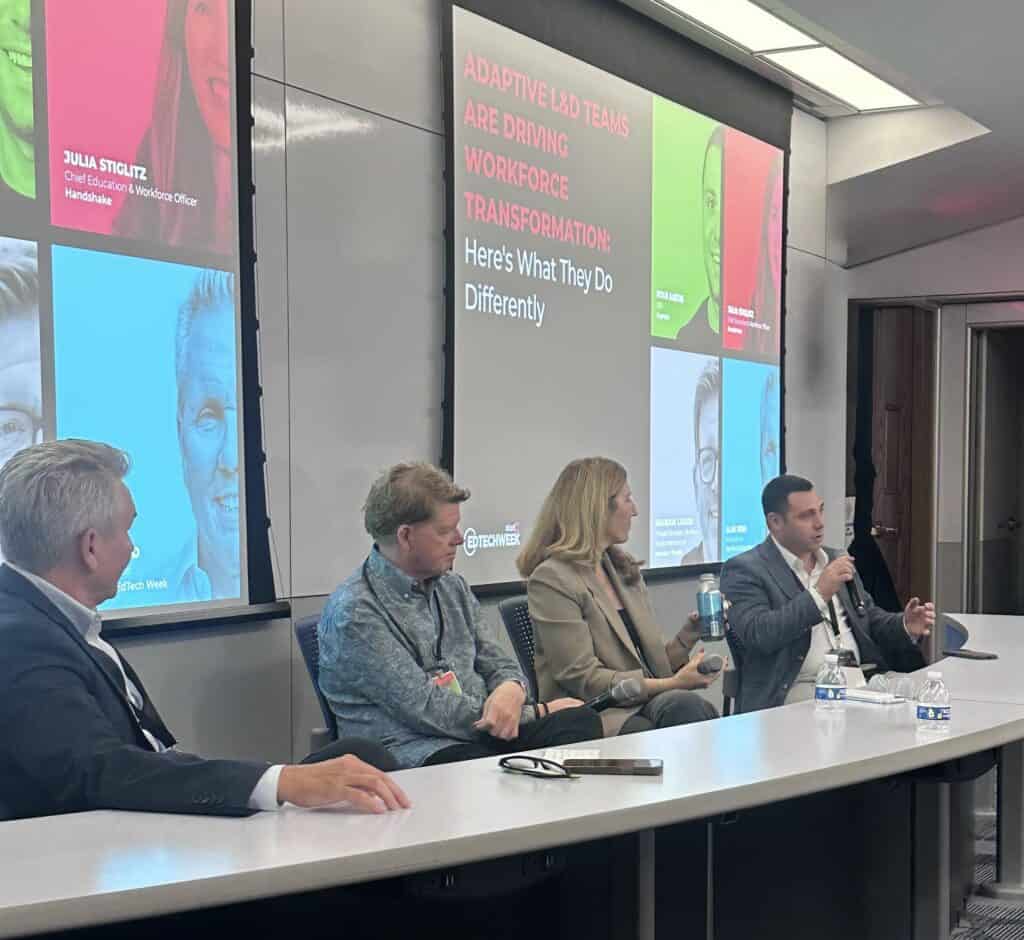
I was in New York recently for EdTech Week, on a panel with Julia Stiglitz (Chief Education & Workforce Officer, Handshake) and Brandon Carson (Principal Consultant, Workforce Transformation and AI, Innovate + Elevate). Alan Todd, Vice Chairman of StartEd and EdTech Week, moderated.
We started with how AI is changing business, then got into what it means for L&D. I’ve been thinking about the conversation since, so I wanted to get a few things down while they’re fresh.
Nobody knows what skills they’ll need in five years
Ask an executive team what capabilities they’ll need in 2031 and you won’t get a confident answer. Roles are shifting every quarter. I don’t think that’s bad news for our field. When no one can predict the skills, the safest bet is to tie everything to the business goals you do know, and put your investment there. L&D and Talent leaders are well placed to lead that kind of change. But only if they’re close enough to the business to see it coming.
Content can’t be the reason L&D exists
At one point Alan asked why L&D exists at all. Fair question. Everyone on stage agreed it can’t be content. AI has turned content into a commodity. But we also agreed the job is getting bigger, not smaller. Getting a workforce ready for what’s next matters more now than it did five years ago.
That’s a big part of why we stopped thinking of LearnOps® as the whole answer at Cognota. Our product team is now focused on learning, talent, and HR operations as one system, because these teams should be pursuing similar business goals and they work better when they can see each other’s work, where applicable. Cognota is now the operating system for workforce enablement teams, used across all three departments.
The strongest teams we work with aren’t doing anything flashy. They know what work is coming in, what’s being prioritized, what’s in progress, and what is or isn’t driving impact for the business. That view is what earns them a seat in the conversation about future capabilities, before the decisions are already made.
Doing more with less isn’t going away
Everyone on the panel agreed on this one. Budgets are down in a lot of organizations, and leaders still want L&D and Talent to get the workforce ready for AI.
Our own data shows how hard this is landing. Across the enterprise teams on Cognota, the busiest 10% of people went from carrying 49% of the work to 65% in a single quarter. That isn’t efficiency. That’s a small group of people on the verge of possible burn out.
A CLO we spoke with recently runs a team of 53. He told us about 10% of their time goes to strategy and 80 to 90% goes to “answering the mail.” He wants to adjust his teams to 70/30, and soon. I think that’s the number one problem to fix. Most L&D time still goes to work that doesn’t tie back to business goals, and most teams are running past capacity, without the impact the business needs. If you want time back, decide what supports the business goals and say no to the rest.
Where AI is actually paying off
Most of the AI work I see in L&D is still about making content. Don Taylor and Eglė Vinauskaitė’s new AI in L&D report backs that up. Content has been the top use of AI in L&D four years running. But the growth is happening around it. Evaluation and analytics jumped from #8 to #3 in their ranking. Operations went from #9 to #6, mostly from teams automating their own work and building internal tools (for now, wait until you see what we’re releasing at Cognota). Agents are still early, but one team in their survey that has linked agents across a full workflow reports cutting cycle times by more than 90%.
That’s an opportunity we’re betting on, and it’s why Digital Teammates is a main focus for our Cognota product team.
A few places agents can help right now:
- Intake. Sorting requests, catching duplicates, and tying each one to a business priority before anyone starts building.
- Early warnings. Flagging an overloaded team or a slipping project while there’s still time to fix it.
- ROI. Pulling together request, task, capacity, spend, and evaluation data and comparing it to what was planned, so you can show impact without building the report by hand.
Two questions worth sitting with
Alan closed with two questions I keep coming back to.
First, is what you’re doing with AI making the same work faster, or is it changing how you operate? Making the same courses faster is fine. Making L&D the team that leads change is a much bigger shift. Give it three years and the function will look very different.
Second, do you still need a content factory? For most companies, I think you need a much smaller one. When anyone can make content, the value moves to judgment: knowing what the business needs, picking the right fix, and checking whether it worked. I’d put more of the team on that and let AI handle more of the production.
Where I’d focus to lead this shift: “governance”
Start with the business priorities, and make sure your team’s work actually supports them. That’s the base for every governance call you’ll make.
Then look hard at your operating model. Don’t pick what feels familiar. Centralizing operations at your last company doesn’t mean it fits this current one. Perhaps a federated or decentralized model is better for what the business needs – leave personal feelings out of it and make a good business decision – choose a model that lets your team move fast and keep up as the business changes.
And know what’s coming in, from whom, what it’s tied to, and how fast you can execute it. It sounds basic, and it is. It’s also hard. Every AI use case after it depends on getting this right, and it’s a big part of why we built Cognota.
Thanks to Alan, Julia, Brandon, and everyone who joined us at EdTech Week.

If you’re working through these same questions with your team, I’d like to hear how you’re approaching them.
And if you want to see how other L&D and Talent teams are building this kind of visibility, book an intro with our team.